Have you ever typed “spy or voo” and wondered which word is actually correct? Small spelling differences can create big confusion, especially when two words look or sound unusual. Whether you found this phrase in a message, search result, conversation, or written text, understanding the correct form can help you communicate more clearly and confidently. In this guide, we will break down spy or voo in simple English and explain what each form means, where it may appear, and how to recognize the correct usage.
Spelling questions are common because English contains words influenced by different languages, pronunciations, abbreviations, and informal internet usage. Rather than relying on guesswork, it is better to look at meaning, context, pronunciation, and standard dictionary usage together. This guide focuses on practical examples and clear explanations so you can quickly understand the difference and avoid common mistakes. By the end, you will know which form fits your sentence and why.
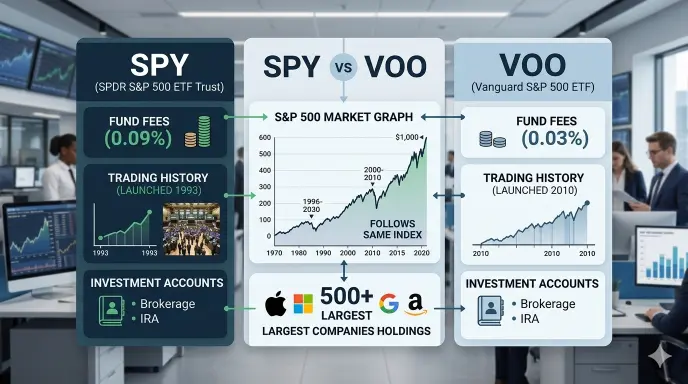
SPY vs VOO: What’s the Difference?
SPY and VOO are both exchange traded funds built to follow the S&P 500 Index. The S&P 500 tracks a large group of major publicly traded companies in the United States.
SPY is the ticker symbol for the SPDR S&P 500 ETF Trust. State Street launched the fund in 1993. It has one of the longest histories among exchange traded funds in the US.
VOO is the ticker symbol for the Vanguard S&P 500 ETF. Vanguard launched it in 2010. Like SPY, VOO is designed to follow the performance of the S&P 500. Vanguard describes VOO as a passively managed fund that uses full replication.
So, what’s the real difference?
The biggest point is that SPY and VOO come from different fund providers. They also have different expense ratios and some differences in how investors commonly use them.
| Feature | SPY | VOO |
|---|---|---|
| Full name | SPDR S&P 500 ETF Trust | Vanguard S&P 500 ETF |
| Provider | State Street | Vanguard |
| Main benchmark | S&P 500 Index | S&P 500 Index |
| Launch date | 1993 | 2010 |
| Expense ratio | 0.0945% | 0.03% |
| Fund type | ETF | ETF |
| Main purpose | S&P 500 exposure | S&P 500 exposure |
| Options | Available | Available |
According to the latest information published by the fund providers, SPY has a 0.0945% expense ratio, while VOO has a 0.03% expense ratio. Therefore, VOO currently has the lower stated annual fund expense.
Still, the expense ratio isn’t the only difference worth knowing.
In short, both funds follow the same major index, but they aren’t the same fund.
SPY belongs to State Street.
VOO belongs to Vanguard.
SPY has the longer history.
VOO currently has the lower stated expense ratio.
Is SPY vs VOO a Grammar, Vocabulary, or Usage Issue?
The phrase SPY vs VOO isn’t really a grammar question. Instead, it’s a question about financial terminology and proper identification.
SPY and VOO are ticker symbols. A ticker symbol is a short code used to identify a particular security in the financial market.
For example, SPY identifies the SPDR S&P 500 ETF Trust. VOO identifies the Vanguard S&P 500 ETF.
Therefore, replacing one ticker with the other can change the meaning of a sentence.
Consider this sentence:
“I’m researching VOO.”
That statement refers specifically to Vanguard’s fund.
Now consider:
“I’m researching SPY.”
That statement refers specifically to State Street’s fund.
Both sentences are grammatically correct. However, they refer to different securities.
In casual conversation, someone might simply say “an S&P 500 fund.” That wording is acceptable when the exact product doesn’t matter. However, formal financial writing should use the correct ticker.
Therefore, the issue isn’t grammar. It’s accurate financial usage.
What Is SPY?
SPY stands for the SPDR S&P 500 ETF Trust.
It is managed by State Street and was launched in 1993. State Street describes SPY as a fund designed to provide investment results that generally correspond to the price and yield performance of the S&P 500 Index.
The fund gives investors exposure to companies included in the S&P 500 through a single exchange traded product.
Because SPY has been trading since 1993, it has a very long market history. This history is one reason the ticker is so widely recognized.
SPY in the workplace
Suppose an investment professional is discussing a portfolio with a colleague.
They might say:
“We currently have SPY in the account.”
The ticker makes the statement precise. The listener knows exactly which fund is being discussed.
SPY in academic writing
A finance student might use SPY as an example when studying the development of exchange traded funds.
Since SPY began trading in 1993, it can also be useful when discussing the history and growth of this type of investment product.
SPY in technology
Financial websites, brokerage applications, and market tracking tools use SPY as the fund’s identifier.
When a user searches for SPY, the platform can display information such as the market price, holdings, trading activity, and distributions.
SPY usage recap
Use SPY when you mean the SPDR S&P 500 ETF Trust.
Don’t use SPY as a general name for every S&P 500 fund.
What Is VOO?
VOO stands for the Vanguard S&P 500 ETF.
Vanguard launched VOO in 2010. The fund seeks to track the S&P 500 Index and uses a passive investment approach. Vanguard currently lists its expense ratio at 0.03%.
VOO gives investors access to many of the large US companies represented in the S&P 500.
Because it follows the same benchmark as SPY, its overall market exposure is broadly similar.
However, VOO is a separate fund. It isn’t simply another name for SPY.
VOO in the workplace
An investor might say:
“My portfolio includes VOO.”
That tells the listener that the Vanguard fund is being held.
VOO in academic writing
A student studying index investing might use VOO as an example of a fund designed to follow a broad market benchmark.
This can help explain the difference between an index and an investment product that tracks that index.
VOO in technology
Brokerage platforms identify Vanguard’s fund using the ticker VOO.
A search for VOO can show information such as its price, holdings, distributions, and expense ratio.
VOO usage recap
Use VOO when you’re specifically referring to Vanguard’s S&P 500 ETF.
Although VOO follows the same broad benchmark as SPY, the two are still separate funds.
SPY or VOO: Why Do People Compare Them?
The main reason people compare SPY and VOO is simple: both follow the S&P 500.
That means they provide broadly similar exposure to large US companies.
However, similar exposure doesn’t mean identical costs or fund characteristics.
For example, the currently published expense ratios are different. SPY is listed at 0.0945%, while VOO is listed at 0.03%.
Their launch dates are also very different.
SPY began trading in 1993.
VOO began trading in 2010.
Trading activity, fund structure, options use, and investor preferences can also influence how people compare them.
Therefore, a useful comparison should look at several factors instead of focusing on only one number.
SPY or VOO: Understanding the Expense Ratio
An expense ratio tells you how much a fund charges each year to cover its operating expenses.
The percentage may look tiny, but the dollar amount grows as the investment balance increases.
For example, imagine you have $10,000 invested.
At an expense ratio of 0.0945%, the annual expense would be about $9.45 if the balance stayed exactly at $10,000.
At 0.03%, the annual expense would be about $3.
The difference would therefore be about $6.45 for that hypothetical year.
Of course, real investment balances change. As a result, the actual dollar amount can be higher or lower.
Also, the expense ratio is only one part of the overall cost of owning an ETF.
Trading costs, taxes, account fees, and other factors may also affect an investor’s final result.
SPY or VOO: Trading and Liquidity
Trading characteristics are another reason people compare these two funds.
SPY has been available since 1993 and has developed a very active market. It is also widely used in options trading. State Street confirms that options are available for SPY.
VOO is also actively traded and is available through brokerage accounts.
For someone who plans to buy and hold an S&P 500 ETF, small differences in trading activity may not receive as much attention as ongoing costs.
On the other hand, someone who trades more frequently may pay closer attention to spreads, trading volume, and options availability.
Therefore, the right comparison depends partly on how you plan to use the fund.
When You Should NOT Use SPY or VOO
Knowing when not to use these ticker symbols can prevent several common mistakes.
1. Don’t use SPY when you mean VOO
If you’re talking about Vanguard’s fund, use VOO.
2. Don’t use VOO when you mean SPY
If you’re discussing State Street’s fund, use SPY.
3. Don’t call either ticker the S&P 500 Index
The S&P 500 is an index.
SPY and VOO are funds that seek to follow that index.
4. Don’t say they’re the same security
They have similar benchmark exposure, but they’re separate funds.
5. Don’t judge a fund by its share price alone
A share price doesn’t tell you whether a fund is cheaper or more expensive to own.
6. Don’t focus only on the expense ratio
Costs matter, but they aren’t the only factor that can affect an investment.
7. Don’t treat past returns as guaranteed future results
Markets can rise and fall, and historical performance doesn’t guarantee future results.
8. Don’t use either ticker as a general term
If you mean S&P 500 funds in general, say “S&P 500 ETF” rather than using SPY or VOO as a generic label.
Common Mistakes: SPY or VOO
| Correct sentence | Incorrect sentence | Explanation |
|---|---|---|
| VOO follows the S&P 500. | VOO is the same fund as SPY. | They are separate funds. |
| SPY began trading in 1993. | SPY and VOO launched together. | Their launch dates differ. |
| VOO is a Vanguard ETF. | VOO is a State Street ETF. | Vanguard manages VOO. |
| SPY is a State Street ETF. | SPY is a Vanguard ETF. | State Street manages SPY. |
| Both funds follow the S&P 500. | Both tickers represent the same security. | Similar benchmark exposure doesn’t make them identical. |
Decision Rule Box
If you mean State Street’s S&P 500 ETF, use SPY.
If you mean Vanguard’s S&P 500 ETF, use VOO.
If you mean the benchmark itself, use S&P 500 Index.
This rule is simple, but it prevents most ticker related mistakes.
SPY and VOO in Modern Technology
Modern investment platforms make it easy to search for SPY and VOO.
You can enter either ticker into a brokerage application or financial website and find information about the fund.
Depending on the platform, you may see the current price, holdings, trading activity, distribution history, and expense information.
Comparison tools can also place SPY and VOO side by side.
However, financial information can change over time. Therefore, always check the latest information from the fund provider when you’re researching current figures.
The key point is that a ticker is an identifier. It tells you which security you’re viewing.
SPY and VOO: Understanding the Names
SPY and VOO are ticker symbols rather than ordinary English words.
SPY identifies the SPDR S&P 500 ETF Trust.
VOO identifies the Vanguard S&P 500 ETF.
The letters don’t work like normal vocabulary terms. Instead, they function as short market identifiers.
This is why you shouldn’t treat SPY and VOO as synonyms.
Two funds can follow the same index while still having different names, providers, costs, and structures.
Understanding this basic idea makes the entire comparison easier.
Expert takeaway: “The benchmark tells you what market a fund follows, while the ticker tells you which specific fund you’re looking at.”
That distinction is useful whenever two investment products appear very similar.
Two Simple SPY and VOO Case Studies
Case Study One: A Basic Cost Comparison
Imagine an investor puts $10,000 into an S&P 500 ETF.
Using the currently published expense ratios, SPY’s 0.0945% ratio would represent approximately $9.45 in annual expenses at that exact balance.
VOO’s 0.03% ratio would represent approximately $3.
The simple difference is about $6.45.
However, this doesn’t mean the actual cost will always be exactly that amount. The investment balance can change, and fund expenses can also change.
Still, this example shows why investors often compare expense ratios before choosing between similar funds.
Case Study Two: Different Trading Needs
Now consider an investor who frequently uses ETF options.
SPY has a long trading history and an established options market. State Street confirms that options are available for the fund.
Another investor may simply want broad S&P 500 exposure and plan to hold the fund for a long period.
That person may place more attention on the ongoing expense ratio and other long term costs.
These examples show that different investors can focus on different characteristics.
Error Prevention Checklist
Always use SPY when
You mean the SPDR S&P 500 ETF Trust.
You’re discussing State Street’s fund.
You’re referring to the ticker SPY.
You’re researching information specifically about SPY.
Always use VOO when
You mean Vanguard S&P 500 ETF.
You’re discussing Vanguard’s fund.
You’re referring to the ticker VOO.
You’re researching information specifically about VOO.
Never use SPY or VOO when
You mean the S&P 500 Index itself.
You are discussing all S&P 500 ETFs.
You haven’t identified a particular fund.
In those cases, “S&P 500 Index” or “S&P 500 ETF” is usually clearer.
Related Investment Confusions You Should Master
Once SPY and VOO make sense, several related financial terms become easier to understand.
ETF vs mutual fund
An ETF and a mutual fund are different types of pooled investment products.
Index vs index fund
An index measures a group of securities. An index fund is designed to follow an index.
Expense ratio vs trading cost
An expense ratio covers fund operating expenses. Trading costs relate to buying or selling an investment.
Market price vs net asset value
Market price is the price at which an ETF trades. Net asset value represents the value of the fund’s underlying assets after liabilities.
Dividend yield vs total return
Dividend yield focuses on income from distributions. Total return also includes changes in the investment’s value.
Stock vs ETF
A stock represents ownership in a company. An ETF holds a group of investments inside one fund.
Large cap vs small cap
Large cap companies generally have much larger market values than small cap companies.
S&P 500 vs total US market
The S&P 500 focuses mainly on large US companies. A total US market fund generally covers a much wider range of companies.
Frequently Asked Questions
What is the difference between SPY and VOO?
SPY and VOO are separate exchange traded funds that both seek to follow the S&P 500 Index. SPY is managed by State Street, while VOO is managed by Vanguard. They differ in areas such as expenses, history, and fund structure.
Is VOO cheaper than SPY?
Based on the currently published figures, VOO has the lower expense ratio. Vanguard lists VOO at 0.03%, while State Street lists SPY at 0.0945%.
Does SPY follow the S&P 500?
Yes. SPY is designed to provide investment results that generally correspond to the performance of the S&P 500 Index.
Does VOO follow the S&P 500?
Yes. VOO seeks to track the S&P 500 Index through a passive investment approach. Vanguard describes the fund as using full replication.
Is SPY older than VOO?
Yes. SPY began trading in 1993, while VOO began trading in 2010.
Are SPY and VOO the same fund?
No. They are separate funds managed by different companies. However, both are designed to follow the same broad S&P 500 benchmark.
Can you own both SPY and VOO?
Yes, it is possible to own both. However, because both funds follow the S&P 500, holding both can create a large amount of overlapping market exposure.
Why do SPY and VOO have different prices?
ETF share prices can differ because each fund has its own share structure and history. Therefore, comparing the share price alone doesn’t tell you which fund is cheaper to own.
Does a lower expense ratio guarantee higher returns?
No. A lower expense ratio can reduce one type of fund cost, but it doesn’t guarantee a particular investment result. Market movements, taxes, trading costs, and other factors can affect returns.
Which one should an investor choose, SPY or VOO?
That depends on the person’s investment goals, trading habits, costs, taxes, account type, and preferred fund characteristics. A useful comparison should consider the complete situation rather than relying on one feature.
Final Meaning
The simplest way to understand SPY or VOO is to remember that they are two different exchange traded funds with similar S&P 500 exposure. SPY is the SPDR S&P 500 ETF Trust from State Street. VOO is the Vanguard S&P 500 ETF from Vanguard. SPY began trading earlier, while VOO currently has the lower stated expense ratio.
So, the basic rule is easy:
SPY means State Street’s S&P 500 ETF.
VOO means Vanguard’s S&P 500 ETF.
They follow the same broad benchmark, but they aren’t the same security.
Therefore, when comparing SPY or VOO, look at more than the ticker. Consider the expense ratio, trading needs, fund structure, taxes, investment period, and your personal goals. Most importantly, remember that historical results and current fund statistics can change. Check the latest fund information before making an investment decision.









