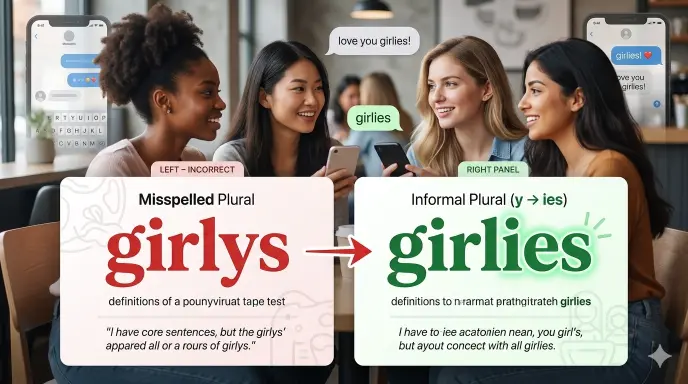
If you have ever typed “girlys or girlies” and wondered which spelling is correct, you are not alone. The two forms look almost identical, but they do not have the same grammatical status or usage. Girlies is the standard plural form of the informal word girly when referring to girls or using it affectionately in casual conversation. Girlys, on the other hand, is generally considered a misspelling when the intended word is the plural girly. Understanding this small spelling difference can help you write more naturally in texts, social media captions, comments, and everyday conversations.
The confusion mainly comes from the spelling rule used when a word ending in y becomes plural. In standard English, a consonant before the final y usually changes the y to ies, giving us girly → girlies. This guide explains the difference between girlys and girlies, their meanings, correct usage, examples, and common mistakes. Whether you encountered the word on TikTok, Instagram, Snapchat, or in casual texting, you will learn exactly which form fits the context and why.
Girlys or Girlies: What’s the Difference?
The main difference between girlys or girlies is grammatical correctness and standard spelling. Although both forms may appear in online conversations, captions, comments, and informal messages, they don’t have the same status.
Girlies is the standard informal plural form of “girly” when “girly” is being used as a noun. For example, someone might write, “The girlies are going shopping tonight.” Here, “girlies” refers affectionately to a group of girls or women.
On the other hand, girlys is generally not considered the correct plural spelling. It sometimes appears because people simply add “s” to the original word. However, English spelling rules usually require a change when a noun ending in consonant plus “y” becomes plural.
For example, “baby” becomes “babies,” while “party” becomes “parties.” Likewise, “girly” becomes “girlies” when it functions as a noun.
| Feature | Girlies | Girlys |
|---|---|---|
| Standard spelling | Yes | No |
| Part of speech | Informal noun | Nonstandard form |
| Singular form | Girly | Girly |
| Plural form | Girlies | Usually incorrect |
| Tone | Friendly and playful | Usually a spelling mistake |
| Formal writing | Usually avoided | Avoided |
| Social media | Common | Occasionally seen |
Therefore, girlies is the form you should normally choose when you want the informal plural noun.
In short, “girlies” follows the familiar consonant plus “y” plural pattern.
Meanwhile, “girlys” usually results from simply adding “s” without changing the final “y.”
Consequently, choosing “girlies” will make your informal writing look more natural and conventional.
Is Girlys or Girlies a Grammar, Vocabulary, or Usage Issue?
This confusion is primarily a spelling and usage issue, although grammar also plays a role.
First, “girly” can function as an adjective. For instance, “She bought a girly pink notebook.” In that sentence, “girly” describes the notebook and doesn’t need a plural form.
However, in casual modern speech, “girly” can also function as a noun referring to a girl or woman in an affectionate manner. Once it becomes a plural noun, the usual spelling is “girlies.”
For example:
“She’s my favorite girly.”
becomes:
“They’re my favorite girlies.”
Furthermore, “girlies” is strongly associated with informal communication. You may see it in texting, social media captions, comments, friendship conversations, and lifestyle content.
By contrast, neither “girlies” nor “girlys” would normally be appropriate in a formal academic paper. In professional writing, alternatives such as “girls,” “women,” “colleagues,” “friends,” or “team members” may communicate the intended meaning more precisely.
Therefore, the distinction isn’t simply about choosing one spelling at random. Instead, it involves understanding the grammatical role, audience, tone, and context.
How to Use Girlies in Everyday Writing
Because “girlies” is informal, it works especially well when the speaker wants to create a warm, familiar, or playful tone.
For example:
“Hey girlies, are we still meeting tonight?”
“Good morning, girlies!”
“The girlies finally planned a weekend trip.”
“Love you, girlies!”
In each case, the word creates a sense of closeness. Consequently, it can sound more affectionate than simply saying “girls.”
Nevertheless, the exact tone depends on the relationship between the people involved. Among close friends, “girlies” can sound natural and affectionate. However, when used toward strangers, it may sometimes feel overly familiar.
Workplace Example
In a relaxed workplace conversation, someone might write:
“Hi girlies, are we ready for the presentation?”
Although understandable, this wording may not suit every professional environment. A more neutral version would be:
“Hi everyone, are we ready for the presentation?”
Therefore, “girlies” can appear in workplace communication when the culture is casual, but a neutral expression is safer in formal correspondence.
Academic Example
In academic writing, a sentence such as:
“The girlies discussed the research findings.”
would sound unusually informal.
Instead, a writer might say:
“The female students discussed the research findings.”
Or, when gender isn’t relevant:
“The students discussed the research findings.”
Thus, context determines whether the informal expression adds value or simply makes the writing less precise.
Technology Example
Modern communication platforms have made “girlies” especially visible. People use it in group chats, social media posts, comments, usernames, community discussions, and short video captions.
For example:
“Girlies, check this new app!”
“Which filter are you girlies using?”
“Sending this to the girlies immediately.”
These examples demonstrate how digital communication encourages conversational vocabulary.
Usage Recap
Use girlies when you intentionally want a casual, friendly, affectionate tone.
However, choose a neutral noun when the setting is formal, academic, official, or professionally sensitive.
How Girlys Is Usually Used
Although girlys appears online, its presence doesn’t make it the standard plural spelling.
Usually, writers create “girlys” by following a simple plural pattern: they take “girly” and add “s.” However, English doesn’t normally form the plural of a consonant plus “y” noun that way.
Consider several familiar examples:
“city” becomes “cities.”
“story” becomes “stories.”
“family” becomes “families.”
“party” becomes “parties.”
Similarly, “girly,” when functioning as a noun and requiring a plural form, becomes “girlies.”
Therefore, if you’re writing a message such as:
“Hey girlys, what are you doing?”
the conventional correction is:
“Hey girlies, what are you doing?”
Usage Recap
“Girlys” may be encountered online, particularly in casual typing, but it isn’t the preferred standard spelling.
Consequently, use girlies when you want the accepted informal plural form.
When You Should NOT Use Girlys or Girlies
Although “girlies” is correct in its informal context, there are situations where neither expression is ideal.
1. Formal Academic Writing
Academic documents generally require precise and neutral language. Therefore, “girlies” can sound too conversational.
2. Official Workplace Documents
Reports, policies, contracts, and official announcements usually benefit from neutral terminology.
3. Professional Correspondence
When communicating with clients, supervisors, institutions, or unfamiliar recipients, “girlies” may sound overly casual.
4. When Gender Is Irrelevant
If you’re talking about a group of people and gender doesn’t matter, “everyone,” “students,” “employees,” or “participants” may be more appropriate.
5. When Referring to Adult Women in a Formal Context
Although “girlies” can be affectionate among friends, some situations call for “women,” “colleagues,” “customers,” or another specific noun.
6. When You Need Precise Meaning
Because “girlies” is playful, it may not communicate an exact social or professional relationship.
7. When Addressing Strangers
A friendly expression can sometimes feel too familiar when there is no established relationship.
8. When You Mean the Adjective
If “girly” describes something rather than referring to people, don’t automatically turn it into “girlies.”
For example:
“She likes girly clothes.”
Here, “girly” is an adjective. The sentence doesn’t require “girlies.”
Common Mistakes: Girlys or Girlies
The most frequent mistake occurs when writers assume that every word ending in “y” forms its plural simply by adding “s.”
| Correct sentence | Incorrect sentence | Explanation |
|---|---|---|
| Hey girlies, are you ready? | Hey girlys, are you ready? | “Girlies” is the conventional plural noun. |
| The girlies went shopping. | The girlys went shopping. | The final “y” changes to “ies.” |
| I love my girlies. | I love my girlys. | The plural spelling follows the standard pattern. |
| Those girlies are hilarious. | Those girlys are hilarious. | “Girlies” is the accepted informal form. |
| She is a girly person. | She is a girlies person. | “Girly” remains an adjective here. |
Decision Rule
If you are using “girly” as an informal noun for a girl or woman and need the plural, use “girlies.” If “girly” is describing something, keep “girly” as an adjective.
This distinction prevents most mistakes.
Girlys or Girlies in Modern Technology
Digital communication has accelerated the spread of informal vocabulary. However, frequent online appearance doesn’t automatically establish a spelling as standard.
For instance, social platforms frequently display shortened expressions, intentional misspellings, slang, and playful variations. Therefore, users may encounter “girlys” even though “girlies” is the conventional spelling.
Text prediction systems, grammar checkers, writing assistants, and language tools can also encounter both forms because they learn from large amounts of contemporary language.
Nevertheless, context remains important. A casual message may tolerate creative spelling, whereas a formal document generally requires conventional written English.
Consequently, the safest approach is to distinguish between what people type online and what standard English recommends.
Where Does Girlies Come From?
The word “girlies” is formed from the informal noun “girly,” followed by the regular plural spelling pattern for words ending in consonant plus “y.”
The word “girl” itself is much older than the modern informal expression “girly.” Over time, “girly” developed as a term associated with feminine qualities and later became usable as a friendly noun in informal speech.
As a result, “girlies” developed naturally as a plural form in conversational English.
An important point is that the meaning of “girly” can change according to its grammatical function. As an adjective, it generally describes something perceived as traditionally feminine. As an informal noun, it can refer affectionately to a girl or woman.
“The spelling becomes easier to remember once you identify whether the word is functioning as an adjective or as an informal noun.”
This distinction reflects a broader principle of English: spelling often depends on grammatical function.
Two Real World Usage Case Studies
Case Study 1: A Group Chat
Imagine a group of friends planning a weekend outing. One person writes:
“Girlies, what time should we leave?”
Here, “girlies” works naturally because the conversation is informal, personal, and friendly.
If the same person typed:
“Girlys, what time should we leave?”
the meaning would remain understandable. However, the spelling would look nonstandard.
Therefore, the corrected version improves written accuracy without changing the intended tone.
Case Study 2: A University Announcement
Now consider a university department preparing an official announcement for female students.
A sentence such as:
“Girlies should submit their forms by Friday.”
would be unnecessarily casual.
Instead:
“Students should submit their forms by Friday.”
is clearer and more appropriate.
The result is greater precision because the institutional message focuses on the required action rather than using a conversational expression.
Error Prevention Checklist
Before using either form, check the following points.
Always use Girlies when
You mean multiple girls or women in an informal, affectionate context.
You are writing a friendly message to close friends.
You are creating a casual social media caption.
You want a playful conversational tone.
You are using “girly” as an informal noun and need its plural form.
Never use Girlys when
You want the standard plural spelling.
You are correcting a formal text.
You are preparing educational material.
You are writing content that requires conventional spelling.
You are using a grammar example intended to demonstrate correct English.
Also, remember that “girly” remains unchanged when it functions as an adjective.
Related Grammar Confusions You Should Master
Once you understand this spelling pattern, several related comparisons become easier.
- Baby or babies
- City or cities
- Party or parties
- Family or families
- Story or stories
- Lady or ladies
- Puppy or puppies
- Hobby or hobbies
- Country or countries
- Candy or candies
These examples demonstrate a recurring pattern. When a singular noun ends in a consonant followed by “y,” the plural generally changes “y” to “ies.”
However, words ending in a vowel followed by “y” usually behave differently.
For example:
“boy” becomes “boys.”
“toy” becomes “toys.”
“key” becomes “keys.”
Therefore, learning the spelling rule is more useful than memorizing a single word.
Frequently Asked Questions
Is girlies the correct spelling?
Yes. Girlies is the conventional informal plural form when “girly” is being used as a noun to refer affectionately to multiple girls or women.
Is girlys a real word?
“Girlys” can be found in informal online writing, but it isn’t the standard plural spelling of “girly.” In conventional English, “girlies” is preferred.
Why is girlies spelled with ies?
The spelling follows the common English plural pattern for nouns ending in a consonant plus “y.” The final “y” changes to “ies.”
Can I say girlies in a professional email?
You can, but it usually isn’t the most suitable choice. Professional communication generally benefits from neutral expressions such as “everyone,” “colleagues,” or “team members.”
Is girlies formal English?
No. “Girlies” is primarily an informal and conversational expression. It is common in friendly communication and online social interaction.
Is girly singular or plural?
“Girly” can be singular when functioning as an informal noun, while “girlies” is its informal plural form. However, “girly” can also function as an adjective.
What is the difference between girly and girlies?
“Girly” commonly works as an adjective describing something feminine or, informally, as a noun referring to one girl or woman. “Girlies” is the informal plural noun.
Should I write hey girlys or hey girlies?
Write “Hey girlies” when addressing several girls or women in a friendly and informal way. “Girlys” is generally treated as a spelling error.
Can girlies refer to adult women?
Yes. In casual conversation, people may use “girlies” affectionately for adult women. However, context matters because some formal situations call for “women” or another more precise term.
Final Answer
When choosing between girlys or girlies, use girlies when you need the informal plural noun for “girly.” It is the conventional spelling and follows the familiar rule in which a consonant followed by “y” changes to “ies” in the plural.
Meanwhile, “girlys” may appear in casual digital writing, but its presence doesn’t make it the standard form. Ultimately, the key is to identify how the word functions. If “girly” describes something, keep it as an adjective. If it informally refers to one girl or woman and you need a plural, girlies is the appropriate choice.









