Have you ever written oriented or orientated and wondered which one is actually correct? You are not alone. Both forms appear in English, but their usage can vary depending on region, context, and writing style. Understanding the difference can help you avoid unnecessary confusion in professional, academic, and everyday writing.
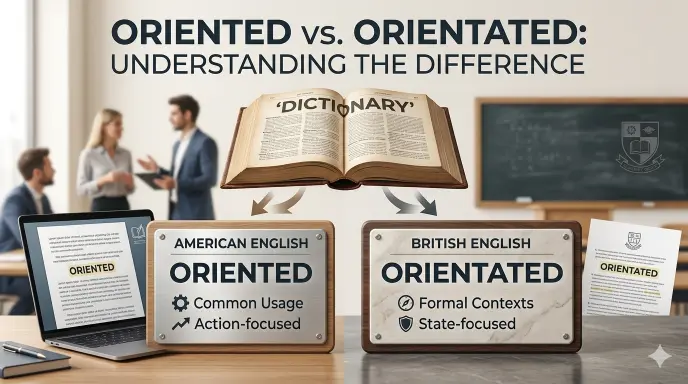
In most modern American English, oriented is the more common choice. It appears frequently in phrases such as “goal oriented,” “customer oriented,” and “career oriented.” Orientated is also a legitimate form, particularly in British English, although it may sound less natural to some American readers.
This guide explains oriented vs orientated in simple terms, including their meanings, grammatical usage, regional differences, examples, and common mistakes. Whether you are writing an email, article, résumé, academic assignment, or professional document, you will learn which form fits your sentence naturally and confidently.
Oriented or Orientated: What Is the Difference?
The main distinction between oriented and orientated is largely regional rather than grammatical. Both words function primarily as past tense or past participle forms of the verb orient. They can describe positioning, direction, adaptation, or a person’s focus toward a particular objective.
However, oriented has become the dominant choice in American English. Meanwhile, orientated remains established in British English and appears regularly in formal writing throughout the United Kingdom and several other English speaking regions.
| Feature | Oriented | Orientated |
|---|---|---|
| Part of speech | Verb form and adjective | Verb form and adjective |
| Base verb | Orient | Orient |
| Common usage | American English and international business writing | British English and some Commonwealth varieties |
| Meaning | Directed, positioned, focused, or adapted | Directed, positioned, focused, or adapted |
| Grammatical status | Correct | Correct |
| Example | The course is career oriented. | The course is career orientated. |
| Overall preference | More widely used internationally | Regionally preferred in some varieties |
Therefore, the meaning is essentially the same. Likewise, both versions can describe something directed toward a purpose.
Nevertheless, readers may notice a difference in regional style. Consequently, writers should consider the variety of English expected by their audience.
Mini recap:
Oriented is generally the safer choice for American English.
Orientated is also correct, particularly in British usage.
Both forms can describe direction, focus, or adaptation.
Therefore, context and regional preference usually determine the better option.
Is Oriented or Orientated a Grammar, Vocabulary, or Usage Issue?
At first, this looks like a grammar problem. However, it is more accurately a matter of usage and regional vocabulary preference.
Both forms originate from the same verb, orient. Thus, choosing one does not normally change the underlying meaning of a sentence.
For example, both statements communicate the same basic idea:
The training program is customer oriented.
The training program is customer orientated.
Nevertheless, the first version is more natural to many American readers. Conversely, the second may sound perfectly ordinary to British readers.
Formal versus informal writing
Interestingly, the distinction isn’t simply formal versus informal. Both words can appear in professional and academic contexts.
However, oriented has broader international recognition. Therefore, organizations communicating with audiences across several countries may prefer it for consistency.
Academic versus casual usage
Academic writers can use either form when it matches their selected variety of English. Likewise, students shouldn’t assume that orientated is grammatically incorrect merely because they encounter oriented more often.
Instead, consistency matters most.
Are they interchangeable?
Generally, yes. In most ordinary contexts, the two forms are interchangeable without changing the intended meaning.
Still, fixed expressions deserve attention. For example, goal oriented, results oriented, and customer oriented are especially familiar constructions in American and international business writing.
As a result, replacing every instance with orientated may make the prose sound less familiar to certain audiences.
How to Use Oriented Correctly
Oriented is the preferred form for many American English contexts. Moreover, it frequently appears in professional, educational, technological, and organizational language.
The word can describe a person who focuses on something, an object positioned in a particular direction, or a system designed around a specific purpose.
Workplace example
Our company is strongly customer oriented.
Here, the adjective indicates that the organization places considerable attention on customer needs.
Another example is:
She is highly results oriented and consistently meets her targets.
In this sentence, the expression describes someone whose behavior focuses on achieving measurable outcomes.
Academic example
The program is research oriented and encourages independent investigation.
Here, oriented communicates that the program is designed around research.
Similarly:
The course is student oriented and emphasizes practical learning.
The phrase indicates that the course has been designed around student needs.
Technology example
The platform is security oriented and protects sensitive information.
Likewise:
The application uses a user oriented interface.
In both cases, the word communicates the central design focus.
Usage recap
Therefore, use oriented when you want a broadly recognized form. It works naturally in business communication, academic prose, technical documentation, and everyday English.
How to Use Orientated Correctly
Orientated is not an error. Instead, it is a recognized alternative form, particularly within British English.
For example:
The company is strongly customer orientated.
A British reader can understand this sentence naturally.
Likewise:
The university offers a career orientated program.
The construction means that the program focuses on professional development.
Workplace example
Our department has become more service orientated.
Here, orientated describes an organizational focus.
Academic example
The curriculum is skills orientated and emphasizes practical experience.
Consequently, the phrase communicates that the curriculum concentrates on developing useful abilities.
Technology example
The software has a user orientated design.
This means that the design is centered around the needs or experience of users.
Usage recap
Therefore, orientated is appropriate when your audience follows British English or another variety in which the form is established.
However, writers should avoid switching randomly between the two forms. Consistency creates a more polished impression.
When You Should NOT Use Oriented or Orientated
Although both forms are correct, certain situations require more careful wording.
1. When describing physical direction
First, consider whether the sentence actually needs a more precise directional verb.
Instead of saying:
The building was oriented toward the river.
you may sometimes use facing if physical direction is the only meaning intended.
2. When your organization follows a specific style guide
Next, check your established editorial conventions. If your institution consistently uses American English, oriented will usually provide greater consistency.
3. When writing for a British audience
Conversely, don’t automatically “correct” orientated to oriented when the publication deliberately follows British usage.
4. When creating fixed terminology
Furthermore, established phrases should remain familiar. Expressions such as market oriented, customer oriented, and goal oriented are widely recognized.
5. When the intended meaning is adaptation
Sometimes adapted, adjusted, or prepared may communicate the idea more clearly.
For example:
The new employee quickly adapted to the workplace.
This can be clearer than forcing oriented into a sentence.
6. When precision matters
Likewise, technical writing should favor the most exact expression.
If something physically changes direction, positioned might be more precise. If someone learns how a new environment works, familiarized could be clearer.
7. When regional consistency matters
Finally, don’t alternate between oriented and orientated without reason. Consistency helps readers understand the intended variety of English.
Common Mistakes With Oriented and Orientated
| Correct sentence | Incorrect or less suitable sentence | Explanation |
|---|---|---|
| The program is career oriented. | The program is career orienting. | The adjective describes the program’s focus. |
| She is customer oriented. | She is customer orientateded. | The second form is incorrectly constructed. |
| The device is oriented toward safety. | The device is orientated toward safety in every American document. | The second version isn’t grammatically wrong, but it may conflict with the chosen regional style. |
| The course is research orientated. | The course is research orientateding. | The participle form has been unnecessarily altered. |
| He is results oriented. | He is result oriented. | The plural noun is conventional in this expression. |
| The team is user oriented. | The team is user orientated when following American style. | Regional consistency makes the first form preferable in American writing. |
Why these mistakes happen
First, English permits more than one form for certain verbs. Consequently, writers sometimes assume that one must be incorrect.
Second, exposure to different varieties can create uncertainty. A British writer may regularly see orientated, while an American writer may encounter oriented almost exclusively.
Therefore, the safest approach is to understand both forms rather than memorizing one as universally correct.
Decision Rule: Oriented or Orientated?
If you need the most broadly recognized form, choose oriented.
If you are following British English or a variety that commonly uses the longer form, orientated is acceptable.
If your publication already has a style preference, follow that preference consistently.
A simple practical rule is therefore:
American English: usually choose oriented.
British English: oriented and orientated can both occur, with orientated retaining established usage.
International communication: oriented is often the clearest default because it is widely recognized.
Oriented and Orientated in Modern Technology
Modern technical language frequently uses oriented in phrases describing design priorities.
For instance, developers may describe a product as user oriented, security oriented, data oriented, or performance oriented.
Likewise, technical teams may discuss object oriented programming, where oriented is firmly established terminology.
In such cases, substituting orientated may sound unusual even when the broader grammatical form is technically acceptable.
Therefore, technology writing benefits from recognizing established terminology rather than treating every variation as equally natural.
For product descriptions, documentation, interface explanations, and professional reports, oriented is usually the safer choice.
Where Did Oriented and Orientated Come From?
Both forms trace back to the verb orient, which ultimately relates to the idea of determining direction, especially in relation to the east.
The historical connection comes through the Latin word oriens, meaning rising, particularly referring to the rising sun.
Over time, English developed orient as a verb meaning to establish direction or position. Later, the participial forms oriented and orientated developed through different patterns of English word formation.
Interestingly, English has several pairs in which a shorter form and a longer form coexist. Therefore, the existence of orientated alongside oriented isn’t unusual.
Expert style insight: “When two forms carry the same meaning, the strongest choice is usually the one that fits your audience, terminology, and established style.”
Two Practical Case Studies
Case Study 1: An International Business Report
Imagine a multinational company preparing an annual report for readers in the United States, Canada, Europe, and Asia.
The editorial team initially uses both customer orientated and customer oriented throughout the document. Although both expressions are understandable, the inconsistent wording creates an uneven editorial style.
The team chooses customer oriented as its standard form.
As a result, the document becomes more consistent, terminology becomes easier to scan, and editors no longer need to make repeated regional decisions.
The concrete improvement isn’t that one form suddenly becomes grammatically correct. Instead, consistency reduces unnecessary variation.
Case Study 2: A British University Prospectus
Now consider a university in the United Kingdom preparing information about its courses.
The institution traditionally describes its curriculum as career orientated and research orientated. An editor changes every occurrence to oriented simply because it appears more frequently online.
After review, the university keeps orientated because it matches the institution’s established British style.
Consequently, the final publication maintains a consistent editorial voice while remaining grammatically sound.
These examples demonstrate an important principle: usage decisions should consider audience and context, not popularity alone.
Oriented or Orientated: Error Prevention Checklist
Always use oriented when:
- You are writing primarily for an American audience.
- You need a widely recognized international form.
- You are using established technology terminology.
- Your organization has selected American English.
- Your existing document consistently uses oriented.
- A professional phrase already commonly contains oriented.
Never use orientated when:
- Your selected style guide specifically requires oriented.
- You are changing terminology randomly within the same document.
- The phrase has an established conventional form using oriented.
- The alternative would make technical wording less familiar.
- You are replacing an established term without a meaningful reason.
Remember, however, that “never” here means never within those specific stylistic circumstances. The word itself isn’t grammatically forbidden.
Related Grammar Confusions You Should Master
Understanding this pair can also help you recognize other English variations.
- Learned or learnt
Both forms are used, although regional preferences differ. - Burned or burnt
Usage can depend on meaning and regional convention. - Spelled or spelt
Both forms are established in different varieties of English. - Focused or focussed
Both spellings occur, with regional and editorial preferences influencing selection. - Canceled or cancelled
American and British spelling conventions differ. - Traveled or travelled
The same regional spelling pattern appears here. - Toward or towards
Both are accepted, although frequency varies across English varieties. - While or whilst
Both can be grammatical, but their tone and regional frequency differ. - Program or programme
Context and regional convention determine the preferred form. - Practice or practise
Meaning and grammatical function determine the correct choice in varieties that preserve the distinction.
Learning these patterns makes regional English differences much easier to recognize.
Frequently Asked Questions
Is oriented or orientated correct?
Both forms are correct. However, oriented is more widely preferred in American English, while orientated has established usage in British English and several related varieties.
Is orientated grammatically correct?
Yes. Orientated is a legitimate form of orient. Although some readers may consider it less familiar, particularly in American English, that does not make it grammatically incorrect.
Which is more common, oriented or orientated?
Oriented is generally more widespread, particularly in American English and international professional communication. However, frequency varies by region, publication, and subject area.
Should I use oriented or orientated in academic writing?
Either can work when grammatically appropriate. Nevertheless, you should follow the English variety required by your institution or publication. Consistency is more important than choosing one form universally.
Is customer oriented or customer orientated correct?
Both constructions can be correct. Customer oriented is especially common in American and international business English, while customer orientated can sound natural in British English.
Is object oriented or object orientated correct?
Object oriented is the established technical expression in programming terminology. Therefore, writers discussing programming should normally retain the conventional form rather than replacing it simply because orientated is grammatically possible elsewhere.
Is oriented a verb or adjective?
Oriented can function as a past tense or past participle form of orient, and it can also function adjectivally. The surrounding sentence determines its grammatical role.
Is orientated more British than oriented?
Generally, yes, although both forms occur in British English. Orientated has a stronger association with British usage, whereas oriented is particularly dominant in American English.
Can I use oriented and orientated in the same article?
Technically, you can, but doing so without a clear reason is usually undesirable. Instead, select the form that fits your chosen variety and maintain that choice throughout the article.
Final Answer:
Ultimately, oriented and orientated are both valid forms of the same verb. The difference is primarily one of regional preference and established usage rather than basic grammar.
For American English, professional communication, international audiences, and many technical contexts, oriented is usually the strongest choice. Meanwhile, orientated remains perfectly acceptable in British English and other varieties where it is commonly used.
Therefore, don’t treat orientated as a spelling error. Instead, consider your readers, publication standards, terminology, and consistency. When you’re uncertain and no regional style has been specified, oriented is generally the safer default. The key lesson is simple: choose the form that matches your audience, then use it consistently.









