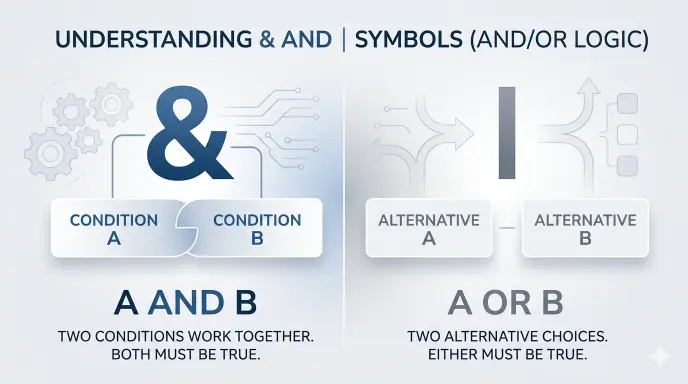
The and or symbol may look like a simple character, but the symbol & has a surprisingly interesting role in English, writing, business, technology, and everyday communication. If you have ever wondered what & means, what it is called, or whether you should use it instead of the word “and,” you are not alone. Understanding its proper use can make your writing clearer and more professional.
The symbol is commonly called an ampersand, and it represents the word “and.” However, it is not always interchangeable with “and” in formal writing. Its appropriateness depends on context, style, and the type of content you are creating.
In this guide, we will explain the and or symbol in simple language, explore its meaning, show real examples, and discuss where it works best. You will also learn common mistakes so you can confidently use & in everyday and professional writing.
And or Symbol: What’s the Difference?
The simplest way to understand the distinction is to separate the two logical ideas first.
And means that two conditions, items, people, or actions are considered together. In everyday English, the word connects related elements. Its common symbol is the ampersand (&), although the word “and” remains preferable in most formal prose.
Or presents alternatives. It indicates that one possibility, another possibility, or sometimes either possibility can satisfy a condition. In formal logic and several programming languages, the vertical bar | or double vertical bar || may represent an OR operation.
| Feature | And | Or |
|---|---|---|
| Basic meaning | Combines conditions | Presents alternatives |
| Common written symbol | & | | |
| Logical operation | Conjunction | Disjunction |
| Typical English wording | and | or |
| Common technical notation | & or && | | or || |
| Main function | Requires combined conditions | Allows alternatives |
| Example | A & B | A | B |
In simple terms, and joins, while or separates possibilities.
Therefore, the correct symbol depends on what you are trying to communicate.
Moreover, ordinary English and technical notation should not automatically be treated as identical systems.
Is And or Symbol a Grammar, Vocabulary, or Usage Issue?
The and or symbol question is primarily a usage and notation issue, rather than a basic grammar problem.
In everyday English, “and” and “or” are conjunctions. They perform different grammatical functions because they establish different relationships between words, phrases, or clauses.
For example, “Sara and Tom arrived” means both people arrived. Conversely, “Sara or Tom arrived” presents alternatives and doesn’t necessarily confirm that both participated.
In formal writing, the words themselves are usually clearer than their symbolic equivalents. An ampersand may appear in company names, titles, labels, references, or compact formats, while a vertical bar belongs more naturally to technical environments.
Consequently, replacing one with another simply because it looks shorter can create ambiguity.
In academic writing, it is generally better to spell out and rather than substitute & unless a particular style or name requires the symbol.
In programming, however, symbolic notation is normal. A programmer may need && for logical AND and || for logical OR.
Thus, the same concept can have different visual representations depending on the communication system.
How to Use the And Symbol Correctly
The most recognizable symbol associated with and is the ampersand, &.
Historically, the character developed from a stylized combination of letters representing the Latin word et, meaning “and.” Today, it has become a familiar typographic character.
In ordinary prose, however, spelling out “and” is usually more natural.
Workplace example
A business document might say:
The marketing and sales teams will meet tomorrow.
That wording is appropriate for professional correspondence.
An ampersand may instead appear in a formal organization name:
Johnson & Partners
Here, the character is part of the established name rather than a casual abbreviation.
Academic example
A research paper would normally use:
The study examines language and communication.
Using an ampersand throughout ordinary academic sentences can look unnecessarily informal or stylistically inconsistent.
Nevertheless, a citation style, publication title, or source name may legitimately contain &.
Technology example
Programming languages frequently assign a technical meaning to the ampersand.
For example, some environments use && to represent logical AND. In that setting, the symbol isn’t simply decorative typography. It instructs the system to evaluate a particular logical relationship.
Usage recap: Use the word and in normal sentences unless a specific name, format, notation system, or technical language calls for & or another form.
How to Use the Or Symbol Correctly
The meaning of or is different because it introduces alternatives.
In ordinary English, the word “or” is normally written out. Its symbolic form varies considerably according to the field.
The vertical bar | is widely recognized as an OR operator in computing and technical notation. Some programming languages also use || for logical OR.
Workplace example
Suppose an instruction says:
Submit the report by email or through the internal portal.
The employee understands that either route can be used.
Replacing “or” with an unfamiliar technical character could make the instruction harder to understand for a general audience.
Academic example
A textbook might explain:
Students may submit a written project or an oral presentation.
That sentence clearly presents two alternatives.
In formal mathematical logic, however, a symbolic expression can make the relationship more compact.
Technology example
A programmer may write an expression resembling:
A || B
This commonly means that the program should treat the condition as satisfied when at least one of the two expressions is true.
Usage recap: Use or in ordinary prose. Use | or || only when the relevant technical, mathematical, or programming convention gives the character that meaning.
When You Should NOT Use And or Symbol
Several mistakes occur when people transfer symbols from one environment into another.
1. Don’t replace every “and” with an ampersand
Although & is recognizable, frequent substitution can make professional prose look abbreviated or inconsistent.
2. Don’t use a vertical bar in ordinary sentences
A reader may interpret | as technical notation instead of understanding it as a normal replacement for “or.”
3. Don’t assume & means logical AND everywhere
Programming languages can assign specialized meanings to individual characters. The exact operator depends on the language.
4. Don’t assume | always means OR
The vertical bar has several uses. Depending on context, it can represent alternatives, absolute value, pattern matching, piping, or other technical concepts.
5. Don’t confuse && with &
Some programming languages distinguish logical AND from bitwise AND. Consequently, one character may perform a different operation from two characters.
6. Don’t confuse || with |
Likewise, logical OR and bitwise OR can have separate operators in programming.
7. Don’t use symbols when the audience needs plain language
Technical shorthand can save space, yet clarity should come first when readers aren’t familiar with the notation.
8. Don’t assume punctuation determines meaning
The surrounding system matters. A symbol acquires meaning from its grammatical, mathematical, or programming context.
Common Mistakes With And or Symbol
| Correct sentence | Incorrect sentence | Explanation |
|---|---|---|
| Sarah and David attended. | Sarah & David attended. | The second version isn’t always wrong, but it may be unsuitable for formal prose. |
| Choose tea or coffee. | Choose tea | coffee. | The vertical bar is unnecessary in normal writing. |
Use && for logical AND where required. | Use ` | |
| Use ` | ` for logical OR where required. | |
| Johnson & Partners | Johnson and Partners | If the ampersand is part of the official name, replacing it may alter the name. |
The important point is that a symbol isn’t automatically correct simply because readers recognize it.
Instead, examine the environment in which it appears.
Decision Rule for And or Symbol
If you mean two elements working together, use “and” or the appropriate AND notation. If you mean alternatives, use “or” or the appropriate OR notation.
For ordinary English, write and and or.
For technical notation, follow the conventions of the particular field.
For programming, check the operator required by the language because &, &&, |, and || can have different functions.
This rule prevents the most common confusion.
And or Symbol in Modern Technology and Computing
Digital systems rely heavily on logical operators.
Computers don’t interpret symbols according to everyday intuition alone. Instead, programming languages define specific operators and assign them precise behavior.
For example, a language may use && for logical AND. The expression evaluates multiple conditions together.
Likewise, || commonly represents logical OR. The program can proceed when one condition or another satisfies the required test.
The single characters & and | may also have separate technical functions. In several programming environments, they can operate at the bit level rather than simply evaluating everyday true or false conditions.
Therefore, beginners should avoid memorizing symbols without learning their surrounding rules.
A symbol is best understood as part of a complete notation system.
Where Did the And Symbol Come From?
The ampersand has a long typographic history.
Its shape developed from a handwritten combination of letters representing the Latin word et, which means “and.” Over centuries, repeated writing transformed the connected characters into the recognizable symbol &.
Eventually, the ampersand became a standard character in writing systems and typography.
The vertical bar has a different history and a much broader technical life. Its uses developed across mathematics, computing, typography, and logic.
Consequently, the two characters shouldn’t be viewed as a matched historical pair. They became associated with related logical ideas through different traditions.
“Good notation reduces complexity by giving a precise visual form to an underlying relationship.”
That principle explains why symbols remain valuable. A well understood character can communicate a complicated relationship quickly, provided the reader knows the convention.
Two Practical Case Studies
Case Study 1: Workplace Instructions
Imagine an employee handbook stating:
Employees must complete training and submit the confirmation form.
Both actions are required.
If the writer mistakenly communicates an alternative relationship, employees could reasonably assume that completing only one task is sufficient.
Therefore, choosing and instead of or isn’t merely stylistic. It can change the required action.
A clearer sentence prevents operational mistakes.
Case Study 2: Programming Conditions
Consider a login system requiring two checks:
valid username AND valid password
The intended behavior is that both conditions must be satisfied.
If the developer accidentally uses an OR relationship, a system could accept a situation where only one condition succeeds.
Thus, a tiny notation difference can produce a major functional consequence.
The lesson is straightforward: logical symbols carry meaning, so accuracy matters more than visual convenience.
Error Prevention Checklist
Always use “and” when
- Two elements must be considered together.
- Both actions are required.
- You are writing ordinary formal prose.
- The audience may not understand specialized notation.
- The surrounding style guide requires the written conjunction.
Never use “or” when
- Both conditions are mandatory.
- You intend to combine two required elements.
- The statement would become logically weaker.
- A technical expression specifically requires AND.
- You are describing a relationship where alternatives would change the intended result.
Similarly, don’t choose &, |, &&, or || merely because the character looks shorter.
Related Grammar Confusions You Should Master
Understanding conjunctions becomes easier when you also study several nearby distinctions.
And vs Or
Learn how combined requirements differ from alternatives.
And vs Ampersand
Understand when & is acceptable and when spelling out “and” is better.
Or vs Nor
These constructions don’t perform the same grammatical function.
Either vs Neither
These words establish different relationships between alternatives and negation.
Between vs Among
Both involve relationships, yet their traditional usage differs.
Each vs Every
Both refer to members of a group, but their grammatical behavior isn’t identical.
Then vs Than
One commonly concerns sequence, while the other establishes comparison.
Its vs It’s
One expresses possession, while the other is a contraction.
Affect vs Effect
These words frequently cause confusion because their meanings and grammatical roles differ.
Fewer vs Less
The distinction depends largely on whether the noun can be counted individually.
Learning these contrasts builds stronger language awareness and reduces avoidable writing errors.
Frequently Asked Questions
What symbol means and?
The ampersand & is the most familiar symbol for “and.” However, the written word and is normally preferred in formal prose. In programming, other operators such as && may represent logical AND.
What symbol means or?
The vertical bar | and double vertical bar || can represent OR in technical and programming contexts. In ordinary English, however, the word or should generally be written out.
Is the ampersand the symbol for and?
Yes. The ampersand & is a typographic symbol representing “and.” It commonly appears in business names, titles, labels, references, and compact writing.
Is the vertical line a symbol for or?
It can be. In logic and computing, | or || may represent OR depending on the notation system. Nevertheless, the vertical bar has several other meanings.
Should I use an ampersand in formal writing?
Usually, spell out “and” in ordinary formal sentences. Use & when it belongs to a proper name, established title, citation convention, or specialized format.
What is the difference between & and &&?
The exact distinction depends on the programming language. In many languages, & performs a bitwise or related operation, while && represents logical AND. Always follow the language’s rules.
What is the difference between | and ||?
In many programming languages, | performs bitwise OR, whereas || performs logical OR. Their behavior can differ significantly, so they shouldn’t be exchanged casually.
Is and a conjunction?
Yes. “And” is a coordinating conjunction. It connects words, phrases, or clauses that have a related grammatical relationship.
Is or a conjunction?
Yes. “Or” is also a coordinating conjunction. It commonly connects alternatives or presents choices.
Final Conclusion:
The and or symbol becomes much easier once the underlying relationship is clear. And combines elements, while or presents alternatives. In ordinary writing, the words themselves are usually the clearest choice. Meanwhile, technical environments may use &, &&, |, or || according to specific conventions.
Therefore, don’t choose a character simply because it appears shorter or more technical. First identify the intended relationship, then follow the rules of the writing system, mathematical notation, or programming language involved.
Ultimately, precise notation protects meaning. When two conditions must work together, choose the appropriate AND expression. When alternatives are intended, choose the appropriate OR expression.









