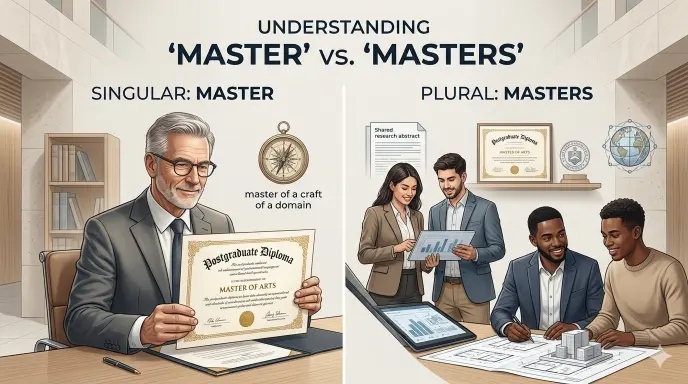
Have you ever wondered whether master or masters is the correct form to use? You are not alone. This small difference can create confusion because both words are correct, but they are used in different situations. Understanding the context makes it much easier to choose the right one.
The word master is generally the singular form, while masters can be the plural form or may appear in specific expressions and academic contexts. For example, you might talk about “a master of the subject,” while “masters” could refer to more than one person or a graduate degree depending on the sentence.
In this guide, we will clearly explain the difference between master and masters, including their meanings, grammar rules, common mistakes, and practical examples. Whether you are writing academically, professionally, or in everyday English, these simple explanations will help you use the correct form with confidence.
Master or Masters: What’s the Difference?
The words master and masters are closely related, yet their grammatical roles can change depending on the sentence. Therefore, choosing the right form requires looking at both meaning and sentence structure.
Master can function as a noun, verb, or adjective. As a noun, it can describe a highly skilled person, an owner, or a person with authority. As a verb, it means to become highly skilled at something or to gain complete control of a skill.
For example, you might say, “She wants to master Spanish.” Here, master is a verb because it describes an action.
Meanwhile, masters can serve several purposes. It can be the plural form of the noun master, the third person singular form of the verb master, or the name commonly used for a postgraduate degree in some contexts.
For example, “The masters of the craft gathered together” uses masters as a plural noun. However, “He masters difficult techniques quickly” uses masters as a verb.
The academic meaning requires additional attention. In American English, people commonly say “a master’s degree” when referring to one postgraduate qualification. The possessive form contains an apostrophe because the degree historically means a degree belonging to a master.
| Word | Part of Speech | Main Meaning | Example |
|---|---|---|---|
| Master | Noun | A skilled person or person with authority | He became a master of the craft. |
| Master | Verb | To become highly skilled at something | She hopes to master French. |
| Master | Adjective | Main, original, or controlling | Keep the master copy safe. |
| Masters | Noun | More than one master | Several masters attended the event. |
| Masters | Verb | Performs the action for he, she, or it | She masters new skills quickly. |
| Master’s | Noun phrase | A postgraduate academic degree | He earned a master’s degree. |
Quick Recap
Therefore, master is usually the singular form or the base verb.
Meanwhile, masters may refer to several people or describe an action performed by one person.
In academic contexts, master’s degree normally refers to one postgraduate qualification.
Consequently, the sentence itself determines which form is appropriate.
Is Master or Masters a Grammar, Vocabulary, or Usage Issue?
The difference between master or masters is primarily a grammar and usage issue, although vocabulary also matters because the two forms can carry different meanings.
First, master is the basic form. It can appear after modal verbs such as “can,” “will,” and “should.” For instance, “You can master this skill” is correct because modal verbs take the base form.
However, masters is used with a singular third person subject when it functions as a verb. Thus, “She masters new techniques quickly” is grammatically correct.
The academic situation is slightly different. When discussing postgraduate education, master’s is normally used for one degree. For example, “I am completing a master’s degree in history.”
Furthermore, masters without an apostrophe can refer to multiple people or can function as a verb. Therefore, writing “I completed my masters degree” is generally considered incorrect in formal standard English when you mean one postgraduate degree.
Instead, write “I completed my master’s degree.”
In casual speech, people sometimes drop the apostrophe and say “masters.” Nevertheless, formal academic writing should preserve the standard possessive form.
Consequently, these words aren’t interchangeable. Their meaning depends on number, grammatical role, and context.
When to Use Master
Use master when you are referring to one person, using the base form of the verb, or describing something as primary or original.
Workplace Example
A manager might tell an employee:
“Your next goal is to master the new reporting system.”
Here, master functions as a verb. The sentence describes gaining strong knowledge of a workplace skill.
Likewise, you could write:
“Please keep the master document in the shared folder.”
In this example, master works as an adjective and identifies the primary document.
Academic Example
A student might write:
“Students should master the fundamental principles before moving to advanced research.”
Here, master is again a verb. The subject “students” is plural, but the verb remains in its base form because the sentence uses “should.”
Another example is:
“She wants to master academic writing before beginning her thesis.”
Therefore, the form remains unchanged after “wants to” because an infinitive uses the base verb.
Technology Example
Consider this sentence:
“Developers must master version control before working on large projects.”
Again, master is the correct form because “must” requires the base verb.
Similarly, technology documentation may refer to a “master copy,” “master account,” or “master configuration.” In these cases, the word identifies something primary or controlling.
Usage Recap
Use master for one person, the base form of the verb, or something primary.
Moreover, words such as “to,” “can,” “should,” “must,” and “will” are strong clues that the base form master is required.
When to Use Masters
Use masters when you are talking about multiple people, describing a third person singular action, or referring to a specific established name or title that uses the plural form.
Workplace Example
“The company’s senior masters trained the new employees.”
Here, masters is a plural noun because more than one person is being discussed.
Alternatively:
“She masters complicated procedures faster than most new employees.”
Here, masters is a verb because the subject is “she.”
Academic Example
“The university’s respected masters of literature discussed the new research.”
Because several experts are mentioned, masters functions as a plural noun.
However, when referring to a postgraduate degree, the standard construction is different:
“He is pursuing a master’s degree in economics.”
If you mean several postgraduate degrees, you may write:
“She has earned two master’s degrees.”
Notice that the apostrophe remains attached to master’s, while the word “degrees” indicates plurality.
Technology Example
“A skilled technician masters complex software tools quickly.”
Here, masters is the third person singular form of the verb.
Meanwhile, “The masters of the system approved the final configuration” uses masters as a plural noun.
Usage Recap
Use masters when the subject is singular and performs the action, or when the noun refers to multiple masters.
However, don’t automatically use masters when discussing postgraduate education. Instead, determine whether you mean one master’s degree or several master’s degrees.
When You Should NOT Use Master or Masters
Several mistakes appear repeatedly because writers choose the word based on sound rather than grammatical function. Therefore, checking the subject and meaning first can prevent most errors.
1. Don’t use masters after a modal verb
Incorrect:
“You should masters the skill.”
Correct:
“You should master the skill.”
The modal “should” requires the base verb.
2. Don’t use master with a singular third person subject
Incorrect:
“She master the software quickly.”
Correct:
“She masters the software quickly.”
Because “she” is a singular third person subject, the present tense verb requires the ending “s.”
3. Don’t write masters degree for one postgraduate qualification
Incorrect:
“He earned a masters degree.”
Correct:
“He earned a master’s degree.”
The apostrophe identifies the standard possessive academic form.
4. Don’t use master when you mean several people
Incorrect:
“The master attended the ceremony.”
If several people are meant, write:
“The masters attended the ceremony.”
5. Don’t use masters after to
Incorrect:
“She wants to masters the subject.”
Correct:
“She wants to master the subject.”
The infinitive construction “to master” requires the base form.
6. Don’t confuse masters with master’s
Incorrect:
“I am applying for a masters program.”
More formal:
“I am applying for a master’s program.”
The apostrophe matters when referring to the academic level.
7. Don’t use masters when the subject is plural
Incorrect:
“They masters the technique quickly.”
Correct:
“They master the technique quickly.”
Plural subjects normally take the base form in the simple present.
8. Don’t remove the apostrophe from a standard academic expression
Incorrect:
“She completed her masters degree.”
Correct:
“She completed her master’s degree.”
Therefore, academic context requires particular attention to punctuation.
Common Mistakes: Master or Masters
The following examples make the distinction easier to recognize in real writing.
| Correct Sentence | Incorrect Sentence | Explanation |
|---|---|---|
| She wants to master coding. | She wants to masters coding. | The infinitive requires the base form. |
| He masters difficult skills quickly. | He master difficult skills quickly. | A singular third person subject requires masters. |
| They master new techniques quickly. | They masters new techniques quickly. | A plural subject takes the base verb. |
| She earned a master’s degree. | She earned a masters degree. | The academic expression normally uses an apostrophe. |
| Several masters attended. | Several master attended. | A plural noun needs the plural form. |
| You can master the process. | You can masters the process. | Modal verbs take the base form. |
| The master copy is secure. | The masters copy is secure. | One primary copy is being described. |
| Two master’s degrees were required. | Two masters degree were required. | The plural is created through degrees, not by removing the apostrophe. |
Decision Rule Box
If you mean the action, use master when the sentence requires the base verb.
If the subject is he, she, or it in the simple present, use masters.
If you mean several skilled people or authorities, use masters.
If you mean one postgraduate qualification, use master’s degree.
If you mean several postgraduate qualifications, use master’s degrees.
Master or Masters in Modern Technology
Modern technology has introduced many contexts in which these words appear naturally. However, the grammar remains the same even when the subject involves advanced software, digital systems, or automated tools.
For example, a technical guide might say:
“Users can master the platform after completing the training.”
Here, master follows “can.”
Another sentence might say:
“She masters the software faster than her colleagues.”
In this case, masters agrees with the singular subject “she.”
Furthermore, technology documentation often uses master as an adjective. Expressions such as “master account,” “master file,” and “master database” can describe a primary source or controlling version.
Therefore, modern terminology doesn’t change the underlying grammar. Instead, it creates more situations where understanding the distinction becomes useful.
Etymology and Historical Development
The word master has a long history in English. It developed from older forms associated with authority, expertise, and leadership. Historically, the word was connected with the idea of someone who had control, knowledge, or superior skill.
Over time, its meaning expanded. Consequently, English speakers began using master not only for people in positions of authority but also for highly skilled individuals.
The verb developed naturally from this broader concept. To master something came to mean gaining a high level of control or ability.
The academic expression master’s degree developed from the title “master,” which historically referred to an academic rank. Therefore, the modern educational meaning is closely connected with the older sense of expertise and scholarly achievement.
An Expert View of the Difference
A useful way to understand the distinction is to focus on grammatical function before focusing on spelling.
“The safest choice is to identify the subject, determine the verb form, and then check whether the context is singular, plural, or academic.”
This approach works because English endings often communicate information about number and grammatical structure. Therefore, looking at the entire sentence is more reliable than memorizing isolated rules.
Case Study 1: Academic Writing
Consider a university student writing:
“I completed my masters degree last year, and now I want to master advanced research methods.”
At first glance, the sentence may appear almost correct. However, the first expression requires revision.
The polished version is:
“I completed my master’s degree last year, and now I want to master advanced research methods.”
The reason is straightforward. The first phrase describes a postgraduate qualification, so master’s degree is appropriate. The second phrase describes an action, so master is the correct base verb after “want to.”
As a result, one sentence can legitimately contain both forms.
Case Study 2: Workplace Communication
Imagine an employee writing:
“She master new software quickly, so she should lead the training session.”
The intended meaning is clear, but the verb form is incorrect.
The corrected sentence is:
“She masters new software quickly, so she should lead the training session.”
Because “she” is a singular third person subject, the simple present requires masters.
Now consider a related sentence:
“She wants to master the new software before leading the training session.”
Here, master returns because it follows the infinitive “to.”
Therefore, changing only the structure of the sentence can change the correct form.
Error Prevention Checklist
Always use master when
You are using the base verb.
You have “to” immediately before the verb.
A modal such as “can,” “should,” “must,” or “will” comes before the verb.
You mean one skilled person.
You are describing something primary or original.
Never use masters when
A modal verb requires the base form.
The verb follows “to.”
The subject is plural in a simple present sentence.
You mean one postgraduate degree without the required apostrophe.
You are using the word merely because it sounds more formal.
Consequently, sentence structure should always guide the decision.
Related Grammar Confusions You Should Master
Once you understand master or masters, several related distinctions become easier.
- Teacher or teachers
This focuses on singular and plural nouns. - Student or students
The same number distinction appears in academic writing. - Degree or degrees
This helps clarify how academic qualifications become plural. - Bachelor or bachelor’s
Apostrophe use becomes especially important here. - Master’s or masters
This is particularly useful when writing about postgraduate education. - Practice or practise
This introduces a different spelling distinction between noun and verb forms. - Advice or advise
These words demonstrate how pronunciation and grammatical function can differ. - Affect or effect
Context determines which word communicates the intended meaning. - Principle or principal
Similar pronunciation can create confusion despite different meanings. - License or licence
Regional English conventions affect the preferred spelling.
Therefore, mastering these distinctions can improve accuracy across professional, academic, and everyday communication.
Frequently Asked Questions
Is it master or masters degree?
The standard expression for one postgraduate qualification is master’s degree. The apostrophe is important because “master’s” functions as a possessive form. For multiple qualifications, write master’s degrees.
Is masters grammatically correct?
Yes. Masters is grammatically correct in several situations. It can be the plural noun for more than one master, or it can be the third person singular present form of the verb “master.”
Should I write master or masters?
Choose master when you need the base verb or singular noun. Choose masters when referring to several masters or when a singular third person subject performs the action in the simple present.
Is it correct to say I have a masters degree?
In formal standard English, the preferred form is I have a master’s degree. The apostrophe distinguishes the academic expression from the plural noun masters.
What is the plural of master’s degree?
The usual plural is master’s degrees. The word “degrees” carries the plural meaning, while master’s retains its standard possessive spelling.
Is master a noun or a verb?
It can be both. As a noun, it can describe a highly skilled person or an authority. As a verb, it means to develop a high level of skill or control over something. It can also function as an adjective in certain expressions.
When do you use masters as a verb?
Use masters as a verb when the subject is singular and third person in the simple present. For example, “She masters difficult techniques quickly.”
Why is there an apostrophe in master’s degree?
The apostrophe reflects the possessive form traditionally used in the academic expression. Thus, master’s degree is the standard form for one qualification.
Can master and masters be interchangeable?
No. They can express related ideas, but their grammatical functions differ. Sentence structure, subject number, and intended meaning determine the correct choice.
Is masters degree acceptable in casual English?
You may encounter “masters degree” in informal writing, but formal academic and professional writing should use master’s degree. Therefore, retaining the apostrophe is the safer choice.
Conclusion:
Understanding master or masters becomes much easier when you identify the role of the word before choosing its spelling. Generally, master is the base form, singular noun, or verb used after structures such as “to,” “can,” “should,” and “must.” Meanwhile, masters can describe several people or a singular third person action.
However, academic writing requires another distinction. When referring to one postgraduate qualification, use master’s degree. For more than one qualification, use master’s degrees.
Ultimately, don’t choose between these forms based only on pronunciation. Instead, examine the subject, verb structure, number, and intended meaning. Once that habit becomes automatic, the distinction becomes simple and your academic and professional writing becomes considerably more precise.









