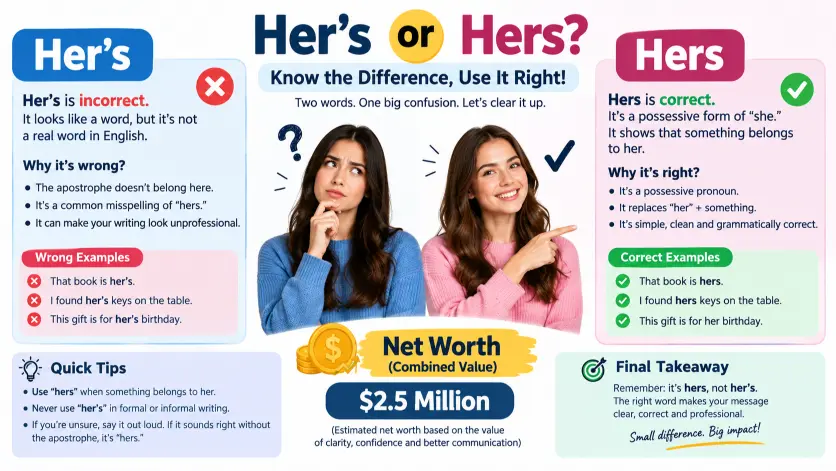
If you have ever wondered whether “her’s or hers” is the correct spelling, you are not alone. This is a common English grammar confusion because many possessive words use an apostrophe, making her’s look natural at first glance. However, English has a specific rule for possessive pronouns that makes the correct choice much easier to understand.
The correct form is “hers”, without an apostrophe. Unlike nouns such as Sarah’s or the girl’s, possessive pronouns follow a different pattern. Understanding this small distinction can help you avoid mistakes in emails, school assignments, professional writing, and everyday conversations.
In this guide, we will clearly explain her’s vs hers, why hers is grammatically correct, when to use it, and how it differs from her and her’s. You will also find simple examples and practical rules that make the difference easy to remember.
Her’s or Hers: What’s the Difference?
The easiest way to understand her’s or hers is to identify the grammatical job each form is supposed to perform.
Hers is a possessive pronoun. It replaces a noun phrase and indicates ownership. For instance, instead of saying “That jacket belongs to Maria,” you can say, “That jacket is hers.”
Her’s, however, isn’t recognized as the standard possessive form of her. The apostrophe doesn’t belong there. Consequently, using it in an essay, email, report, application, or professional message creates a spelling and grammar error.
| Form | Part of speech | Standard English? | Main function | Example |
|---|---|---|---|---|
| hers | Possessive pronoun | Yes | Shows ownership independently | The blue bag is hers. |
| her’s | Incorrect possessive form | No | Not a standard grammatical form | Avoid this spelling. |
Mini Recap
Hers is the accepted possessive pronoun.
Her’s is an incorrect spelling in standard English.
Use hers when the word stands alone and identifies ownership.
When a noun follows the possessive word, use her, as in “her book.”
Is Her’s or Hers a Grammar, Vocabulary, or Usage Issue?
At first glance, this may seem like a vocabulary question. However, the main issue is actually grammar and standard usage.
The word hers belongs to a group of possessive pronouns that includes mine, yours, his, ours, and theirs. These forms can stand without a noun immediately after them.
For example:
This phone is mine.
That seat is yours.
The final decision was his.
The house across the street is theirs.
The red umbrella is hers.
Notice the pattern. None of these possessive pronouns needs an apostrophe.
Furthermore, her has a different grammatical role. It usually functions as a possessive determiner when it appears directly before a noun.
Consider these examples:
This is her laptop.
I borrowed her notebook.
Her presentation was excellent.
However, when the noun is omitted because the ownership is already understood, hers becomes appropriate.
This laptop is hers.
That notebook is hers.
The presentation was hers.
Therefore, the distinction isn’t about formal versus informal English. Hers is correct in both casual and formal writing. Her’s doesn’t become acceptable simply because the context is conversational.
When to Use Hers Correctly
Use hers when you need a possessive pronoun that stands independently.
For example, imagine two colleagues comparing laptops. One says, “My laptop is newer, but hers is faster.” Here, hers replaces the phrase “her laptop.”
Similarly, you might write:
The final report is hers.
That desk is hers.
The responsibility was hers.
The idea was hers.
Workplace Example
“Sarah completed the presentation, so the final version is hers.”
Here, hers identifies ownership without repeating Sarah’s presentation.
Academic Example
“The research paper was hers, although the presentation was completed jointly.”
Again, hers works independently because the noun being referred to is already understood.
Technology Example
“My tablet is charging, but the device on the desk is hers.”
The possessive pronoun makes the sentence concise because there is no need to repeat the person’s name.
Usage Recap
Use hers when ownership is expressed independently. Therefore, whenever the intended meaning is “belonging to her,” and no noun directly follows the possessive form, hers is usually the appropriate choice.
When to Use Her Instead of Hers
Although hers is the correct answer when choosing between the two forms in the question, another important distinction deserves attention.
Use her directly before a noun.
For example:
Her car is outside.
Her brother called earlier.
Her answer was correct.
Her computer needs an update.
In each sentence, her modifies a noun. Consequently, replacing it with hers would produce an error.
Compare these pairs:
That is her car.
That car is hers.
This is her notebook.
This notebook is hers.
That is her decision.
That decision is hers.
The pattern becomes much easier once you notice the position of the word.
Workplace Example
“Her manager approved the request.”
Here, her appears before manager, so it functions as a possessive determiner.
Academic Example
“Her argument provides a useful explanation.”
The word her directly describes argument.
Technology Example
“Her account uses two factor authentication.”
Again, her comes immediately before a noun.
Usage Recap
Choose her when a noun follows it. Choose hers when the noun is omitted and ownership is expressed independently.
When You Should NOT Use Her’s or Hers
Understanding incorrect situations can make the rule easier to remember. Therefore, consider these common mistakes carefully.
1. Don’t Write Her’s Before a Noun
Incorrect:
“Her’s phone is on the table.”
Correct:
“Her phone is on the table.”
The possessive determiner her already performs the required grammatical function.
2. Don’t Add an Apostrophe to Hers
Incorrect:
“The blue jacket is her’s.”
Correct:
“The blue jacket is hers.”
Possessive pronouns such as hers don’t normally receive apostrophes.
3. Don’t Use Hers Before a Noun
Incorrect:
“Hers laptop is expensive.”
Correct:
“Her laptop is expensive.”
The form hers cannot normally function as the determiner immediately before a noun.
4. Don’t Treat Apostrophes as Universal Possession Markers
Apostrophes do appear in many possessive constructions, particularly with nouns.
For example:
“Maria’s book”
However, that pattern doesn’t mean every possessive form requires an apostrophe.
5. Don’t Use Her’s in Formal Writing
Even if readers understand what you mean, the spelling can make an otherwise polished document appear careless.
6. Don’t Choose Hers Simply Because It Sounds More Complete
The correct form depends on sentence structure rather than pronunciation.
7. Don’t Confuse Her With Hers
These forms are related, but they aren’t interchangeable.
8. Don’t Assume Texting Changes the Standard Rule
Casual messages may contain spelling shortcuts, but standard written English still uses hers.
Common Mistakes With Her’s and Hers
The following examples highlight errors that frequently appear in everyday writing.
| Correct sentence | Incorrect sentence | Explanation |
|---|---|---|
| The red coat is hers. | The red coat is her’s. | Hers is the standard possessive pronoun. |
| Her coat is red. | Hers coat is red. | Her must come before the noun. |
| That computer is hers. | That computer is her’s. | The apostrophe isn’t needed. |
| Her computer is new. | Hers computer is new. | Hers cannot normally modify the following noun. |
| The decision was hers. | The decision was her’s. | Independent possession requires hers. |
| Her decision surprised everyone. | Hers decision surprised everyone. | A possessive determiner is required before decision. |
Decision Rule Box
If you mean something belongs to her and the noun is not stated, use “hers.”
If you place the possessive form directly before a noun, use “her.”
Never use “her’s” as the standard possessive spelling.
This simple distinction solves most questions involving these forms.
Her’s or Hers in Modern Technology and Language Tools
Digital communication has made spelling questions more visible because people write constantly across phones, messaging platforms, documents, forms, and workplace systems.
Consequently, small punctuation mistakes can appear repeatedly without being noticed.
Modern writing tools may also suggest corrections when a nonstandard form such as her’s appears. Nevertheless, understanding the underlying grammar remains valuable because automated suggestions aren’t a substitute for knowing why a particular form is correct.
For instance, consider:
“The account is hers.”
The ownership relationship is already clear. Adding an apostrophe doesn’t improve the meaning.
Likewise:
“She updated her account.”
Here, her appears before account, so the grammatical structure determines the correct form.
Therefore, whether you’re writing a text message, preparing a report, completing an academic assignment, or entering information into a digital form, the same standard rule applies.
Why Does Hers Have No Apostrophe?
The answer becomes clearer when you look at the broader possessive pronoun system.
English has several independent possessive pronouns:
mine
yours
his
hers
ours
theirs
These forms indicate ownership without requiring a noun immediately afterward.
For example:
“That notebook is mine.”
“The tickets are yours.”
“The car is his.”
“The apartment is hers.”
“The responsibility is ours.”
“The seats are theirs.”
Notice something important: none of these words needs an apostrophe.
The confusion often arises because English also uses apostrophes with possessive nouns:
“John’s phone”
“Emma’s notebook”
“The teacher’s desk”
That distinction can make her’s seem logical at first. Nevertheless, possessive pronouns follow their own established forms.
Her’s or Hers: Etymology and Historical Development
The modern form hers developed as part of the historical evolution of English possessive pronouns.
Old and Middle English had several possessive forms that differed from modern usage. Over centuries, English gradually simplified many grammatical structures while retaining distinctions between possessive determiners and independent possessive pronouns.
Today, her commonly functions before a noun, while hers functions independently.
This difference can be compared with:
“my book” versus “the book is mine”
“your seat” versus “the seat is yours”
“their house” versus “the house is theirs”
Likewise:
“her house” versus “the house is hers”
Therefore, modern standard English doesn’t require an apostrophe in hers.
An Expert Style Explanation
A useful way to remember the distinction is to focus on grammatical position rather than punctuation.
“Possessive pronouns such as hers already contain the grammatical information needed to express ownership, so adding an apostrophe creates a nonstandard form.”
The important lesson is practical: don’t decide between her’s and hers by asking whether ownership requires an apostrophe. Instead, identify whether the word is functioning as a possessive pronoun or as a possessive determiner.
Case Study 1: Workplace Communication
Imagine an employee writing an internal message:
“The blue folder is her’s.”
The intended meaning is completely understandable. However, the spelling introduces an unnecessary error into professional communication.
After correction:
“The blue folder is hers.”
The revised sentence is shorter, standard, and immediately recognizable as polished English.
Now consider a different sentence:
“Her blue folder is on the desk.”
Here, changing her to hers would create a new problem.
Therefore, the practical result is straightforward. Understanding the grammatical position prevents both the apostrophe error and the incorrect substitution.
Case Study 2: Academic Writing
Suppose a student writes:
“The final interpretation was her’s.”
A teacher may recognize the intended meaning immediately, but standard academic writing requires:
“The final interpretation was hers.”
The correction doesn’t change the underlying idea. Instead, it removes an unnecessary apostrophe and follows the established possessive pronoun pattern.
Now compare:
“Her final interpretation was widely discussed.”
In this sentence, her is correct because interpretation follows it.
Thus, one small grammatical distinction can prevent recurring mistakes throughout essays, examinations, research papers, and other formal work.
Error Prevention Checklist
Always Use Hers When
The word stands alone.
You are identifying something that belongs to her.
The noun has already been mentioned or is obvious from context.
You can replace the expression with “belongs to her.”
Examples include:
“That bag is hers.”
“The responsibility is hers.”
“The choice was hers.”
Never Use Her’s When
You’re writing standard English.
You want to express ordinary possession.
You are completing an academic assignment.
You are preparing professional correspondence.
You are checking a formal document.
You can simply use hers instead.
Remember Her When
A noun directly follows the possessive form.
Examples include:
“her phone”
“her office”
“her opinion”
“her project”
Her’s or Hers: A Simple Test
When you’re uncertain, try replacing the word with the phrase belongs to her.
Consider:
“That jacket is hers.”
You can understand this as:
“That jacket belongs to her.”
The sentence works naturally.
Now consider:
“Her jacket is expensive.”
Here, replacing her with belongs to her doesn’t work:
“Belongs to her jacket is expensive.”
That failure tells you that her is functioning differently.
This test isn’t necessary in every sentence, but it’s useful when you’re learning the distinction.
Related Grammar Confusions You Should Master
Once you’ve understood her’s or hers, several related possessive questions become easier.
1. Your or You’re
Your shows possession, while you’re means you are.
2. Its or It’s
Its expresses possession, while it’s usually means it is or it has.
3. Their or They’re
Their indicates possession, while they’re means they are.
4. Whose or Who’s
Whose asks about possession, while who’s usually means who is or who has.
5. Yours or Your’s
The standard possessive pronoun is yours, not your’s.
6. Ours or Our’s
The correct independent possessive pronoun is ours.
7. Theirs or Their’s
Standard English uses theirs, without an apostrophe.
8. His or His’
The standard possessive form is his, not his’.
9. My or Mine
Use my before a noun and mine independently.
10. Who or Whom
This distinction involves grammatical function rather than possession, but it creates a similar kind of uncertainty for many writers.
Frequently Asked Questions
Is hers the correct spelling?
Yes. Hers is the standard English possessive pronoun used to show that something belongs to a female person.
Is her’s ever correct?
In standard modern English, her’s isn’t considered a correct possessive form. The accepted spelling is hers, without an apostrophe.
Why is hers spelled without an apostrophe?
Because hers is an established possessive pronoun. Like mine, yours, ours, and theirs, it doesn’t use an apostrophe to indicate possession.
Should I write her book or hers book?
Write her book. The word her functions as a possessive determiner before the noun book. The expression hers book isn’t standard English.
Should I say this book is her or this book is hers?
Say “This book is hers.” The word hers functions independently after the noun phrase.
Is hers formal English?
Yes. Hers is standard English and is appropriate in academic, professional, formal, and casual contexts.
What is the difference between her and hers?
Her normally appears before a noun, as in “her car.” Hers normally stands independently, as in “the car is hers.”
Is your’s correct like hers?
No. The standard form is yours, without an apostrophe. The same general pattern applies to several independent possessive pronouns.
How can I remember whether to use her or hers?
Look at what comes next. If a noun follows immediately, use her. If the possessive word stands independently, use hers.
Final Verdict: Her’s or Hers?
When choosing between her’s or hers, the correct standard form is hers. The apostrophe in her’s is unnecessary because hers is an established possessive pronoun.
Use her before a noun, as in “her phone” or “her idea.” Conversely, use hers when the possessive expression stands independently, as in “the phone is hers” or “the idea was hers.”
Ultimately, the easiest rule is simple: her + noun, hers + no following noun. Once you recognize that grammatical pattern, this spelling question becomes much easier to answer accurately.









