Have you ever wondered whether to write mantle or mantel when describing a fireplace, a responsibility, or a layer of the Earth? These two words look almost identical and sound the same in standard English, making them easy to confuse. However, choosing the wrong spelling can affect the clarity and accuracy of your writing. Whether you are a student, blogger, homeowner, or English learner, understanding the difference between mantle and mantel can help you communicate more confidently.
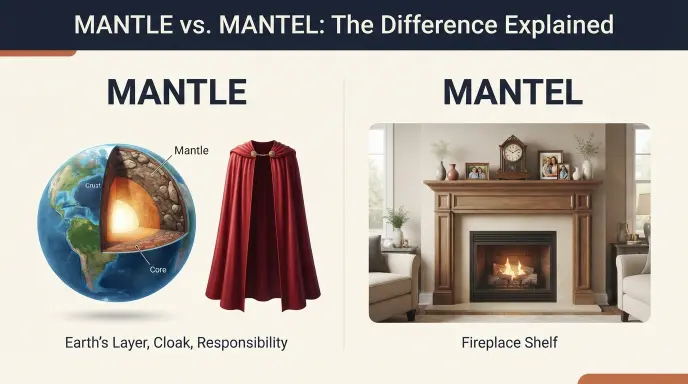
The main difference comes down to meaning and context. Mantel usually refers to the shelf or decorative structure above a fireplace, often used to display photographs, clocks, and ornaments. In contrast, mantle has several meanings, including a cloak, a covering, the Earth’s layer beneath its crust, or a role and responsibility someone takes on. Although the words are pronounced alike, they are not interchangeable in most situations.
In this guide, we will explore the definitions, spelling rules, practical examples, and common mistakes associated with mantle or mantel. By examining how these words appear in everyday conversations, academic writing, and home design, you will learn how to choose the correct spelling with confidence. This straightforward, example-based explanation will help you remember the difference and improve your English vocabulary for clearer, more accurate writing.
Mantle vs Mantel: What’s the Difference?
The words mantle and mantel are homophones, meaning they sound alike but have different spellings and meanings. However, their correct uses become easy to understand once you identify what each word describes.
Mantle is a noun that refers to a cloak, covering, geological layer, or position of responsibility. It can also describe the role someone accepts, such as the mantle of leadership.
Mantel is a noun that refers to the shelf above a fireplace or the decorative framework surrounding it. In home design, it often holds photographs, ornaments, clocks, or seasonal decorations.
Comparison Table
| Feature | Mantle | Mantel |
|---|---|---|
| Part of speech | Noun | Noun |
| Primary meaning | Covering, layer, or responsibility | Fireplace shelf or framework |
| Common context | Geology, literature, leadership | Architecture, interior design |
| Example | She accepted the mantle of leadership. | A clock rested on the mantel. |
| Memory trick | Think of a cloak or a calling | Think of a fireplace shelf |
Quick recap:
Mantle describes a covering, an important role, or a layer of material.
Mantel refers specifically to the shelf or framework around a fireplace.
Therefore, when discussing Earth’s interior, leadership, or a symbolic burden, choose mantle. Conversely, when describing fireplace furniture, use mantel.
Is Mantle vs Mantel a Grammar, Vocabulary, or Usage Issue?
The distinction is primarily a vocabulary and spelling issue, rather than a grammatical one. Both words are nouns, and both can function correctly in a sentence when used according to their meanings.
Are Mantle and Mantel Interchangeable?
No. Although their pronunciation is similar, their definitions differ. Replacing one with the other can change the meaning of a sentence or create an obvious spelling error.
For example, consider these sentences:
- Correct: The scientist explained the composition of Earth’s mantle.
- Incorrect: The scientist explained the composition of Earth’s mantel.
In the first sentence, the word refers to a geological layer. Consequently, the alternative spelling doesn’t communicate the intended scientific meaning.
Formal vs Informal Usage
Both terms are appropriate in formal and informal writing. However, mantle appears frequently in scientific, literary, historical, and political discussions, while mantel is more common in descriptions of homes and architectural features.
Academic vs Casual Writing
In academic writing, mantle can describe Earth’s internal structure or a symbolic responsibility assumed by a historical figure. Meanwhile, a home improvement assignment might use mantel when discussing fireplace measurements, materials, or decoration.
In casual conversation, the same distinction applies. The setting changes, but the meanings remain consistent.
Usage recap: Neither spelling is more correct in every situation. Instead, select the word that accurately expresses the intended meaning.
How to Use Mantle Correctly
The word mantle has several established meanings. Therefore, understanding its context helps you use it accurately in different types of writing.
Meaning 1: A Covering or Cloak
Historically, a mantle was a loose, sleeveless cloak worn over clothing. In literature, it may describe a garment associated with royalty, dignity, or ceremony.
Example: The king wore a magnificent mantle during the coronation.
Similarly, the term can describe something that covers or conceals another object.
Example: A mantle of snow covered the mountain slopes.
Meaning 2: A Position of Responsibility
In figurative language, a mantle represents a duty, role, or responsibility that someone accepts. This usage frequently appears in discussions of leadership, family traditions, and public service.
Example: After the founder retired, his daughter assumed the mantle of leadership.
Likewise, a young athlete might carry the mantle of a celebrated predecessor when continuing that person’s legacy.
Meaning 3: Earth’s Geological Layer
In geology, the mantle is the thick layer of mostly solid rock located between Earth’s crust and outer core. Although its material is predominantly solid, parts of it can deform and flow extremely slowly over geological timescales.
Example: Scientists study the Earth’s mantle to understand how heat moves inside the planet.
This scientific meaning is especially important because mantel would be incorrect in this context.
Workplace Example
A manager might write:
“Following the director’s departure, Maria assumed the mantle of team leadership.”
Here, the word describes the responsibility Maria accepted, rather than a physical object.
Academic Example
A geology student could write:
“The Earth’s mantle plays a major role in internal heat transfer and the movement of tectonic plates.”
In this case, the term identifies a geological layer.
Technology Example
A technology journalist might describe a software developer who assumes the mantle of maintaining a widely used application after its original creator retires.
The expression remains figurative. It communicates responsibility for continuing an existing project rather than identifying a physical covering.
Usage recap: Use mantle for a cloak, covering, geological layer, or symbolic position of responsibility.
How to Use Mantel Correctly
The word mantel has a narrower meaning than its counterpart. It usually identifies the shelf above a fireplace or the surrounding architectural framework.
Meaning 1: The Shelf Above a Fireplace
A mantel often provides a surface for displaying decorations, framed photographs, candles, or small ornaments.
Example: Two family photographs stood on the wooden mantel.
Because the shelf is part of the fireplace area, this is the standard spelling for the object.
Meaning 2: The Decorative Fireplace Framework
In some contexts, mantel refers to the ornamental structure surrounding the fireplace opening. Depending on the design, this feature may include side supports, a top shelf, and decorative detailing.
Example: The renovation included a marble mantel with carved edges.
Therefore, the word can describe more than the shelf alone, depending on the architectural context.
Workplace Example
An interior designer might write:
“The client requested a white oak mantel to complement the living room’s traditional furniture.”
Here, mantel identifies a physical design element that can be measured, manufactured, and installed.
Academic Example
A student studying architectural history might write:
“The carved stone mantel reflects the decorative style popular during the period.”
The term is appropriate because the sentence concerns a physical feature of a building.
Technology Example
A home renovation application might include a field labeled “Mantel Width” when calculating the dimensions of a fireplace installation.
Similarly, a digital interior design tool may let users select a mantel material, color, or finish.
Usage recap: Use mantel when discussing the shelf or architectural framework associated with a fireplace.
When You Should NOT Use Mantle or Mantel
Even experienced writers can confuse these spellings, particularly when working quickly. Nevertheless, several simple checks can prevent the most common errors.
1. Do not use mantel for Earth’s interior. Geological discussions require mantle because the term identifies a planetary layer.
2. Do not use mantle for a fireplace shelf. When describing the shelf above a fireplace, choose mantel.
3. Do not use mantel for a leadership role. Expressions such as “assuming the mantle of leadership” describe responsibility, not furniture.
4. Do not use mantle automatically for every covering. Although the word can describe a cloak or covering, another term may be more precise when discussing a specific garment, coating, or protective layer.
5. Do not replace mantel with mantle in home improvement instructions. Incorrect spelling can create confusion in product descriptions, measurements, and construction notes.
6. Do not assume the longer word is more formal. Both spellings are standard English words, so formality alone cannot determine the correct choice.
7. Do not rely exclusively on pronunciation. Since the words sound alike, listening carefully will not resolve the spelling question. Instead, examine the intended meaning.
Mantle vs Mantel: Common Mistakes and Decision Rules
The following examples show how a single spelling change can affect clarity.
| Correct sentence | Incorrect sentence | Explanation |
|---|---|---|
| Earth’s mantle contains hot rock. | Earth’s mantel contains hot rock. | The geological layer is called the mantle. |
| She accepted the mantle of leadership. | She accepted the mantel of leadership. | Leadership is a figurative responsibility. |
| The clock sits on the mantel. | The clock sits on the mantle. | A fireplace shelf is a mantel. |
| Snow formed a white mantle over the hills. | Snow formed a white mantel over the hills. | The covering is described metaphorically. |
| They replaced the old fireplace mantel. | They replaced the old fireplace mantle. | The sentence identifies an architectural feature. |
| The author explored the mantle of kingship. | The author explored the mantel of kingship. | The word represents a role or burden. |
A Simple Decision Rule
Choose the spelling by meaning
Use mantle when you mean a cloak, a covering, Earth’s geological layer, or an assumed duty or position.
Use mantel when you mean the shelf or decorative framework around a fireplace.
Remember: This distinction is about meaning, not whether a word describes an action or a person. Both terms are nouns.
For an additional memory aid, associate mantel with a mantelpiece in a living room. Meanwhile, associate mantle with mountains, the Earth’s interior, and the transfer of responsibility.
Mantle and Mantel in Modern Technology and Digital Tools
Although these words originated long before modern computing, they remain relevant in digital communication.
For example, geological software and educational applications use mantle when labeling Earth’s internal layers. Similarly, online science lessons may use the term when explaining convection, temperature, and tectonic activity.
In contrast, architecture software, home renovation platforms, and online furniture catalogs use mantel to identify fireplace components. A product listing might specify the mantel’s dimensions, finish, material, and installation requirements.
Spelling and grammar assistants can sometimes flag an incorrect word when surrounding context makes the intended meaning clear. However, because both spellings are legitimate English words, a basic spellchecker might not recognize the mistake.
Therefore, writers should verify the meaning rather than relying entirely on automatic corrections. Context remains the most reliable guide.
Mantle vs Mantel: Etymology and Word Origins
Understanding the history of these words provides another way to remember their differences.
The word mantle entered English through Old French mantel, which came from Latin mantellum, meaning a cloak or covering. Over time, its meaning expanded beyond clothing to include figurative responsibilities and geological terminology.
The spelling mantel became associated specifically with the architectural feature above or around a fireplace. Although the two words share historical roots, modern English assigns them different meanings.
Consequently, their similar appearance and pronunciation are understandable. Nevertheless, their current spellings serve distinct purposes.
An Expert Style Explanation
As a practical language principle:
“Accurate word choice depends on meaning and context, not pronunciation alone.”
This principle applies to many English words that sound alike but perform different roles in communication. By identifying the object, concept, or responsibility being described, writers can choose the appropriate spelling confidently.
Two Practical Case Studies: Mantle vs Mantel
The following hypothetical examples illustrate how the distinction works in everyday writing. The results are illustrative rather than claims about documented individuals or measured research outcomes.
Case Study 1: A Student Writing a Science Assignment
A student preparing a geology report writes:
“The Earth’s mantel lies between the crust and the outer core.”
Although the intended meaning is understandable, the spelling is incorrect for a scientific assignment.
The student checks a geology textbook and changes mantel to mantle. The revised sentence now uses the standard scientific term.
Result: The correction removes a terminology error and makes the sentence suitable for an academic report.
The lesson is straightforward: when describing planetary structure, use mantle, regardless of how the word sounds.
Case Study 2: A Homeowner Ordering a Fireplace Shelf
A homeowner contacts a carpenter and requests a custom “stone mantle” for a living room fireplace.
The carpenter understands the request, but the written specification uses the wrong spelling for the intended architectural feature.
The homeowner revises the order to request a “stone mantel” and includes the shelf’s width, depth, and finish.
Result: The updated specification uses the conventional term and communicates the product requirement more precisely.
This example also demonstrates why spelling matters in practical situations. Although context may prevent serious misunderstanding, correct terminology makes instructions clearer and more professional.
Mantle vs Mantel: Error Prevention Checklist
Before submitting an assignment, publishing an article, or sending a design specification, review the following checklist.
Always Use Mantle When
- Describing Earth’s internal geological layer.
- Referring to a cloak or figurative covering.
- Discussing the mantle of leadership, authority, or responsibility.
- Describing a symbolic burden or inherited role.
- Writing about a covering that metaphorically spreads across a landscape.
Never Use Mantel When
- Naming the geological layer beneath Earth’s crust.
- Describing an individual’s responsibility or leadership position.
- Referring to a cloak, covering, or symbolic role.
- Explaining a scientific process involving Earth’s internal structure.
However, remember that mantel is perfectly correct when discussing a fireplace shelf or its decorative framework. The purpose of this checklist is to identify the intended meaning, not to label either spelling as universally wrong.
Related Grammar Confusions You Should Master
Once you understand the distinction between similar sounding words, you can apply the same method to other common English confusions.
- Affect vs Effect: Understand the difference between influencing something and the result of an action.
- Accept vs Except: Distinguish receiving something from excluding something.
- Principal vs Principle: Separate a person or primary element from a fundamental rule.
- Compliment vs Complement: Identify praise versus something that completes or improves another thing.
- Stationary vs Stationery: Distinguish remaining still from writing materials.
- Their vs There: Learn the difference between possession and a reference to a place.
- Its vs It’s: Separate possessive usage from the contraction of “it is” or “it has.”
- Weather vs Whether: Distinguish atmospheric conditions from a choice or possibility.
- Elicit vs Illicit: Separate drawing out a response from describing something unlawful.
- Canvas vs Canvass: Distinguish a strong fabric from the act of soliciting opinions, votes, or support.
Likewise, the best way to master these pairs is to learn each word’s meaning, examine example sentences, and practice using it in context.
Frequently Asked Questions
1. What is the difference between mantle and mantel?
A mantle is a cloak, covering, geological layer, or figurative responsibility. By contrast, a mantel is the shelf or decorative framework associated with a fireplace. Although the words sound alike, their meanings and spellings differ.
2. Is it mantel or mantle above a fireplace?
The correct spelling is mantel when referring to the shelf above a fireplace or its decorative framework. For example, “A family photograph stood on the mantel” uses the standard spelling.
3. Is Earth’s mantle spelled with an E or an A?
Earth’s geological layer is spelled mantle, with the letter E at the end. It lies between the crust and the outer core and plays an important role in the planet’s internal heat transfer.
4. What does assuming the mantle mean?
Assuming the mantle means accepting a position, duty, or responsibility. For instance, a new director might assume the mantle of leadership after the previous director retires.
5. Are mantle and mantel pronounced the same?
Yes. In standard English, mantle and mantel are generally pronounced alike. Because pronunciation cannot reliably distinguish them, writers should select the spelling according to context.
6. Is a mantel the same as a mantelpiece?
The terms overlap, although usage can vary. Mantel commonly refers to the fireplace shelf or surrounding structure, while mantelpiece often refers to the shelf or the decorative feature as a whole.
7. Can mantle be used as a verb?
In established English, mantle can function as a verb meaning to cover or become covered, often in literary or descriptive writing. For example, “Mist mantled the valley at dawn.” In contrast, mantel is generally used as a noun.
8. What is a mantle in geology?
In geology, the mantle is the thick layer of mostly solid rock between Earth’s crust and outer core. Heat and extremely slow movement within this layer contribute to processes that shape the planet over long periods.
9. Why do mantle and mantel have different spellings?
Both words share historical roots associated with a cloak or covering. However, their meanings developed along different paths in English. Today, mantle has broader figurative and scientific meanings, whereas mantel identifies a fireplace feature.
Conclusion:
Understanding mantle vs mantel becomes much easier when you focus on what each word describes. Although both words sound alike, they serve different purposes in written English.
Use mantle when referring to a cloak, a geological layer, a covering, or an important responsibility. Meanwhile, choose mantel when discussing a fireplace shelf or its surrounding decorative structure.
For everyday writing, academic assignments, and professional communication, the most reliable strategy is to check the intended meaning before choosing the spelling. Once you connect mantle with coverings and responsibilities and mantel with fireplaces, you’ll be far less likely to confuse them.
Ultimately, context determines the correct word. Learn the distinction, remember the examples, and apply the same approach whenever two English words look or sound similar.









