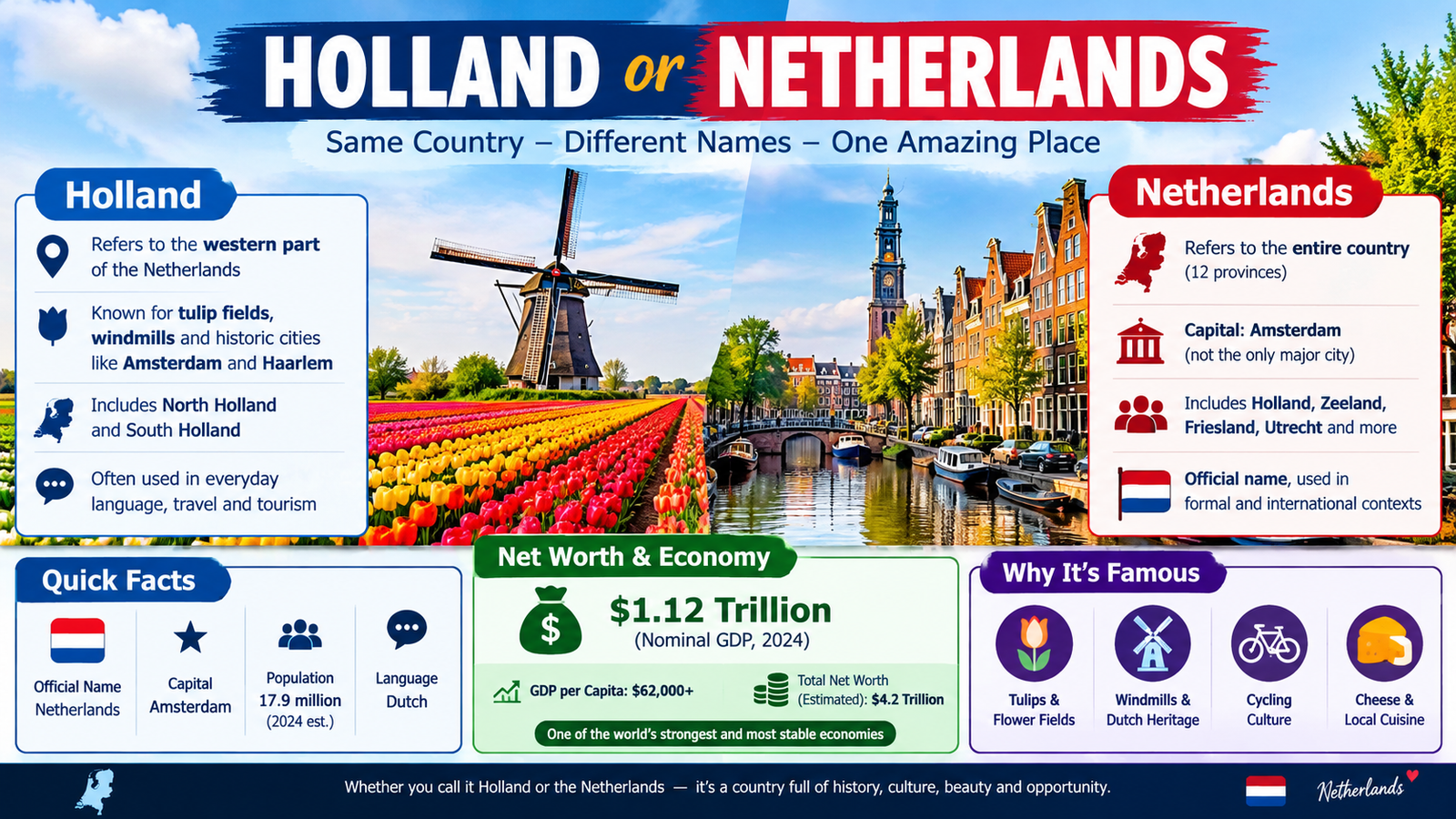
Have you ever wondered whether Holland and the Netherlands are the same place? You may have heard people use both names when talking about Dutch culture, Amsterdam, tulip fields, and beautiful European canals. However, there is an important geographical difference between these two terms. Although many people use them interchangeably, Holland is not the official name of the entire country. Understanding this distinction can help you avoid common mistakes when writing, traveling, studying geography, or discussing European destinations. So, which name is actually correct, and why do people around the world continue to call the country Holland?
The Netherlands is the official name of the country, located in northwestern Europe. Holland refers specifically to two provinces: North Holland and South Holland. These provinces include well-known cities such as Amsterdam, Rotterdam, and The Hague. Historically, the Holland region played a major role in Dutch trade, culture, and international influence, which helps explain why its name became widely recognized around the world. Over time, the popular use of Holland expanded beyond its geographical boundaries, creating confusion among international audiences.
In this guide, we will explain the difference between Holland and the Netherlands in simple, accurate, and easy-to-understand language. You will discover their geographical meanings, historical background, cultural connections, and correct usage in everyday English. We will also clarify whether Holland is a country, why tourists often use the wrong name, and which term is best for travel articles, educational writing, and professional communication. By the end, you will understand both names clearly and know exactly when to use each one.
Holland vs Netherlands: What’s the Difference?
Although Holland and the Netherlands are closely connected, they don’t describe exactly the same place. To understand the distinction, it helps to examine their geographical meanings, grammatical roles, and everyday usage.
The Netherlands is a proper noun that identifies an entire sovereign country. It includes twelve provinces, such as North Holland, South Holland, Utrecht, Friesland, and Gelderland.
Holland is a proper noun referring to a historical region that now consists of two provinces: North Holland and South Holland. These provinces contain major cities, including Amsterdam, Rotterdam, and The Hague.
Consequently, calling the entire country Holland is common in conversation, but it isn’t geographically precise.
| Feature | Holland | Netherlands |
|---|---|---|
| Meaning | A historical region comprising two provinces | An entire country |
| Geographical status | Region within a country | Sovereign country |
| Administrative divisions | North Holland and South Holland | Twelve provinces |
| Capital city | No separate national capital | Amsterdam |
| Seat of government | The Hague is located in South Holland | The Hague |
| Official country name | Not the country’s official name | The Netherlands |
| Common adjective | Hollandic in historical contexts; Dutch in everyday national contexts | Dutch |
| International use | Informal shorthand for the country | Standard country name |
Quick recap
The Netherlands is the country, while Holland is part of it.
North Holland and South Holland are two of the country’s twelve provinces.
Amsterdam is the capital of the Netherlands and is located in North Holland.
Rotterdam and The Hague are both located in South Holland.
Therefore, when you mean the entire country, the Netherlands is the clearest and most accurate choice.
Is Holland vs Netherlands a Grammar, Vocabulary, or Usage Issue?
The difference between Holland and the Netherlands is primarily a geographical and vocabulary issue, rather than a grammar problem. Both names are valid English expressions; however, each has a different meaning.
Are Holland and the Netherlands interchangeable?
In casual conversation, people often use Holland to mean the Netherlands. For instance, a tourist might say, “I’m visiting Holland this summer,” even when the trip includes several regions across the country.
Nevertheless, the terms aren’t strictly interchangeable. If you’re discussing a particular province, Holland may be appropriate. Conversely, if you’re describing the entire nation, the Netherlands is the more precise expression.
Formal versus informal usage
In formal writing, official documents, international reporting, and geographical research, use the Netherlands when referring to the country. This choice avoids ambiguity and demonstrates geographical accuracy.
In informal conversation, sports discussions, and tourism, Holland remains widely understood. However, understanding its narrower meaning is still important, especially when communicating with people who live elsewhere in the country.
Academic versus casual usage
For school assignments, university essays, examinations, and research papers, the Netherlands is generally the preferred term when discussing national history, population, government, or geography.
By contrast, in casual conversations, either expression may be understood. Even so, choosing the correct geographical name helps readers distinguish a particular region from the entire country.
When to Use the Netherlands Correctly
The Netherlands is the appropriate choice whenever your sentence refers to the whole country, its government, its national population, or its international identity.
Workplace example
Suppose a company is expanding its operations into Europe. In a business report, the following sentence communicates the intended meaning clearly:
Correct: “Our company plans to open a new office in the Netherlands next year.”
This statement refers to the country as a whole. Consequently, it remains appropriate regardless of whether the office eventually opens in Amsterdam, Rotterdam, or another city.
Academic example
Similarly, a geography student might write:
Correct: “The Netherlands is known for its water management systems, extensive cycling infrastructure, and low lying landscape.”
This sentence describes national characteristics rather than the customs or geography of only two provinces. Therefore, the country’s full name is the better choice.
Technology example
Likewise, a software developer might configure an application’s country selection or shipping destination.
Correct: “Select the Netherlands from the country list to calculate the correct delivery options.”
In this context, the application needs to identify a country, not a historical region. As a result, the Netherlands provides the correct geographical classification.
Usage recap: Use the Netherlands for national statistics, international trade, travel documentation, country selection menus, academic research, and general descriptions of the nation.
When to Use Holland Correctly
Holland is appropriate when you’re specifically discussing North Holland, South Holland, or the historical region associated with those provinces. Additionally, the name appears frequently in tourism, cultural references, and traditional expressions.
Workplace example
Imagine that a business is researching commercial property in Rotterdam.
Correct: “Our team is examining commercial property opportunities in South Holland.”
This statement identifies the province where Rotterdam is located. Therefore, South Holland is more geographically specific than the Netherlands.
However, if the research covers offices throughout the country, the Netherlands would be the more suitable term.
Academic example
A history student might discuss the economic influence of Holland during the Dutch Golden Age.
Correct: “Holland played a major role in the maritime trade networks of the Dutch Golden Age.”
Here, Holland refers to a historical region whose political and economic influence was particularly significant. Nevertheless, the student should clarify the historical context because the region’s influence does not mean it represented every part of the modern country.
Technology example
A travel website might offer accommodation searches by province.
Correct: “Choose North Holland to explore hotels near Amsterdam and other nearby destinations.”
Because the search targets a particular province, Holland is appropriate within the provincial name.
Usage recap: Use Holland when the intended meaning is the historical region, North Holland, or South Holland. For the entire country, choose the Netherlands instead.
Holland or Netherlands: When You Should NOT Use Either Name Incorrectly
Although both names are widely recognized, several situations call for greater geographical precision. In particular, the following mistakes can affect academic accuracy, travel planning, and professional communication.
1. When naming the entire country in an official report: Avoid using Holland as though it were the country’s formal name. Instead, write the Netherlands.
2. When identifying a specific province: Don’t use the Netherlands if the sentence specifically concerns North Holland or South Holland. Name the relevant province instead.
3. When describing all twelve provinces: Avoid suggesting that every province belongs to Holland. Only North Holland and South Holland carry that name.
4. When writing international business documents: Don’t substitute Holland for the Netherlands in formal country identification fields. Use the recognized country name requested by the document.
5. When discussing national population statistics: Avoid attributing a country’s entire population to Holland. Instead, use the Netherlands unless the data specifically concerns the two Holland provinces.
6. When explaining Dutch national identity: Don’t assume that every Dutch person comes from Holland. Dutch is the adjective and demonym commonly associated with the country and its people.
7. When comparing regional economies: Avoid treating Holland and the Netherlands as equivalent statistical areas. Check whether the data covers two provinces or the whole country.
8. When describing historical events: Don’t automatically replace historical references to Holland with the Netherlands. Depending on the period, the political and geographical meanings may differ.
Ultimately, the correct term depends on the place you’re describing. Therefore, identify whether your subject is a province, a historical region, or the entire country before choosing a name.
Holland vs Netherlands: Common Mistakes and Correct Usage
Even experienced English speakers sometimes confuse these geographical names because international media and everyday conversations frequently use Holland as shorthand for the Netherlands. However, a few simple corrections make the distinction easier to remember.
| Correct sentence | Incorrect sentence | Explanation |
|---|---|---|
| The Netherlands is a country in Europe. | Holland is the official name of the country. | The Netherlands is the country’s conventional official English name. |
| Amsterdam is in North Holland. | Amsterdam is in South Holland. | Amsterdam is located in North Holland. |
| Rotterdam is in South Holland. | Rotterdam is in North Holland. | Rotterdam is located in South Holland. |
| The Netherlands has twelve provinces. | Holland has twelve provinces. | Holland consists of two provinces, not twelve. |
| Dutch is the national adjective commonly used for the Netherlands. | Hollandish is the standard adjective for all Dutch people. | Dutch is the normal English adjective and demonym. |
| The Netherlands participates in international organizations as a country. | Holland is the sovereign country represented internationally. | The country, not the Holland region, holds sovereign state status. |
The decision rule
Choose the Netherlands
When discussing the entire country, national government, population, economy, or international relations.
Choose Holland
When referring specifically to the historical region, North Holland, or South Holland.
Choose Dutch
When describing the language, nationality, people, or something associated with the country, as in Dutch culture or Dutch cheese.
As a result, you can resolve most Holland versus Netherlands questions by identifying the exact geographical meaning before writing your sentence.
Holland and the Netherlands in Modern Technology and Digital Tools
Modern applications frequently distinguish countries, regions, and cities to ensure that information is stored and displayed correctly. Therefore, understanding these geographical labels is useful beyond ordinary writing.
For example, international shopping platforms usually identify the Netherlands as the destination country. Meanwhile, a regional delivery service might use North Holland or South Holland to calculate delivery zones.
Similarly, digital maps distinguish the country from its constituent provinces. When users search for Amsterdam, they find a city in North Holland, whereas a search for Rotterdam identifies a city in South Holland.
Language processing and translation software can also encounter the two names in different contexts. For instance, a translation system may interpret Holland as a casual reference to the country when translating an informal conversation. However, a geographical database should preserve the distinction between the region and the nation.
Consequently, context matters more than popularity. A familiar expression may work in everyday conversation, yet a structured database, formal report, or location selection tool benefits from the precise geographical name.
The Etymology of Holland and the Netherlands
Understanding the origins of these names helps explain why they have different meanings today.
Where does the name Holland come from?
The name Holland is commonly traced to a historical regional name associated with land described as wooded or forested. Over time, the name became associated with an influential region in the western part of the Low Countries.
During the Dutch Golden Age, Holland gained considerable economic, maritime, and political influence. Consequently, its name became familiar to international traders and visitors, which helped explain why outsiders increasingly used Holland to refer to the wider country.
Nevertheless, historical prominence didn’t make Holland the geographical name for every province.
Where does the name Netherlands come from?
The name Netherlands derives from expressions meaning low lands. This description reflects the country’s low lying geography, including extensive areas protected from the sea and rivers by dikes and other water management systems.
The English name is conventionally written as the Netherlands, with the definite article included. Meanwhile, Dutch speakers call the country Nederland.
In modern usage, the Netherlands identifies the country, while Holland retains its more specific regional meaning.
An Expert Style Rule for Remembering the Difference
A useful geographical rule is:
“Use the name of the whole country for national matters, and use the regional name when the location is limited to that region.”
This principle reflects a broader rule of accurate communication: geographical names should match the actual place being described.
For example, if a news report discusses national elections, the Netherlands is appropriate. Conversely, if a local planning document concerns a municipality within North Holland, the regional name provides more useful information.
Likewise, when teaching geography, explaining this distinction helps students avoid confusing political boundaries with historical identities.
Two Practical Case Studies: Holland or Netherlands?
The following illustrative scenarios show how choosing the correct name can improve clarity. They are examples of common communication problems rather than documented real world incidents.
Case Study 1: An international company preparing a market report
Imagine a company preparing a report on European expansion. Its initial draft repeatedly refers to Holland when discussing the country’s national economy, business regulations, and population.
Although readers may understand the intended meaning, the terminology creates unnecessary ambiguity because the report covers all twelve provinces.
The editorial team replaces Holland with the Netherlands wherever the full country is intended. It retains North Holland and South Holland for province specific statistics.
Result: The revised report clearly separates national information from regional data, making comparisons easier to interpret and reducing the risk of geographical misclassification.
Case Study 2: A student writing a geography assignment
Consider a student who writes that the Netherlands contains two provinces: North Holland and South Holland.
The statement incorrectly describes the administrative structure because the country has twelve provinces altogether.
After reviewing the geographical distinction, the student changes the explanation to say that Holland refers to two provinces within the Netherlands. The assignment then lists the Netherlands as the country and identifies Holland as a region.
Result: The corrected explanation accurately represents the country’s administrative divisions and demonstrates a clearer understanding of European geography.
Both scenarios illustrate the same lesson: using precise geographical terminology improves clarity, whether you’re writing a business report, completing schoolwork, or communicating with an international audience.
Holland or Netherlands: Error Prevention Checklist
Before publishing a document or completing an assignment, use the following checklist to confirm that each name is appropriate.
Always use the Netherlands when:
- Referring to the entire country.
- Describing national government, laws, or international relations.
- Reporting countrywide population or economic statistics.
- Identifying the destination country on travel or shipping forms.
- Explaining national history or geography in a general context.
Avoid using Holland when:
- You mean all twelve provinces rather than two.
- You need the country’s formal name in an official document.
- You’re describing a city or province outside Holland.
- You want to describe the nationality of all people from the country.
- You need to distinguish regional statistics from national statistics.
Use Holland when:
- Referring specifically to North Holland or South Holland.
- Discussing the historical region and its influence.
- Quoting a historical source that uses Holland in a particular context.
- Describing a cultural or tourism expression where Holland is intentionally used.
Ultimately, a quick geographical check can prevent most mistakes. If your sentence concerns the whole nation, choose the Netherlands; if it concerns the two provinces, Holland may be correct.
Related Grammar and Vocabulary Confusions You Should Master
Similarly, several other English language distinctions can cause confusion in everyday writing. Learning them can improve geographical accuracy, vocabulary, and sentence clarity.
- England vs United Kingdom: England is one country within the United Kingdom, whereas the United Kingdom includes four constituent countries.
- Great Britain vs United Kingdom: Great Britain is the island containing England, Scotland, and Wales; the United Kingdom also includes Northern Ireland.
- Holland vs Dutch: Holland is a geographical region, whereas Dutch describes the language, people, and things associated with the Netherlands.
- Country vs nation: These terms often overlap, although country emphasizes territory and political organization while nation can emphasize a shared identity.
- City vs province: A city is an urban settlement, whereas a province is a larger administrative division.
- Nationality vs ethnicity: Nationality generally relates to legal membership of a country, while ethnicity concerns shared cultural or ancestral identity.
- Official name vs common name: An official name is formally recognized, whereas a common name may be used more casually.
- Capital vs seat of government: A capital is a country’s designated capital city, while the seat of government identifies where its governing institutions operate.
- Region vs country: A region may form part of a country or extend across several countries, whereas a sovereign country has its own statehood.
- Dutch vs Danish: Dutch relates to the Netherlands, while Danish relates to Denmark. Despite the similar spellings, they refer to different languages and national identities.
Consequently, mastering these distinctions helps prevent geographical errors and makes formal writing more precise.
Frequently Asked Questions
1. Is Holland the same as the Netherlands?
No. The Netherlands is a country in northwestern Europe, whereas Holland refers to North Holland and South Holland, two of its twelve provinces. Although the names are often used interchangeably in casual conversation, they have different geographical meanings.
2. Why is the Netherlands sometimes called Holland?
The name became widely associated with the country because Holland was historically an influential region in international trade, maritime activity, and politics. As a result, foreign visitors and traders often used Holland as shorthand for the wider country.
3. Is Amsterdam in Holland or the Netherlands?
Amsterdam is in both geographical senses, because it is located in North Holland, which is a province within the Netherlands. Therefore, the Netherlands identifies the country, while North Holland identifies Amsterdam’s province.
4. Is Holland a country or a province?
Holland is neither a sovereign country nor a single modern province. Instead, it is a historical region comprising two provinces: North Holland and South Holland. Both belong to the Netherlands.
5. Should I write Holland or the Netherlands in formal writing?
In formal writing, use the Netherlands when referring to the entire country. However, use Holland when the subject specifically concerns the historical region or either of its two provinces. This distinction is particularly important in academic and professional documents.
6. What is the difference between Dutch and Holland?
Dutch is the adjective and demonym commonly associated with the Netherlands, and it is also the name of the country’s principal language. Holland, by contrast, is a geographical region within the Netherlands. Therefore, Dutch culture is a standard expression, while Holland describes a place.
7. Does the Netherlands have twelve provinces?
Yes. The Netherlands has twelve provinces, including North Holland and South Holland. The other ten are Zeeland, Utrecht, Gelderland, Overijssel, Flevoland, Friesland, Groningen, Drenthe, Limburg, and North Brabant.
8. Is Holland the official name of the Netherlands?
No. The country’s conventional official English name is the Netherlands. Holland is a regional name that people frequently use informally when referring to the country as a whole.
9. Why do sports teams sometimes use Holland instead of the Netherlands?
Sports teams and international media have historically used Holland as a familiar shorthand for the country. However, the Netherlands is the more geographically precise name. Usage can vary by organization, event, and historical context.
Conclusion:
When deciding between Holland or Netherlands, the most important consideration is geographical accuracy. The Netherlands is the country, while Holland refers to the two provinces of North Holland and South Holland. Although Holland remains familiar in everyday conversation, the two names don’t have identical meanings.
For example, use the Netherlands when discussing national government, international travel, business, or countrywide statistics. Conversely, choose Holland when referring specifically to its historical region or either of its two provinces.
Ultimately, remembering this simple distinction will help you write more accurately, avoid common geographical mistakes, and communicate confidently in academic, professional, and everyday situations.
Final Verdict
The Netherlands is the correct choice when you mean the entire country. Holland is appropriate when you mean North Holland, South Holland, or the historical region they form together. Meanwhile, Dutch is the standard word for the language, nationality, and associated culture.









