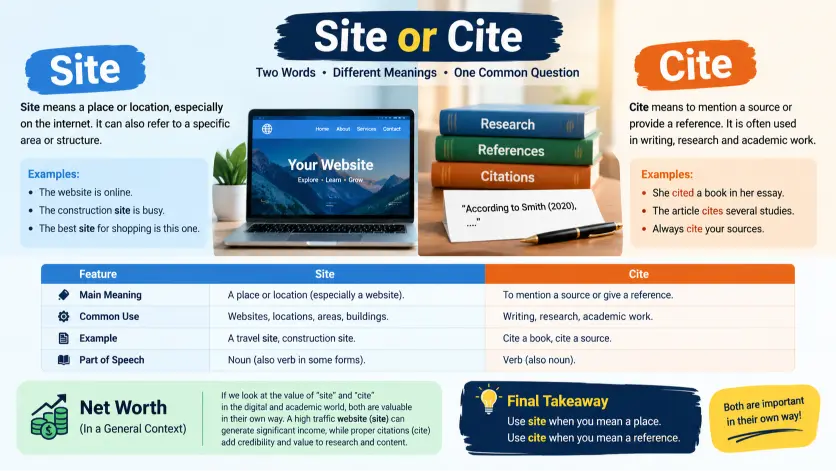
Have you ever wondered whether to write “site” or “cite” in an email, school assignment, blog post, or professional document? These two words sound exactly alike, but their meanings and uses are completely different. Choosing the wrong word can make your writing confusing and reduce its clarity. The good news is that understanding the difference is easier than you might think.
A site is a place or location, such as a website, construction site, or historical site. In contrast, cite means to mention or refer to a source, usually to support information, provide evidence, or acknowledge someone else’s work. For example, you visit a website, but you cite a source in an academic paper.
In this guide, we will explain the meanings of site and cite, compare their grammatical uses, and provide simple sentence examples. You will also learn common mistakes to avoid and practical tricks to remember the correct word. By the end, you will be able to use both words confidently in everyday and professional writing.
Site or Cite: What’s the Difference?
The main difference between site and cite is their meaning and function in a sentence. Although both words are pronounced the same way, they aren’t interchangeable. Therefore, choosing the correct spelling matters in academic writing, workplace communication, website management, and everyday English.
Site is primarily a noun that describes a location, place, or website. For example, a construction company might select a new site for a building project. Similarly, a reader might visit a news site to find current information.
Cite, on the other hand, is a verb that means to quote, mention, or provide evidence from a source. For instance, a student may cite a research paper to support an argument. Likewise, a lawyer may cite a legal case to explain a decision.
| Feature | Site | Cite |
|---|---|---|
| Part of speech | Primarily a noun | Primarily a verb |
| Main meaning | A location or website | To reference or mention a source |
| Pronunciation | /saɪt/ | /saɪt/ |
| Example | We visited the construction site. | Please cite your sources. |
| Common context | Buildings, locations, websites | Research, law, journalism |
| Related word | Siting | Citation |
Quick recap
Site identifies a place or online destination.
Cite describes the act of acknowledging a source.
Both words sound identical, but their spellings and meanings are different.
Consequently, the surrounding sentence determines which word belongs in your writing.
Is Site or Cite a Grammar, Vocabulary, or Usage Issue?
Understanding site or cite involves vocabulary, grammar, and practical usage. Although both words share the same pronunciation, they perform different functions and communicate different ideas.
Are site and cite interchangeable?
No. These words aren’t interchangeable because each expresses a separate meaning. Using one in place of the other can make a sentence confusing or incorrect.
For example:
Correct: The company selected a new site for its office.
Incorrect: The company selected a new cite for its office.
The incorrect sentence uses a word associated with referencing information rather than identifying a location. Therefore, site is the appropriate choice.
Formal versus informal usage
Both terms are acceptable in formal and informal English. However, their contexts differ according to the intended message.
For example, someone might casually say, “I found the site yesterday.” In an academic discussion, another person might write, “The researcher cited three previous studies.”
Neither word is inherently more formal than the other. Instead, accuracy depends on meaning.
Academic versus casual writing
Academic writing frequently uses cite when discussing sources, evidence, quotations, and research findings. Meanwhile, site commonly appears when describing study locations, archaeological discoveries, research facilities, or websites.
In casual conversation, people might discuss a favorite shopping site or ask someone to cite an example. Nevertheless, the same distinction applies in every setting.
Usage recap
Remember that grammar determines how a word functions, while vocabulary establishes what it means. Because site and cite have different meanings, selecting the correct spelling is primarily a vocabulary decision supported by grammatical context.
How to Use Site Correctly
The word site generally functions as a noun. It identifies a place where something exists, happens, or is developed. In modern communication, it also commonly refers to a website.
Workplace example
Consider a property development company planning a new residential project.
Correct sentence: “The manager inspected the construction site before approving the project.”
Here, site identifies the physical location where construction will take place.
Similarly, an employee might write, “Please send the delivery team to the new warehouse site.” The word identifies the destination rather than an information source.
Academic example
Researchers frequently use site when describing the location of an investigation.
For example, “The research team collected soil samples from three different sites.”
In this sentence, the term refers to physical locations where researchers gathered evidence.
Likewise, a historian might describe an archaeological site where ancient objects were discovered. Therefore, the word is useful when discussing places connected with research or historical events.
Technology example
In digital communication, site often means a website or online platform.
For instance, “The university launched a new site for its online courses.”
Similarly, a business owner might say, “Our site allows customers to place orders at any time.”
In both examples, the word identifies an online destination that users can visit.
When site is appropriate
Use site when describing a location, property, construction area, research setting, or website. Additionally, consider whether the sentence answers the question, “Where?” If it does, site may be the correct choice.
Usage recap: A building site is a place, and a website is an online destination. In either case, site identifies where something is located or accessed.
How to Use Cite Correctly
The word cite is a verb that means to mention, quote, or acknowledge a source. It is especially common when writers support claims with evidence or identify information obtained from another person or publication.
Workplace example
Imagine an employee preparing a report about customer satisfaction.
Correct sentence: “Please cite the survey results that support your recommendation.”
Here, cite means to identify the evidence used to support the recommendation.
Similarly, a manager might ask a colleague to cite the relevant company policy when explaining a workplace decision. The purpose is to establish where the information originated.
Academic example
Students, researchers, and teachers regularly use cite when discussing published information.
For example, “You must cite every source used in your research paper.”
This sentence instructs the writer to acknowledge the material consulted during research.
Likewise, a student might write, “The author cited two earlier studies to support the conclusion.” In this case, cited is the past tense of cite.
Technology example
Digital writing tools often help users organize references and prepare bibliographies.
For instance, “The writing application reminds students to cite their sources.”
Similarly, a researcher might use reference management software to organize publications before citing them in a report.
However, a citation tool doesn’t guarantee that every reference is accurate. Therefore, users should verify publication details and ensure that cited material genuinely supports their claims.
When cite is appropriate
Choose cite when the sentence involves referencing a source, quoting evidence, mentioning a legal authority, or acknowledging another person’s work.
Usage recap: Use cite when you need to answer the question, “Which source supports this statement?” The noun citation refers to the reference itself.
When You Should NOT Use Site or Cite
Although these words sound alike, several common situations reveal why choosing the correct spelling matters.
1. When identifying a physical location
Don’t use cite to describe a place where construction, research, or another activity occurs.
Incorrect: The engineers inspected the building cite.
Correct: The engineers inspected the building site.
The sentence describes a physical location, so site is necessary.
2. When acknowledging a research source
Don’t use site when instructing someone to reference a book, article, or study.
Incorrect: Remember to site your sources.
Correct: Remember to cite your sources.
The intended action is acknowledging sources, not identifying locations.
3. When describing a website
Avoid using cite to identify an online destination simply because the sentence mentions the internet.
Incorrect: I discovered an interesting educational cite.
Correct: I discovered an interesting educational site.
The correct word identifies the website itself.
4. When supporting an argument
Don’t substitute site for cite when providing evidence.
Incorrect: The author sited several scientific studies.
Correct: The author cited several scientific studies.
The second sentence explains that the author referenced existing research.
5. When describing a citation
Neither word should replace the noun citation when the sentence refers to the reference itself.
Incorrect: The paper includes three cites in its bibliography.
Better: The paper includes three citations in its bibliography.
Although cite is a verb, citation is the standard noun for a formal reference.
6. When writing legal documents
Legal writing often uses cite to identify statutes, court decisions, and legal authorities.
Incorrect: The attorney included the relevant court site in the argument.
Correct: The attorney cited the relevant court decision in the argument.
However, site remains appropriate when the attorney genuinely means a physical location or website.
7. When discussing research locations
Don’t automatically use cite just because the sentence concerns research.
Incorrect: The scientists returned to the original cite to collect samples.
Correct: The scientists returned to the original site to collect samples.
Research can involve both places and references, so context determines the appropriate term.
8. When editing similar sounding words
Don’t assume that identical pronunciation means identical meaning.
For example, site, cite, and sight sound alike in standard English. Nevertheless, sight refers to vision or something seen, while the other terms refer to a location and the act of referencing a source.
Common Mistakes and Decision Rules
Writers sometimes confuse site and cite because English contains many homophones. However, a simple review of the intended meaning usually resolves the problem.
| Correct sentence | Incorrect sentence | Explanation |
|---|---|---|
| We visited the building site. | We visited the building cite. | A physical location is a site. |
| Please cite the textbook. | Please site the textbook. | Referencing a source requires cite. |
| The company launched a new site. | The company launched a new cite. | An online destination is a site. |
| The author cited several studies. | The author sited several studies. | The author referenced the studies. |
| Workers returned to the site. | Workers returned to the cite. | The sentence identifies a place. |
| The lawyer cited a statute. | The lawyer sited a statute. | Legal references are cited. |
| The student provided a citation. | The student provided a siteation. | Citation is the correct noun. |
Decision rule
If you mean a place or website, use site. If you mean the action of referencing a source, use cite.
You can also test the sentence by replacing the word with a simple definition.
If “location” or “website” preserves the meaning, choose site. Conversely, if “reference” or “quote a source” fits, choose cite.
For example, “We visited the new location” makes sense, so site is appropriate in “We visited the new site.”
Likewise, “Please reference the original study” preserves the meaning of “Please cite the original study.” Therefore, cite is correct.
Site or Cite in Modern Technology
Modern digital platforms use both terms frequently, particularly in website development, online publishing, research, and information management.
A content management system allows a business to create and maintain a website. Consequently, developers might discuss a site’s design, navigation, performance, and accessibility.
Meanwhile, research platforms and writing applications help users identify and organize sources. Writers may cite online articles, scientific papers, public reports, and other materials when preparing their work.
Automated writing assistants can also suggest references or format citations. Nevertheless, generated references may contain incorrect details or point to sources that don’t support the associated claims. Therefore, writers should verify every citation against the original publication.
Similarly, a website’s presence on a search engine doesn’t establish that its content is reliable. Readers should evaluate authorship, evidence, publication dates, and supporting documentation before accepting important claims.
Ultimately, site describes a destination, while cite describes an action involving a source. That distinction remains consistent across modern technology.
Etymology of Site and Cite
The history of these words helps explain why their spellings differ despite their identical pronunciation.
Site entered English through French, ultimately tracing back to the Latin situs, meaning position, situation, or location. Over time, the term developed its familiar meaning of a place where something stands, happens, or is established.
Cite comes through French from the Latin citare, meaning to summon, call upon, or bring forward. Its modern meaning includes referring to an authority, quotation, or source as supporting evidence.
Although the words developed from different historical roots, their modern pronunciations converged. As a result, they became homophones: words that sound alike but have different meanings and spellings.
Their shared pronunciation explains the confusion, but their distinct histories reinforce the difference between identifying a location and referring to a source.
An Expert Style Explanation
A useful principle for learning English vocabulary is to connect each word with its function rather than relying exclusively on pronunciation.
“Choose a word according to the meaning your sentence needs, not simply the sound you hear.”
This is a teaching principle rather than a quotation attributed to a named linguist. It emphasizes the practical skill that prevents confusion between homophones.
For example, a writer discussing an online publication should consider whether the sentence identifies the publication itself or refers to information obtained from it. The first meaning calls for site, while the second may require cite.
Likewise, a careful editor considers the sentence’s purpose before correcting its spelling. As a result, the final wording communicates the intended message more precisely.
Two Practical Case Studies
The following hypothetical examples demonstrate how the distinction works in real situations.
Case study 1: A university research paper
A university student prepares a paper about water pollution. During the writing process, the student visits a riverbank to collect observations and reviews several published environmental studies.
Initially, the student writes, “The researcher visited the cite and sited three studies.”
However, the sentence contains two spelling errors because it confuses the location with the act of referencing sources.
The corrected version is: “The researcher visited the site and cited three studies.”
The revision makes both actions clear. The student visited a location and referenced published research.
Result: The sentence becomes grammatically appropriate and communicates the research process accurately. The improvement is qualitative rather than a measured academic outcome.
Case study 2: A company’s website report
A marketing employee prepares a monthly report about an online store. The report describes the company’s website and discusses customer reviews used to support recommendations.
The original draft states, “The company improved its cite and sited customer feedback.”
Although the intended message is understandable, both word choices are incorrect.
The revised sentence reads, “The company improved its site and cited customer feedback.”
Now, the first word refers to the online store, while the second explains how the employee acknowledged supporting information.
Result: The revision distinguishes the company’s digital destination from the evidence used in the report. As in the first example, the result is an illustrative improvement in clarity, not a measured business performance gain.
Error Prevention Checklist
Before submitting an essay, report, email, or website page, review the following checklist.
Always use site when
- You describe a physical location.
- You identify a construction or archaeological area.
- You refer to a website or online destination.
- You explain where an activity takes place.
- You discuss the location of a facility or research project.
Never use cite when
- You mean a physical location rather than a reference.
- You are identifying a website instead of acknowledging its content.
- You need a noun meaning a formal reference and should use citation.
- The sentence describes visiting a place rather than quoting a source.
Always use cite when
- You acknowledge a book, article, report, or study.
- You refer to a legal authority.
- You support an argument with published evidence.
- You mention another person’s work in academic writing.
Finally, read the sentence aloud and replace the disputed word with its intended meaning. If the sentence remains clear, your choice is likely correct. However, always check the surrounding context before making the final decision.
Related Grammar Confusions You Should Master
Learning other commonly confused words can strengthen your writing and improve vocabulary accuracy.
1. Site vs sight: A site is a location, whereas sight relates to vision or something seen.
2. Cite vs sight: Cite means to reference a source, while sight refers to seeing.
3. Their vs there: Their indicates possession, while there identifies a place or introduces certain expressions.
4. Your vs you’re: Your shows ownership, whereas you’re means you are.
5. Its vs it’s: Its indicates possession, while it’s commonly means it is or it has.
6. Affect vs effect: Affect is usually a verb meaning to influence, while effect is usually a noun meaning a result.
7. Then vs than: Then relates to time or sequence, while than introduces comparisons.
8. Principal vs principle: Principal can mean a leader or something most important, whereas principle means a fundamental rule or belief.
9. Compliment vs complement: A compliment expresses praise, while a complement completes or enhances something.
10. Advice vs advise: Advice is a noun meaning a recommendation, while advise is a verb meaning to recommend.
By learning the meanings and grammatical functions of these pairs, you can avoid errors that frequently appear in professional emails, academic assignments, and everyday communication.
Frequently Asked Questions
1. What is the difference between site and cite?
Site refers to a location or website, whereas cite means to reference, quote, or acknowledge a source. Although both words sound identical, their meanings and grammatical functions differ. Therefore, use site for places and online destinations and cite when referring to supporting information.
2. Is it site or cite your sources?
The correct expression is “cite your sources.” The verb cite means to acknowledge the books, articles, studies, or other materials used to support your work. By contrast, site refers to a place or website, so it doesn’t express the intended meaning.
3. How do you use site in a sentence?
You can use site to identify a physical location or online destination. For example, “The engineers inspected the construction site before beginning work.” Alternatively, “The company launched a new website for its customers” uses the related idea of an online destination.
4. How do you use cite in a sentence?
Use cite when referencing information from a source. For example, “The student cited three research papers in the final assignment.” Here, the verb indicates that the student acknowledged the publications used to support the discussion.
5. Are site and cite homophones?
Yes. In standard English pronunciation, site and cite sound the same but have different spellings and meanings. Such words are called homophones. Their identical pronunciation explains why writers sometimes confuse them, especially when typing quickly.
6. What is the noun form of cite?
The most common noun form associated with cite is citation. It refers to a reference that identifies a source or acknowledges supporting material. For example, “The research paper includes a citation for each major source.”
7. Is a website called a site or a cite?
A website is called a site. The word identifies an online destination containing pages, information, products, or services. For example, “I found the information on an educational site” uses the correct spelling.
8. Can cite mean to mention a law?
Yes. In legal writing, cite can mean to refer to a law, statute, court decision, or other legal authority. For example, “The attorney cited a relevant court ruling to support the argument.” In this context, the word identifies the act of referring to legal authority.
9. What is the difference between site, cite, and sight?
These three words sound alike but communicate different ideas. Site means a location or website, cite means to reference a source, and sight relates to vision or something seen. For example, you can visit a site, cite a book, or enjoy the sight of a mountain.
Conclusion:
The difference between site or cite becomes straightforward once you understand the purpose of each word. A site is a physical location or an online destination, while cite means to acknowledge, quote, or reference a source.
Therefore, use site when discussing websites, buildings, research locations, or other places. Conversely, choose cite when supporting an argument, acknowledging published research, or referring to legal authority.
Although the two words share the same pronunciation, they cannot replace one another without changing the meaning of a sentence. By checking whether you mean a place or the act of referencing a source, you can choose the correct spelling confidently in academic, professional, and everyday writing.









