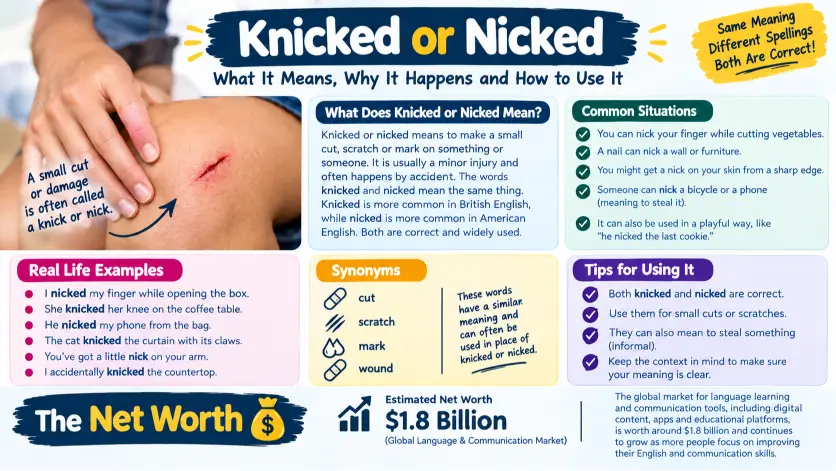
Have you ever typed “knicked” or “nicked” and stopped to wonder which spelling is actually correct? You are not alone. These two forms look almost identical, but choosing the wrong one can make your writing appear careless or confusing. The good news is that understanding the difference is much easier once you know how the word is formed and where it is commonly used.
In standard English, “nicked” is the established spelling in common uses, while “knicked” is generally considered a misspelling when you mean the past tense of nick. The word nick can have several meanings, including making a small cut or notch, stealing something informally, or arresting someone in British English. Context therefore matters when deciding exactly what “nicked” means.
This guide explains knicked or nicked in simple language, including the correct spelling, meanings, pronunciation, example sentences, common mistakes, and practical usage. Whether you are writing an email, school assignment, social media post, or professional content, you will learn how to confidently choose the right form and avoid this common spelling confusion.
Knicked or Nicked: What’s the Difference?
First, nicked is the correct standard spelling in ordinary English. It comes from the verb nick, which has several meanings depending on context.
For example, someone can nick an object by cutting or scratching it slightly. Someone can also nick something by stealing it, particularly in informal British English. In another context, a person might be nicked by the police, meaning arrested.
By contrast, knicked is generally not the standard spelling for these meanings. Although English contains many words beginning with kn, such as knee, knife, and knock, that spelling pattern does not apply to nick.
| Term | Part of speech | Standard spelling | Common meaning | Example |
|---|---|---|---|---|
| Nicked | Verb or adjective | Yes | Stolen, cut, scratched, chipped, or arrested | Someone nicked my phone. |
| Knicked | Usually intended as a verb | No | Usually a misspelling of nicked | Knicked my phone is incorrect. |
Therefore, the practical distinction is simple.
Nicked is the accepted spelling.
Knicked is usually an error.
Moreover, the meaning of nicked changes according to the surrounding sentence. It can describe theft, a small cut, a minor surface mark, or an arrest. Thus, context determines the exact interpretation.
For instance, The table was nicked suggests a small mark or chip. Meanwhile, Someone nicked my wallet means someone stole it. Similarly, He got nicked last night can mean he was arrested in informal British usage.
Is Knicked or Nicked a Grammar, Vocabulary, or Usage Issue?
Primarily, knicked or nicked is a spelling and vocabulary usage issue rather than a complicated grammar problem.
Both forms may appear to represent the same pronunciation, yet standard English recognizes nicked as the correct form. Therefore, replacing the initial n with kn changes the spelling incorrectly.
Furthermore, nicked can appear in several grammatical roles. As a verb, it can describe an action.
Someone nicked my headphones.
Here, nicked is the past tense of nick.
However, it can also describe a condition or result.
The screen is slightly nicked.
In this sentence, nicked describes the screen’s condition.
The word is especially common in informal British English when referring to theft or arrest. Nevertheless, American readers may understand those meanings from context even though they may use other expressions more frequently.
In academic writing, nicked should be used only when the intended meaning genuinely requires it. For example, a scientific or technical report might describe a surface as nicked if it has a small cut or indentation. Meanwhile, informal theft related meanings are usually inappropriate in formal academic prose.
Consequently, the issue isn’t whether the two spellings are interchangeable. They aren’t. The important point is recognizing the standard form and selecting it according to context.
How to Use Nicked Correctly
The spelling nicked is appropriate when you are using the past tense or past participle of nick.
One common meaning is to steal something.
Someone nicked my umbrella from the office.
Here, the speaker means that someone took the umbrella without permission.
Another meaning involves making a small cut or mark.
The carpenter nicked the wooden surface while trimming the edge.
In this example, the object wasn’t necessarily ruined. Instead, it received a small unintended mark.
Additionally, nicked can describe something with a minor chip or scratch.
The corner of the desk is nicked.
In British informal speech, nicked can also mean arrested.
The suspect was nicked by the police.
However, that expression is informal, so a formal report would normally say arrested instead.
Workplace example
The delivery box was nicked during handling.
Here, the word indicates that the box received a small mark or cut.
Alternatively:
Someone nicked the company tablet.
This sentence uses the informal theft meaning. In a formal workplace report, however, stolen would usually be clearer.
Academic example
The sample container was nicked along the outer edge.
This usage is suitable when describing physical damage precisely.
Nevertheless, an academic writer should avoid using nicked as a casual synonym for stolen. A research paper would generally use removed without authorization, taken, or stolen, depending on the circumstances.
Technology example
The phone case was nicked near the charging port.
Here, nicked means slightly cut, scratched, or damaged.
However, if someone took the phone, the sentence changes:
Someone nicked my phone at the station.
Thus, the surrounding words determine whether nicked describes damage or theft.
Usage recap: Use nicked when you mean a small cut or mark, informal theft, or informal arrest. Above all, remember that the spelling remains nicked, regardless of which meaning you intend.
How Knicked Is Usually Used
Because knicked is generally a misspelling, it doesn’t have a separate standard meaning that competes with nicked.
For example, this sentence is incorrect:
Someone knicked my wallet.
The intended word is nicked:
Someone nicked my wallet.
Similarly, this sentence should be corrected:
The table was knicked near the corner.
The standard version is:
The table was nicked near the corner.
Therefore, if you see knicked in a message, comment, draft, or informal post, the writer probably intended nicked.
There can be unusual situations where a nonstandard spelling appears as a personal name, brand, fictional term, or deliberate stylistic choice. Nevertheless, those special cases don’t make knicked the standard spelling of the English verb nick.
Workplace example
Incorrect:
The equipment was knicked during transportation.
Correct:
The equipment was nicked during transportation.
However, if the intended meaning is theft, stolen may be clearer in a formal report.
Academic example
Incorrect:
The surface became knicked during preparation.
Correct:
The surface became nicked during preparation.
Alternatively, a more precise technical description might be slightly scratched or chipped, depending on the physical condition.
Technology example
Incorrect:
My laptop was knicked near the edge.
Correct:
My laptop was nicked near the edge.
Thus, the problem isn’t grammar alone. Rather, the initial k has been added where standard spelling does not require it.
Usage recap: Don’t select knicked simply because English has many familiar kn spellings. Instead, use nicked for the standard form of nick.
When You Should Not Use Knicked or Nicked
Although nicked is correct, there are situations where another word communicates your meaning more accurately.
1. When you mean formally stolen
Instead of saying:
The company laptop was nicked.
A formal report would usually be clearer with:
The company laptop was stolen.
The word nicked is informal in this sense.
2. When you mean seriously damaged
If an object has major damage, nicked may minimize the problem.
For example:
The vehicle was seriously damaged.
is more appropriate than describing major structural damage as nicked.
3. When you mean arrested in formal writing
Although British informal speech can use nicked for arrested, formal writing should normally use arrested.
4. When you mean scratched extensively
A tiny mark can be called a nick. However, numerous deep scratches require more precise language.
5. When you are writing for beginners
If your audience may not understand informal British expressions, stolen or arrested can prevent confusion.
6. When the object has a large chip
A substantial piece missing from a surface may be better described as chipped, broken, or damaged.
7. When you are writing a formal complaint
A complaint should communicate the exact issue rather than relying on casual vocabulary.
8. When you are unsure about the intended meaning
If the context is unclear, choose a more precise term. Consequently, stolen, scratched, chipped, or arrested may be better depending on what happened.
Common Mistakes With Knicked and Nicked
| Correct sentence | Incorrect sentence | Explanation |
|---|---|---|
| Someone nicked my bag. | Someone knicked my bag. | Nicked is the standard spelling. |
| The table was nicked. | The table was knicked. | The small mark is described with nicked. |
| He was nicked by police. | He was knicked by police. | Informal arrest meaning still uses nicked. |
| My phone case is nicked. | My phone case is knicked. | The standard spelling has no k after the initial consonant. |
| Someone nicked the bicycle. | Someone knicked the bicycle. | The theft meaning requires nicked. |
| The edge was nicked during cutting. | The edge was knicked during cutting. | The damage meaning uses nicked. |
Decision Rule Box
If you mean a small cut, mark, theft, or informal arrest, use “nicked.”
If you mean the standard English form of the verb “nick,” use “nicked.”
Do not use “knicked” as the normal spelling.
Therefore, when choosing between the two, nicked is the dependable answer.
Knicked or Nicked in Modern Technology
Modern writing tools frequently encounter nicked because the word appears in several different contexts. For example, a sentence about a damaged screen requires a different interpretation from a sentence about a stolen phone.
Consequently, context matters more than the spelling alone.
A proofreading system may identify knicked as a spelling error, particularly when the surrounding sentence clearly uses the verb nick. However, automated correction should still be checked against the intended meaning because English words can carry several meanings.
For example:
The screen was nicked.
means the screen has a small mark or cut.
Meanwhile:
Someone nicked the screen.
could mean someone stole it, although the context might sound unusual.
Therefore, accurate editing requires attention to the entire sentence rather than simply replacing unfamiliar spellings.
The Etymology of Nicked
The verb nick has a long history in English and developed several related meanings.
Historically, nick has been associated with making a small cut, notch, or mark. From that physical idea, the word developed broader meanings connected with taking something quickly or secretly.
Over time, informal British usage also developed the expression nick for arresting someone. The exact historical development of every sense is complex, yet the modern spelling remains consistent.
Importantly, the presence of words such as knife and knock can create a false spelling association. Those words preserve an older kn pattern, whereas nick does not belong to that spelling group.
As a result, the correct past form is nicked, not knicked.
“When spelling feels familiar because of a similar looking word, context and established usage should still guide the final choice.”
Two Practical Case Studies
Case Study 1: Workplace Property
Suppose an employee writes:
My laptop was knicked from the meeting room.
At first glance, the intended meaning is understandable. Nevertheless, the spelling is incorrect. The corrected sentence is:
My laptop was nicked from the meeting room.
However, if this sentence appears in a formal incident report, an even stronger version would be:
My laptop was stolen from the meeting room.
Consequently, nicked solves the spelling problem, while stolen improves formality.
Case Study 2: Product Damage
Imagine a customer reports:
The wooden cabinet arrived knicked on one corner.
Again, the spelling should be corrected:
The wooden cabinet arrived nicked on one corner.
Nevertheless, a customer service representative might choose chipped or scratched if those words describe the damage more precisely.
Therefore, good writing requires two decisions: first, select the correct spelling; second, select the most accurate word for the situation.
Error Prevention Checklist
Use this checklist whenever you’re deciding between the two forms.
Always use Nicked when
The intended verb is nick.
You mean a small cut or mark.
You mean something was taken informally.
You are using the informal British expression for arrest.
You are writing the past tense of nick.
Never use Knicked when
You mean stolen.
You mean scratched or chipped.
You mean arrested.
You are writing the standard English form of nick.
You are preparing academic or professional content.
You want standard dictionary spelling.
Related Grammar Confusions You Should Master
Once you’ve understood knicked or nicked, several other spelling and usage pairs become easier to recognize. In particular, these common comparisons deserve attention:
- Nickel or nickle
- Fought or faught
- Focused or focussed
- Lense or lens
- Program or programme
- Apologize or apologise
- Favor or favour
- Planned or planed
- Shiny or shiney
- Affect or effect
These pairs demonstrate an important principle: familiar pronunciation doesn’t always reveal the correct written form. Therefore, checking the word’s function, meaning, spelling pattern, and regional usage can prevent avoidable errors.
Frequently Asked Questions
Is nicked the correct spelling?
Yes. Nicked is the standard spelling of the past tense and past participle of nick. Therefore, it is the correct choice when describing something stolen, slightly cut, marked, or informally referring to an arrest.
Is knicked a real word?
Generally, knicked is not the standard spelling of the verb nick. In ordinary English writing, it should be replaced with nicked. However, an unusual spelling could appear as a proper name or deliberate stylistic creation.
Does nicked mean stolen?
Yes, in informal usage, particularly British English, nicked can mean stolen. For example, Someone nicked my phone means someone stole the phone. In formal writing, however, stolen is usually clearer.
Does nicked mean scratched?
Yes. Nicked can describe something that has a small cut, scratch, chip, or indentation. For instance, The table was nicked along the edge indicates minor surface damage.
Is nicked British English?
The word nicked is widely understood in English, but some of its informal meanings are especially associated with British usage. In particular, British informal speech can use nicked to mean stolen or arrested.
Can nicked mean arrested?
Yes. In informal British English, nicked can mean arrested. For example, He was nicked by the police means he was arrested. However, arrested is preferable in formal communication.
Why do people spell nicked as knicked?
The error probably feels natural because English contains several familiar words beginning with kn, including knee, knife, and knock. Nevertheless, nick follows a different spelling pattern, so its past form is nicked.
Should I use nicked in formal writing?
That depends on the meaning. If you are describing a small physical mark, nicked can be perfectly suitable. However, when you mean stolen or arrested, more formal alternatives such as stolen or arrested are generally preferable.
What is the easiest way to remember nicked?
Remember that the base word is nick, not knick. Once you add the past tense ending, you get nicked. Therefore, there is no extra k.
Final Answer:
When deciding between knicked or nicked, choose nicked in standard English. It is the correct past form of nick and can describe a small cut or mark, informal theft, or an informal arrest depending on context.
Meanwhile, knicked is normally a spelling mistake rather than an alternative standard form. Therefore, if you’re writing an email, assignment, report, article, product description, or everyday message, nicked is the safe and accepted choice.
Ultimately, the spelling is simple: nick + ed = nicked. However, the best word still depends on your audience. In formal situations, consider whether stolen, scratched, chipped, or arrested communicates the intended meaning more precisely.
The short answer is clear: Nicked is correct. Knicked is usually incorrect.









