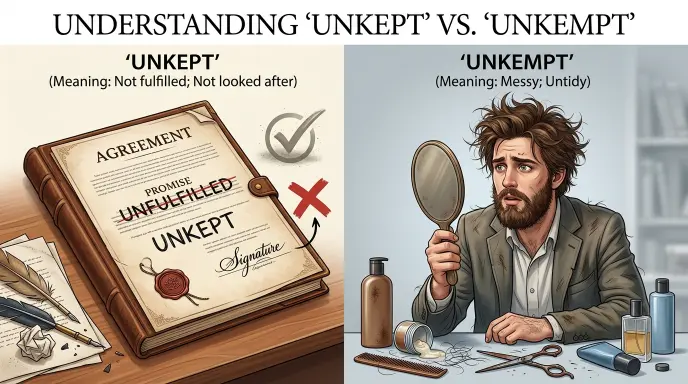
Have you ever written “unkept” when you meant to describe someone’s messy appearance or a neglected place? You are not alone. Unkept and unkempt look similar, but they are not always interchangeable, which makes this spelling question surprisingly confusing. Knowing the difference can help you write more naturally and avoid common English mistakes.
In standard English, unkempt is the usual word for something that looks untidy, messy, or poorly cared for, especially hair, clothing, or personal appearance. For example, you might describe someone as having unkempt hair. Unkept, meanwhile, is generally associated with something that has not been kept, maintained, or fulfilled, such as an unkept promise.
This guide explains unkept vs unkempt in simple language, including their meanings, correct usage, examples, grammar, and common mistakes. By the end, you will know exactly which word to choose and why.
X vs Y: What’s the Difference?
To begin with, unkept and unkempt are both adjectives, but they developed around different meanings.
Unkept means not kept, maintained, observed, or fulfilled. It commonly appears with nouns such as promise, agreement, commitment, secret, garden, or property. The exact meaning depends on the noun it modifies.
Unkempt, on the other hand, means untidy, disorderly, neglected, or poorly groomed. It most frequently refers to someone’s hair, clothing, appearance, beard, or general personal presentation. It can also describe an area that looks neglected.
| Word | Part of speech | Main meaning | Common examples | Typical context |
|---|---|---|---|---|
| Unkept | Adjective | Not maintained, honored, preserved, or fulfilled | unkept promise, unkept garden | Commitments, maintenance, conditions |
| Unkempt | Adjective | Untidy, messy, or poorly groomed | unkempt hair, unkempt appearance | Appearance and neglected surroundings |
Mini Recap
Unkept focuses on something that wasn’t kept or fulfilled.
Unkempt focuses mainly on untidiness or poor grooming.
An unkept promise wasn’t honored.
An unkempt appearance looks messy or neglected.
Consequently, the surrounding noun usually gives you a strong clue about which spelling belongs in the sentence.
Is Unkept vs Unkempt a Grammar, Vocabulary, or Usage Issue?
Primarily, this is a vocabulary and usage issue, rather than a basic grammar problem. Both words can function correctly as adjectives, yet they cannot normally be substituted for one another without changing the meaning.
For instance, consider the sentence, “She made an unkept promise.” The intended idea is that she failed to honor her promise. Replacing unkept with unkempt would produce a strange sentence because promises aren’t normally described as messy or poorly groomed.
Conversely, “He had unkempt hair” is perfectly natural because hair can look untidy. Saying “He had unkept hair” would usually sound unusual because the intended meaning is probably messy or neglected hair.
Are They Interchangeable?
No. Although the spellings are visually similar, their meanings differ.
Formal vs Casual Usage
Both words are suitable for formal writing when used correctly. Unkept is especially useful in discussions involving commitments, standards, maintenance, or obligations. Unkempt is appropriate when describing appearance, grooming, or neglected surroundings.
Academic vs Casual Usage
In academic writing, precision matters. Therefore, a student should use unkept for an unfulfilled commitment and unkempt for a disorderly appearance. In casual conversation, speakers may occasionally confuse them, but standard written English still benefits from the distinction.
How to Use Unkept Correctly
The adjective unkept comes from the verb keep and generally communicates the idea that something wasn’t kept in the expected condition or wasn’t honored as required.
For example, “The manager apologized for the unkept agreement.” Here, the agreement wasn’t respected or fulfilled. Likewise, “He regretted his unkept promise” means he regretted failing to honor what he had promised.
Workplace Example
A manager might write:
“The company addressed several unkept commitments made during the previous meeting.”
Here, unkept refers to commitments that weren’t fulfilled.
Academic Example
A researcher could write:
“The study discusses the consequences of unkept promises between public institutions and communities.”
In this context, the adjective relates to commitments that weren’t honored.
Technology Example
A technology team might document:
“The application contained several unkept configuration requirements.”
Here, the word suggests that expected requirements weren’t maintained or followed.
Usage Recap
Use unkept when something was supposed to be kept, honored, maintained, or fulfilled but wasn’t. Therefore, common combinations include unkept promise, unkept commitment, unkept agreement, and similar expressions.
How to Use Unkempt Correctly
The word unkempt describes something that appears untidy, disordered, neglected, or insufficiently groomed. Most often, it describes people and their physical appearance.
For example, “His unkempt hair made him look tired.” Here, the adjective clearly refers to hair that isn’t neatly arranged.
Furthermore, unkempt can describe more than personal appearance. It may also refer to neglected gardens, lawns, rooms, or other physical spaces. For instance, “The house had an unkempt garden” suggests that the garden hadn’t been properly cared for.
Workplace Example
A workplace description might say:
“His unkempt appearance seemed inappropriate for the formal client meeting.”
Here, the adjective concerns grooming and presentation.
Academic Example
A literature student might write:
“The novel presents the character with an unkempt beard and disordered clothing.”
Consequently, the word provides a visual description of the character.
Technology Example
A digital interface cannot normally be called unkempt in the same way a person can. Nevertheless, a programmer might use the term creatively when describing poorly organized visual elements or neglected digital content. In conventional technical writing, words such as disorganized, cluttered, or poorly maintained are often more precise.
Usage Recap
Use unkempt when something looks messy, untidy, neglected, or poorly groomed. Therefore, common expressions include unkempt hair, unkempt beard, unkempt appearance, and unkempt garden.
When You Should NOT Use Unkept or Unkempt
Understanding incorrect contexts is just as valuable as memorizing definitions. Therefore, consider these common misuse situations.
1. Don’t use unkempt for a broken promise
Incorrect:
“She made an unkempt promise.”
Better:
“She made an unkept promise.”
The issue concerns fulfillment, not appearance.
2. Don’t use unkept for messy hair
Incorrect:
“He has unkept hair.”
Better:
“He has unkempt hair.”
The intended meaning concerns grooming.
3. Don’t use unkempt for an unpaid obligation
Incorrect:
“The borrower left the loan unkempt.”
Better wording would depend on the intended meaning, such as unpaid, unfulfilled, or overdue.
4. Don’t assume unkept always means messy
Although something unmaintained can sometimes be described using related ideas, unkept doesn’t automatically mean visually untidy.
5. Don’t use unkempt for a promise
A promise can’t normally be groomed or physically arranged. Therefore, unkept promise is the established expression.
6. Don’t use unkept when discussing personal grooming
When hair, clothing, facial hair, or general presentation looks neglected, unkempt is normally the appropriate choice.
7. Don’t treat the spellings as stylistic alternatives
These aren’t two accepted spellings of one word. Instead, they are separate words with different meanings.
8. Don’t choose based only on pronunciation
Because the words can sound somewhat similar in casual speech, pronunciation isn’t a reliable decision method. Instead, identify the intended meaning first.
Common Mistakes: Unkept or Unkempt
The following examples show how a small spelling difference can create a major meaning problem.
| Correct sentence | Incorrect sentence | Explanation |
|---|---|---|
| She apologized for her unkept promise. | She apologized for her unkempt promise. | The promise wasn’t honored, so unkept is appropriate. |
| His hair looked unkempt. | His hair looked unkept. | The sentence concerns messy grooming. |
| The garden had become unkempt. | The garden had become unkept. | The intended meaning is visibly neglected. |
| They discussed several unkept commitments. | They discussed several unkempt commitments. | Commitments can be unfulfilled, not groomed. |
| He arrived with an unkempt beard. | He arrived with an unkept beard. | The beard looked messy or poorly maintained. |
| The organization addressed its unkept obligations. | The organization addressed its unkempt obligations. | Obligations are fulfilled or neglected, rather than groomed. |
Decision Rule for Choosing the Correct Word
If you mean something that was not kept, honored, maintained, or fulfilled, use “unkept.” If you mean a person, appearance, hair, beard, garden, or similar thing that looks messy or neglected, use “unkempt.”
The simplest memory trick is to connect unkept with keep and unkempt with messy appearance.
However, one requested rule sometimes causes confusion: “If you mean the action, use X; if you mean the person or tool, use Y.” That rule doesn’t accurately apply to this pair because neither term is primarily a noun for a person or tool. Instead, meaning should guide the choice.
Unkept and Unkempt in Modern Technology and Automated Tools
Modern writing platforms, spellcheckers, grammar applications, and language tools can recognize many spelling differences. Nevertheless, contextual mistakes can still occur when two legitimate words look similar.
For example, a spelling checker may recognize both unkept and unkempt as valid words. However, recognizing that both are real words doesn’t automatically determine whether the chosen term fits the sentence.
Consequently, human understanding of context remains important. A sentence containing “promise” strongly points toward unkept, while one containing “hair” strongly points toward unkempt.
Similarly, automated writing systems can sometimes select a semantically related term that sounds plausible but isn’t the best choice. Therefore, writers should always check the relationship between the adjective and the noun it modifies.
Etymology: Where Do Unkept and Unkempt Come From?
The history of unkept is comparatively straightforward. It combines the negative prefix un with kept, the past participle of keep. Therefore, its basic sense developed around something not being kept, maintained, or fulfilled.
By contrast, unkempt has a more distinctive history. The word is connected with the older verb kemp, meaning to comb or arrange hair. Over time, unkempt developed the sense of hair or appearance that hasn’t been properly arranged.
Therefore, the two spellings aren’t simply accidental variations. Their histories help explain why their meanings remain different today.
An Expert Style Explanation
“The safest way to distinguish these adjectives is to identify what has failed to be kept: a commitment points toward unkept, while an untidy appearance points toward unkempt.”
This distinction reflects ordinary modern usage and provides a practical method for choosing between the two.
Two Practical Case Studies
Case Study 1: The Broken Commitment
Imagine a project manager who promises to deliver a report on Friday but doesn’t submit it. On Monday, the team discusses the situation.
A natural description would be:
“The manager failed to honor an unkept commitment.”
Here, unkept communicates failure to fulfill an obligation. Using unkempt would be inappropriate because the issue has nothing to do with appearance.
Case Study 2: The Neglected Appearance
Now imagine an employee arriving at an important presentation with messy hair, an untidy beard, and wrinkled clothing.
A suitable description would be:
“He arrived with an unkempt appearance.”
Here, unkempt accurately communicates poor grooming and disorder. Using unkept would obscure the intended meaning.
Consequently, these examples demonstrate why context is more important than visual similarity.
Error Prevention Checklist
Before publishing or submitting a sentence, check the noun that follows the adjective.
Always use unkept when:
You are describing a promise that wasn’t honored.
You are discussing a commitment that wasn’t fulfilled.
You mean something wasn’t maintained or observed as expected.
You are describing an obligation that wasn’t properly fulfilled.
You are referring to something that should have been kept but wasn’t.
Never use unkempt when:
You mean a promise wasn’t honored.
You mean an agreement wasn’t fulfilled.
You mean a commitment was ignored.
You mean an obligation wasn’t satisfied.
Instead, reserve unkempt primarily for messy appearance, grooming, or neglected physical surroundings.
Related Grammar Confusions You Should Master
Once you understand unkept or unkempt, several other commonly confused terms become easier to recognize.
Affect vs Effect
These words often differ according to grammatical role and meaning.
Advice vs Advise
One is normally a noun, while the other is a verb.
Compliment vs Complement
A compliment expresses praise, whereas a complement completes or enhances something.
Principal vs Principle
One commonly refers to a person or primary element, while the other concerns a rule or belief.
Stationary vs Stationery
The first relates to remaining still, while the second refers to writing materials.
Loose vs Lose
These words differ in both pronunciation and meaning.
Then vs Than
Then commonly relates to time or sequence, while than is used for comparisons.
Their vs There vs They’re
These forms have distinct grammatical functions despite their similar pronunciation.
Lay vs Lie
These verbs have different grammatical patterns and are frequently confused.
Passed vs Past
One is commonly associated with movement or completion, while the other can function as a noun, adjective, preposition, or adverb relating to an earlier time or position.
Frequently Asked Questions
What is the difference between unkept and unkempt?
Unkept generally means not kept, maintained, honored, or fulfilled. Unkempt means untidy, messy, poorly groomed, or neglected in appearance. Therefore, an unkept promise was not honored, while unkempt hair looks messy.
Is unkept a correct English word?
Yes. Unkept is a legitimate English adjective. It can describe something that hasn’t been kept, maintained, preserved, observed, or fulfilled. Its correct interpretation depends on the noun and surrounding context.
Is unkempt the correct word for messy hair?
Yes. Unkempt is the standard adjective for hair that looks messy, untidy, or poorly groomed. For example, “His unkempt hair needed attention” is a natural sentence.
Is it unkept promise or unkempt promise?
The correct expression is unkept promise. A promise can be kept or broken, so unkept relates naturally to its meaning. Unkempt refers primarily to physical untidiness or poor grooming.
Can unkempt describe a garden?
Yes. Unkempt garden is a natural expression when a garden looks neglected, overgrown, untidy, or poorly maintained. Therefore, the term isn’t limited exclusively to human appearance.
Is unkept formal English?
Yes. Unkept can be used in formal, academic, professional, and everyday English when its meaning fits the context. However, writers should choose a more specific word such as unfulfilled or unmaintained when greater precision is needed.
What is another word for unkempt?
Depending on context, alternatives include untidy, messy, disheveled, neglected, unkempt, and disordered. The best alternative depends on whether you’re discussing hair, clothing, appearance, or a physical space.
What is another word for unkept?
Depending on context, alternatives can include unfulfilled, broken, unhonored, neglected, or unmaintained. Because the meaning varies, choose the substitute according to what wasn’t kept.
How can I remember unkept vs unkempt?
Connect unkept with keep. If something wasn’t kept or fulfilled, choose unkept. Connect unkempt with a messy appearance. If someone’s hair, beard, clothing, or surroundings look untidy, choose unkempt.
Final Verdict:
The difference between unkept or unkempt becomes simple once you focus on meaning rather than spelling. Unkept describes something that wasn’t kept, honored, fulfilled, or maintained as expected. Unkempt describes something visibly untidy, messy, neglected, or poorly groomed.
Therefore, remember one practical distinction: unkept relates to something not being kept, while unkempt relates primarily to an untidy appearance or neglected condition.
For example, you can have an unkept promise and unkempt hair, but switching those adjectives would create an incorrect or unnatural expression. Ultimately, checking the noun and asking what you actually mean will help you select the right word confidently.









