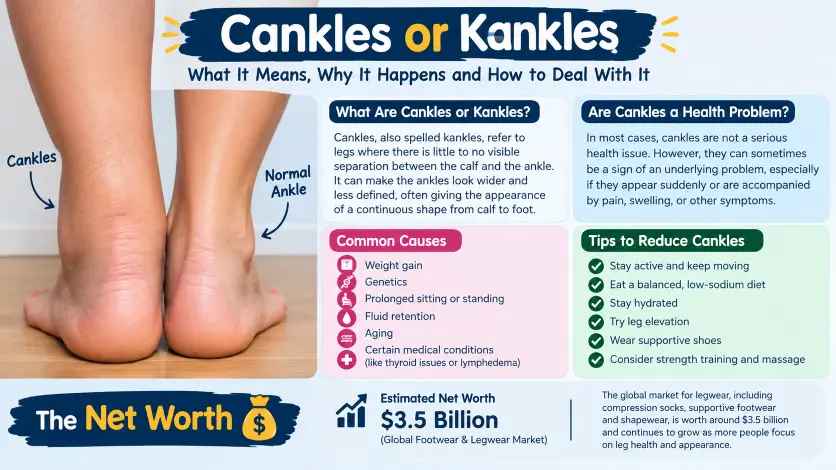
Have you ever seen the words “cankles” and “kankles” and wondered which one is actually correct? This spelling confusion is understandable because the term is informal and is sometimes written phonetically. However, when you are writing an article, social media post, or everyday message, choosing the standard spelling can make your writing clearer and more credible.
The correct and widely recognized spelling is “cankles.” It is an informal word formed from “calf” and “ankle,” generally referring to an ankle area where the calf and ankle appear to have little visible distinction. “Kankles” is a nonstandard spelling that may appear online because people sometimes spell the word according to how it sounds.
In this guide, we will explain cankles or kankles in simple English, including the correct spelling, meaning, origin, usage, common mistakes, and practical examples. Whether you encountered the term in a dictionary, on social media, or in casual conversation, this guide will help you understand which form to use and why.
Cankles or Kankles: What’s the Difference?
The main difference between cankles and kankles is their spelling status rather than their intended meaning.
Cankles is an informal noun commonly used to describe an ankle area that appears broad or has a less noticeable transition between the lower leg and ankle.
By contrast, kankles usually refers to the same idea, but it isn’t the conventional spelling. Instead, it may be used as a humorous variation, phonetic spelling, or simple mistake.
The word “cankles” is commonly explained as a blend involving calf and ankle. Because “calf” begins with the letter C, the established spelling uses C rather than K.
Therefore, you shouldn’t normally treat the two forms as separate words with completely different meanings. Rather, one is the established form and the other is a nonstandard variation.
Cankles and Kankles Comparison Table
| Feature | Cankles | Kankles |
|---|---|---|
| Spelling | Correct and established spelling | Nonstandard spelling |
| Part of speech | Informal noun | Informal noun variant |
| Meaning | Describes an ankle area that appears to blend into the lower leg | Usually intended to describe the same appearance |
| Word formation | Commonly associated with calf and ankle | Usually a phonetic or playful alteration |
| Standard English | Preferred form | Not the preferred form |
| Formal writing | Use when the informal term is relevant and explained | Generally avoid |
| Casual writing | Commonly understood | May appear in jokes or informal posts |
| Academic writing | Can be discussed when relevant | Shouldn’t be presented as the standard form |
| Professional writing | Preferred if the term is necessary | Usually inappropriate |
| Recommended choice | Use cankles | Avoid kankles unless discussing the variant itself |
Quick Recap
Cankles is the established spelling.
Kankles is generally a nonstandard variation.
Both forms may communicate the same intended idea.
Therefore, choose cankles when accuracy and clarity matter.
Is Cankles vs Kankles a Grammar, Vocabulary, or Usage Issue?
The difference is primarily a vocabulary and usage issue, rather than a grammar problem.
Grammar concerns how words function and combine within sentences. Vocabulary concerns the words and expressions available to communicate meaning. Usage, meanwhile, considers whether a particular form is conventional or appropriate in a specific situation.
For example, the sentence “She wrote about cankles” is grammatically straightforward. The word functions as a noun after the preposition “about.”
Now consider “She wrote about kankles.” The sentence remains understandable, and its grammatical structure hasn’t changed. Nevertheless, the spelling doesn’t follow the conventional form.
Moreover, context affects whether the word itself should be used. Informal vocabulary may work naturally in casual conversation, yet formal writing often requires more precise terminology.
Therefore, this distinction shouldn’t be memorized as a difficult grammar rule. Instead, remember that cankles is the established spelling, while “kankles” is generally a variation.
How to Use Cankles Correctly
The word cankles functions as an informal noun. Consequently, it can appear naturally in casual discussions, popular culture, body image conversations, and other informal contexts.
For example:
“The article explains what cankles means.”
Here, “cankles” identifies the topic being discussed.
Likewise, someone might say:
“She searched for information about cankles.”
Again, the word functions normally as a noun.
Nevertheless, the expression should be used thoughtfully because it refers to someone’s physical appearance. Therefore, using it as an insult can be inappropriate even when the spelling is correct.
Workplace Example
Suppose a clothing company is researching how customers describe different body proportions. During a discussion about search terminology, an employee might mention “cankles” because customers use the expression.
However, using the term to criticize a colleague’s appearance would be inappropriate. Professional communication should focus on relevant information rather than unnecessary personal comments.
Academic Example
A researcher studying body image, language, or popular culture could discuss “cankles” as an informal vocabulary item.
For example, an academic paper might examine how appearance related expressions influence social attitudes. In that context, defining the term first would help readers understand the discussion.
Technology Example
Writing software, search systems, and language databases may encounter the term in online text. Consequently, understanding the conventional spelling helps distinguish the established word from variations.
For instance, a user might type the word incorrectly, while a search system recognizes the intended expression. Nevertheless, recognition doesn’t mean both spellings are equally standard.
Usage Recap
Use cankles when the established informal expression is genuinely relevant. Furthermore, explain the term when your audience may be unfamiliar with it. Above all, keep the surrounding language respectful.
How to Use Kankles Correctly
Unlike “cankles,” kankles isn’t normally the preferred written form.
Nevertheless, you may encounter it in humorous conversations, memes, casual comments, fictional dialogue, or intentionally playful writing.
For example:
“My friend jokingly calls them kankles.”
Here, the writer deliberately highlights the unusual spelling. Therefore, changing it to the conventional version could remove part of the intended humor.
However, that situation is different from presenting “kankles” as the standard spelling.
Workplace Example
A professional document should generally use cankles if the term is necessary. Otherwise, “kankles” may look like an accidental spelling mistake.
Academic Example
Academic writers shouldn’t introduce “kankles” as the accepted form. However, they can discuss it if their subject involves spelling variations, internet language, or informal vocabulary.
Technology Example
Online platforms contain enormous amounts of user generated writing. Therefore, unusual spellings such as “kankles” can appear even though dictionaries and polished publications favor “cankles.”
Usage Recap
Use “kankles” only when the unusual spelling has a deliberate purpose. Otherwise, cankles remains the better choice for clear written communication.
When You Should NOT Use Cankles or Kankles
Although cankles is an established informal expression, neither word is suitable for every situation.
1. When You Are Insulting Someone
Appearance based vocabulary can easily become offensive. Therefore, don’t use either spelling as a derogatory label for another person.
2. When Giving Medical Advice
Neither term is itself a medical diagnosis. Consequently, don’t use it to claim that someone has a particular health condition.
3. In Sensitive Workplace Conversations
Professional environments require respectful communication. Thus, unnecessary comments about someone’s physical appearance should be avoided.
4. In Academic Writing Without Context
Because the word is informal, some readers may not recognize it immediately. Therefore, provide a definition if the expression is relevant to your research.
5. When Making Health Assumptions
A person’s body shape doesn’t automatically reveal their health. Consequently, don’t use the word to make unsupported claims about someone’s physical condition.
6. When Writing for Children
Appearance related labels can influence how young readers think about themselves and others. Therefore, neutral wording is often preferable.
7. When Formal Anatomical Language Is Needed
If your subject requires scientific precision, a formal anatomical description may communicate the idea more accurately than an informal expression.
8. When the Word Adds No Value
If the term isn’t necessary to your point, leaving it out may produce clearer and more respectful writing.
Common Mistakes: Cankles or Kankles
The following examples show how spelling and usage errors can occur.
| Correct Sentence | Incorrect Sentence | Explanation |
|---|---|---|
| The article explains the meaning of cankles. | The article explains the meaning of kankles. | The intended meaning is understandable, but cankles is the conventional spelling. |
| Cankles is an informal expression. | Kankles is the standard spelling. | Kankles isn’t normally recognized as the standard written form. |
| She searched for the definition of cankles. | She searched for the definition of kankles. | The second sentence uses the nonstandard spelling when the established form is intended. |
| The writer explained the term cankles. | The writer explained the term kankles as standard English. | The problem is the claim that the altered spelling is standard. |
| The article discusses cankles as informal vocabulary. | The article describes cankles as a medical diagnosis. | The expression describes appearance and isn’t itself a diagnosis. |
| The author used cankles in a discussion of body image. | The author used kankles as the preferred academic term. | The conventional spelling should be used when presenting the established vocabulary item. |
Decision Rule Box
If you mean the established informal term, use “cankles.”
If you see “kankles,” treat it as a nonstandard or playful variation unless the writer intentionally chose that spelling.
Therefore, when you’re unsure, choose cankles.
Cankles and Kankles in Modern Technology
Modern writing environments encounter many spelling variations because people communicate quickly across digital platforms. Consequently, both “cankles” and “kankles” may appear in online text.
Autocorrect systems may suggest the conventional spelling when someone enters an unusual variation. Likewise, search systems can often understand that different spellings refer to the same intended expression.
However, recognition doesn’t make every spelling equally appropriate. A digital platform may understand “kankles,” yet a professional writer should still choose “cankles” when referring to the established term.
Furthermore, online communication encourages creative spelling. Users often modify words for humor, personality, or emphasis. Therefore, unusual forms can become visible even when they aren’t conventional.
The important lesson is simple: technology can recognize variations, but writers should still understand standard usage and context.
Etymology: Where Does Cankles Come From?
The term cankles is generally described as a blend associated with calf and ankle.
A blend combines parts of existing words to create a new expression. English contains many examples of this type of word formation, particularly in informal vocabulary.
The construction of “cankles” helps explain why its spelling begins with C. The initial sound and letter are connected with “calf,” while the remainder relates to “ankle.”
By contrast, “kankles” doesn’t follow the same conventional formation. Instead, it appears to be a spelling variation based largely on sound or playful modification.
Therefore, understanding the word’s formation provides a useful memory aid. Think of the beginning as coming from calf, and the spelling becomes easier to remember.
Expert Style Explanation
A useful language principle applies here:
“When a word has an established spelling and a playful alternative, the established form is normally the better choice when clarity matters.”
This principle is especially useful for informal vocabulary. People naturally experiment with language, yet polished writing usually benefits from recognizable forms.
Consequently, “kankles” can exist in real communication without becoming the preferred spelling.
Case Study 1: A Publishing Editor Corrects a Spelling
Consider a lifestyle publication preparing an article about body image. During editing, the writer notices that several sections use “kankles,” while another section uses “cankles.”
At first, the difference may seem minor because readers can understand both forms. However, the editor checks the terminology and decides to standardize the article around “cankles.”
As a result, the finished article becomes more consistent. Readers no longer encounter two spellings that might appear to represent separate terms.
This example demonstrates an important editing principle. Consistency improves clarity, especially when an article discusses one specific vocabulary item repeatedly.
Case Study 2: A Casual Social Media Post
Now consider a person creating a humorous social media caption. They intentionally write “kankles” because they want the spelling to look playful.
In this situation, the unusual form may be part of the tone. The writer isn’t necessarily claiming that “kankles” is the standard spelling.
However, suppose the same person later writes an educational article explaining the term. In that setting, switching to cankles would be the stronger choice.
Therefore, the context determines whether a spelling variation is purposeful or simply an error.
Error Prevention Checklist
Always Use Cankles When
You are defining the established term.
You are writing an educational article.
You are preparing professional content.
You are discussing the conventional spelling.
You are explaining the word’s meaning.
You want maximum clarity.
You are correcting a spelling mistake.
Never Use Kankles When
You are presenting it as standard spelling.
You are writing a formal definition.
You are preparing academic material and need the conventional form.
You are correcting another person’s spelling.
You want polished professional communication.
You are writing a dictionary style explanation.
Related Grammar Confusions You Should Master
Once you understand cankles or kankles, several other confusing word pairs are worth studying.
Affect or Effect
These words are frequently confused because their pronunciation can be similar. However, their meanings and grammatical roles differ.
Fewer or Less
Both words refer to quantity, yet traditional usage generally distinguishes countable items from uncountable amounts.
Altar or Alter
These spellings sound alike but represent completely different meanings.
Sheer or Shear
One can describe something transparent or complete, while the other relates to cutting.
Former or Latter
These terms identify the first and second items in a previously mentioned pair.
Lens or Lense
“Lens” is the conventional singular spelling, while “lense” is generally a spelling mistake.
Shiny or Shiney
“Shiny” is the standard spelling of the adjective meaning bright or reflective.
Focused or Focussed
Both forms can occur in English depending on regional conventions, making context particularly important.
Program or Programme
These forms differ partly according to regional English usage and context.
Indescribable or Undescribable
The two forms can appear in writing, although “indescribable” is the widely preferred conventional form.
Frequently Asked Questions
Is cankles or kankles the correct spelling?
Cankles is the conventional spelling. “Kankles” is generally a nonstandard or playful variation that may appear in informal communication.
What does cankles mean?
Cankles is an informal noun describing an ankle area that appears broad or has limited visible distinction from the lower leg.
Is kankles a real word?
“Kankles” can be found in informal writing, especially online. However, it isn’t normally treated as the conventional spelling of the established expression.
Why is cankles spelled with a C?
The term is generally understood as a blend associated with “calf” and “ankle.” Therefore, the C connects naturally with the beginning of “calf.”
Are cankles and kankles the same thing?
Usually, yes, in terms of intended meaning. However, cankles is the established spelling, whereas “kankles” is generally a variant.
Can you use cankles in formal writing?
You can mention the word when it is relevant, particularly when discussing language, popular culture, or body image. Nevertheless, because it is informal, it should be explained and used carefully.
Should I use kankles in an academic paper?
Generally, no. If the unusual spelling itself is part of your research, you can discuss it as a variant. Otherwise, use the conventional spelling.
Are cankles a medical condition?
No. The term is an informal description rather than a medical diagnosis. Therefore, it shouldn’t be used to make health claims about a person.
Why do people write kankles instead of cankles?
People may use “kankles” because they hear the word rather than see it written. Additionally, the spelling may be intentionally altered for humor or casual expression.
How do you remember the correct spelling?
A simple memory trick is to connect the beginning of cankles with calf. Since the expression is associated with calf and ankle, the C spelling becomes easier to remember.
Conclusion: Cankles or Kankles?
When choosing between cankles or kankles, the best answer is straightforward: cankles is the established spelling.
The term is an informal noun describing an ankle area that appears to have limited visible separation from the lower leg. Meanwhile, “kankles” generally functions as a playful, phonetic, or nonstandard variation.
Therefore, use cankles in definitions, educational explanations, polished articles, and other situations where conventional spelling matters. On the other hand, “kankles” may appear when someone intentionally uses an unusual spelling for humor or stylistic effect.
Ultimately, this isn’t a complicated grammar rule. It is mainly a matter of spelling, vocabulary, and appropriate usage. Once you remember that cankles is the established form, the confusion becomes much easier to avoid.









