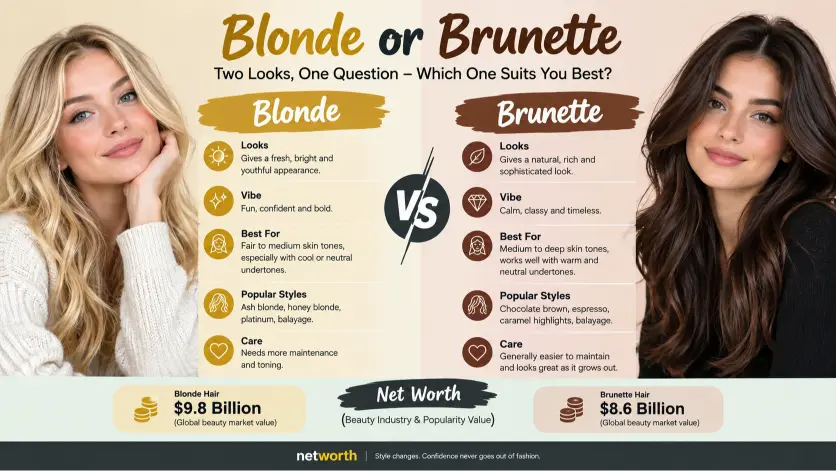
Choosing between blonde or brunette hair can feel surprisingly difficult. Both shades offer completely different vibes, from bright and playful to rich and sophisticated. But the best choice is not simply about following a trend. Your skin tone, eye color, natural hair color, lifestyle, and maintenance routine can all influence which shade looks and feels right for you.
In this guide, we will compare blonde and brunette hair in a simple, practical way so you can understand the key differences before making a change. We will look at popular shades, appearance, maintenance, styling, and how each color can complement different features. Whether you are thinking about your first major hair transformation or simply curious about which shade suits you better, these insights can help you make a more confident decision.
Rather than saying one color is universally better, the goal is to help you discover which option works best for your individual look and personal style. By understanding the differences between blonde and brunette shades, you can choose a color that feels natural, flattering, and easy to maintain.
Blonde or Brunette: What’s the Difference?
The words blonde and brunette are primarily used to describe a person’s natural or dyed hair color. However, their grammatical behavior and cultural usage have a few interesting differences.
Blonde can function as an adjective or a noun. As an adjective, it describes someone or something with light colored hair. For example, you might say, “She has blonde hair.” As a noun, particularly in traditional usage, it can refer to a woman with blonde hair.
Brunette is commonly used as both a noun and an adjective. It describes a person with brown or dark brown hair. For example, “He is brunette” is understandable, although “He has brown hair” sounds more natural in many everyday contexts.
Here is a simple comparison:
| Feature | Blonde | Brunette |
|---|---|---|
| Basic meaning | Light colored hair | Brown or dark brown hair |
| Common part of speech | Adjective and noun | Noun and adjective |
| Typical hair shades | Golden, yellow, honey, ash, platinum | Light brown, medium brown, dark brown |
| Example | She has blonde hair. | She has brunette hair. |
| Common alternative | Fair haired | Brown haired |
| Hair spectrum | Usually lighter | Usually darker |
Quick recap
Blonde describes lighter hair shades, while brunette describes brown hair.
Both words can describe a person’s appearance.
Hair dye, highlights, and lighting can affect classification.
For everyday clarity, describing the exact shade can sometimes be more precise.
Is Blonde vs Brunette a Grammar, Vocabulary, or Usage Issue?
The distinction is mainly a vocabulary and usage issue, rather than a difficult grammar rule. Both words are legitimate English terms, yet they aren’t interchangeable because they communicate different hair color categories.
For instance, saying “She is blonde” tells the reader that her hair is light. Conversely, “She is brunette” indicates brown hair. Therefore, replacing one with the other changes the meaning.
In formal writing, it can be better to use a direct description such as “a woman with blonde hair” or “a person with dark brown hair.” This approach sounds neutral and removes uncertainty.
Meanwhile, casual conversation often uses these labels without any problem. Friends may say, “He’s a brunette,” while a magazine might describe an actress as blonde.
Academic writing requires more care because appearance labels can be subjective. Consequently, researchers or students discussing appearance may prefer specific color descriptions instead of broad categories.
The same principle applies to workplace communication. If someone’s hair color isn’t relevant, there’s usually no reason to mention it. However, when appearance is directly relevant, precise wording is preferable.
How to Use Blonde Correctly
The word blonde is most commonly associated with light hair. The shade can vary considerably, which means the label doesn’t necessarily indicate one exact color.
For example, platinum hair may be called blonde even though it is almost white. Similarly, golden, honey, ash, and sandy shades can fall within the broader blonde category.
Workplace example
Suppose a receptionist is helping identify a visitor. A practical description might be:
“She is the person with shoulder length blonde hair.”
That sentence gives a useful visual detail without making the description unnecessarily complicated.
Academic example
A paper discussing hair pigmentation might state:
“Participants with naturally blonde hair were placed in the light hair category.”
Here, the term functions as an adjective and clearly modifies the word “hair.”
Technology example
Image organization software may categorize photographs according to visible characteristics. In that context, a description such as “person with blonde hair” can help distinguish one photograph from another.
However, such classifications may not always be perfect because photographs can contain shadows, filters, colored lighting, or dyed hair.
Usage recap
Use blonde when referring to light colored hair. Additionally, specify the shade when precision matters. Therefore, “ash blonde,” “golden blonde,” and “platinum blonde” can communicate more information than the general label alone.
How to Use Brunette Correctly
Brunette generally refers to brown hair. The category can include several shades, from relatively light brown through medium brown and into deep brown.
For everyday conversation, “brunette” is widely understood. Nevertheless, “brown haired” can sometimes sound more straightforward, particularly when the person’s gender isn’t relevant.
Workplace example
Imagine that an employee is describing a visitor:
“The customer with long brunette hair is waiting near reception.”
The phrase provides a recognizable appearance detail and fits naturally into ordinary conversation.
Academic example
A study involving hair color could use wording such as:
“The survey recorded participants who identified their hair as brunette.”
In a formal setting, researchers may define their categories beforehand because people’s perceptions of color can differ.
Technology example
A photo application might describe an image as showing a person with brunette hair. However, the software could mistake very dark blonde, auburn, or black hair for brown depending on lighting and image quality.
Consequently, technology based descriptions should be treated as classifications rather than absolute measurements.
Usage recap
Use brunette for brown hair, especially in ordinary descriptive language. Furthermore, use a specific shade when accuracy is important. Dark brown, chestnut, and medium brown can communicate more detail.
When You Should NOT Use Blonde or Brunette
Although these terms are common, there are situations where using them may create confusion or simply be unnecessary.
- When the person’s hair is clearly black
Calling black hair brunette can cause disagreement because brunette traditionally centers on brown hair.
- When the hair is distinctly red
A person with naturally red hair is usually described as red haired or a redhead rather than blonde or brunette.
- When the exact shade matters
For professional descriptions, a phrase such as “dark ash brown” may be more useful than brunette.
- When discussing temporary lighting effects
A photograph taken under warm lighting can make brown hair appear reddish or golden. Therefore, relying only on the image may produce an inaccurate label.
- When hair has several contrasting colors
Someone with blonde highlights over brown hair doesn’t always fit neatly into one category.
- When discussing a person’s identity rather than appearance
Hair color shouldn’t automatically become a defining characteristic. Use it only when it serves a genuine descriptive purpose.
- When the person has dyed hair
The visible color may not represent the person’s natural shade. Therefore, “dyed blonde hair” may be more accurate than simply calling someone blonde.
- When neutrality is important
A direct phrase such as “a person with light brown hair” can be preferable to a label when the context calls for objective description.
Common Mistakes With Blonde and Brunette
Understanding the difference becomes easier when you see how incorrect wording can change or weaken a sentence.
| Correct sentence | Incorrect sentence | Explanation |
|---|---|---|
| She has blonde hair. | She has brunette hair. | The first sentence describes light hair, while the second describes brown hair. |
| He has brown hair and is often described as brunette. | He has blonde hair because it looks bright. | Brightness doesn’t automatically make brown hair blonde. |
| Her hair is platinum blonde. | Her hair is platinum brunette. | Platinum is normally associated with very light blonde coloring. |
| She dyed her hair blonde. | She dyed her hair brunette. | The correct choice depends on the color she selected. |
| He has dark brown hair. | He has blonde hair. | Dark brown belongs to the brunette range rather than the blonde range. |
| Her highlights are blonde. | Her highlights are brunette. | Blonde highlights are lighter than the surrounding brown base. |
The most frequent mistake occurs when people treat these terms as interchangeable labels for any attractive or noticeable hair color. They aren’t. Instead, the underlying shade determines the appropriate description.
Decision Rule Box
If you mean light colored hair, use blonde.
If you mean brown colored hair, use brunette.
If the shade is uncertain, describe the actual color instead of guessing.
This simple rule solves most everyday usage questions.
Blonde or Brunette in Modern Technology and Digital Tools
Digital platforms increasingly classify photographs, avatars, profile images, and visual content according to recognizable characteristics. As a result, hair color terminology can appear in image descriptions, character profiles, games, virtual avatars, and photo editing applications.
Nevertheless, computer based color classification isn’t identical to human judgment. A photograph may contain artificial lighting, shadows, reflections, filters, or color adjustments.
For example, dark blonde hair under warm indoor lighting may look brown. Similarly, medium brown hair photographed in bright sunlight can appear significantly lighter.
Therefore, when writing a digital description, specificity is valuable. “Person with medium brown hair” provides more information than simply saying “brunette.” Likewise, “person with golden blonde hair” gives a clearer visual picture than the broader word “blonde.”
This distinction matters especially when accessibility descriptions or image labels need to communicate useful visual information.
Etymology and History of Blonde and Brunette
The history of these words helps explain why they look different from many ordinary English color terms.
Blonde entered English through French and ultimately traces back to older European language forms associated with a light or fair color. Over time, English speakers adopted the term as a common description for light colored hair.
Brunette, likewise, came into English through French. It is connected with a word family associated with brown or dark coloring.
Interestingly, English has retained these foreign influenced labels even though simpler descriptions such as “fair haired” and “brown haired” are also available.
Because of this history, the two terms have developed slightly different grammatical traditions. In modern English, however, everyday speakers generally focus more on meaning than historical grammatical distinctions.
Expert style quotation
“When a color category covers several shades, context determines whether a broad label or a precise description communicates best.”
That principle is useful beyond hair terminology. Clear writing usually favors the word that gives readers exactly the information they need.
Two Practical Case Studies
Case Study 1: Workplace Identification
Consider a reception desk where an employee needs to identify a visitor among several people. The employee says, “The blonde person is waiting by the entrance.”
This description works because the person’s light hair provides a useful distinguishing feature.
Now imagine that the visitor actually has medium brown hair. Calling the person blonde could cause the receptionist to approach the wrong individual.
The practical result is simple: accurate color terminology improves identification when appearance is genuinely relevant.
Case Study 2: Product Photography
Imagine an online retailer photographing two models wearing the same clothing style. One model has golden blonde hair, while the other has dark brown hair.
If the image descriptions simply say “woman,” the visual distinction is reduced. However, describing one as having golden blonde hair and the other as having dark brown hair creates clearer differentiation.
The concrete outcome is improved descriptive precision because readers receive a more complete visual picture.
These examples are illustrative rather than claims about measured commercial experiments. Their purpose is to show how choosing the right term can improve clarity in realistic situations.
Error Prevention Checklist
Always use blonde when:
☑ The hair is clearly light colored.
☑ The shade is golden, ash, sandy, honey, or platinum.
☑ You are describing blonde highlights.
☑ The context specifically identifies a light hair category.
Never use brunette when:
☑ The hair is unmistakably blonde.
☑ You are describing platinum or very pale hair.
☑ The color is clearly red rather than brown.
☑ You need to communicate a precise shade and “brunette” is too broad.
Always consider:
☑ Natural versus dyed hair.
☑ Lighting conditions.
☑ Highlights and lowlights.
☑ The purpose of the description.
☑ Whether a precise color name would be clearer.
Related Grammar Confusions You Should Master
Once you understand hair color terminology, several other English distinctions are worth learning because they involve similar problems of meaning, form, and usage.
- Affect vs effect: Learn when each word functions as a verb or noun.
- Fewer vs less: Understand countable and uncountable nouns.
- Lay vs lie: Distinguish placing something from reclining.
- Then vs than: Separate time expressions from comparisons.
- Your vs you’re: Identify possession versus a contraction.
- Their vs there vs they’re: Keep possession, location, and contraction separate.
- Former vs latter: Use each term correctly when comparing two things.
- Compliment vs complement: Distinguish praise from something that completes another thing.
- Affectation vs affection: Recognize the difference between artificial behavior and fondness.
- Everyday vs every day: Separate an adjective from a time expression.
These comparisons reinforce an important lesson: similar looking or frequently confused words can have very different meanings.
Frequently Asked Questions
Is blonde or brunette correct?
Both are correct words. However, they describe different hair color categories. Blonde generally refers to light hair, whereas brunette normally refers to brown hair. The correct choice therefore depends on the person’s visible or relevant hair color.
Is brown hair considered brunette?
Yes. Brown hair is generally described as brunette, particularly when referring to a person. However, specific shades such as chestnut, chocolate brown, or dark brown can provide greater precision.
Is blonde hair the same as fair hair?
Not always. Blonde usually refers to a range of light hair colors, while fair hair can be a broader expression. Depending on context, fair may describe overall light coloring rather than one specific shade.
Can a person have both blonde and brunette hair?
Yes. Highlights, lowlights, balayage, ombré coloring, and natural variations can create combinations of light and brown hair. In such cases, describing the individual shades may be more accurate than assigning one label.
Is brunette only used for women?
Traditionally, brunette has sometimes been associated particularly with women because of its French linguistic history. However, contemporary English can use brunette more broadly. Still, “brown haired” is often the simplest gender neutral alternative.
What is the difference between blonde and blond?
In modern English, both forms appear. Blonde is traditionally associated with feminine references, while blond has traditionally been used for masculine references and can also function as a general adjective. American English often uses blonde as the familiar spelling for the hair color category.
Is dark blonde considered brunette?
Usually, dark blonde remains within the blonde category, although the boundary can be subjective. If the color is close to light brown, people may disagree. Therefore, naming the precise shade can prevent uncertainty.
Can dyed hair change whether someone is called blonde or brunette?
Yes. Descriptions usually refer to the visible hair color unless the speaker specifically discusses natural hair. For example, someone with naturally brown hair who dyes it blonde may commonly be described as blonde.
Which term is more precise, blonde or brunette?
Neither is automatically more precise because both are broad categories. If accuracy matters, use a specific shade such as platinum blonde, golden blonde, light brown, or dark brown.
Final Verdict:
The simplest distinction is clear: blonde describes light colored hair, while brunette describes brown hair. Therefore, the correct word depends on the actual shade rather than personal preference.
However, real hair color doesn’t always fit perfectly into two categories. Highlights, dye, lighting, and natural variation can blur the boundary. Consequently, precise descriptions such as golden blonde or dark brown may be better when accuracy matters.
Ultimately, good English isn’t only about choosing a grammatically acceptable word. It is also about selecting the expression that gives the reader the clearest meaning with the least uncertainty.









