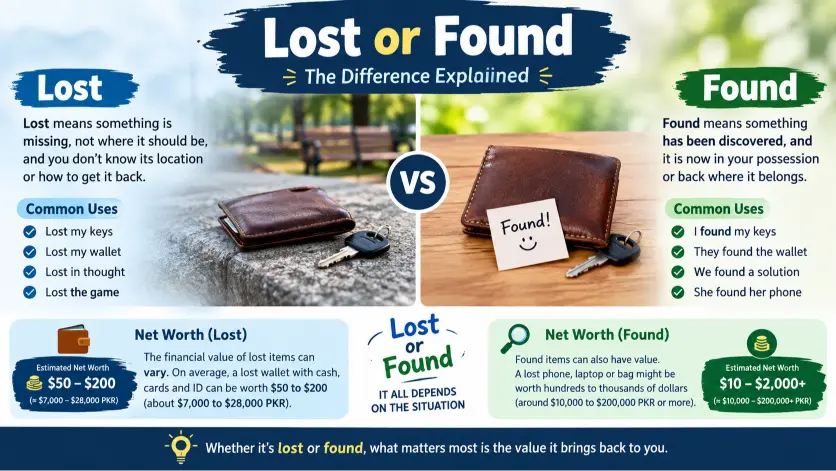
Have you ever stopped while writing a sentence and wondered whether “lost or found” is the right expression? These two words are closely connected, but they describe very different situations. Understanding their meanings can help you communicate more clearly, whether you are writing a message, completing a form, speaking in everyday conversation, or describing something that has disappeared and later been discovered.
The word lost generally describes something that cannot be found or someone who no longer has something. Found, on the other hand, refers to discovering or locating something that was previously missing. Although the distinction seems simple, common sentence patterns, verb forms, and context can sometimes make their usage confusing.
In this guide, we will explain lost or found in simple English, compare their meanings, provide practical examples, and highlight common mistakes learners make. The goal is to give you a clear, reliable understanding that you can apply naturally in everyday writing and conversation.
X vs Y: What’s the Difference?
First, lost and found are related terms, but they describe opposite stages of a situation. Both can function as past participles of verbs, and both can also work as adjectives depending on context.
Lost is the past participle and past tense form of lose. It means that something has disappeared, cannot be located, or is no longer possessed. For example, “I lost my wallet” explains an action, whereas “My wallet is lost” describes its current condition.
Found is the past tense and past participle form of find. It means that someone discovered, located, or recovered something. For example, “I found my wallet” tells us that the item was located.
| Point | Lost | Found |
|---|---|---|
| Basic meaning | Missing or no longer possessed | Discovered or located |
| Related verb | Lose | Find |
| Part of speech | Verb or adjective | Verb or adjective |
| Typical situation | An item cannot be located | An item has been located |
| Example | “My keys are lost.” | “My keys were found.” |
| Opposite concept | Found | Lost |
| Common notice | Lost property | Found property |
Consequently, the simplest distinction is based on location and discovery.
If an item cannot be located, it is lost.
If somebody discovers or recovers that item, it is found.
Therefore, the two expressions shouldn’t normally be substituted for one another.
Is Lost vs Found a Grammar, Vocabulary, or Usage Issue?
Primarily, this is a vocabulary and usage distinction, although grammar also matters because both words can appear in several grammatical structures.
For instance, “I lost my phone” uses lost as the past tense of a verb. However, “My phone is lost” uses the same form to describe a condition.
Similarly, “She found my phone” uses found as a verb. Yet “The found phone was placed at reception” can use it descriptively, although that construction is less natural in everyday conversation.
Moreover, the words aren’t interchangeable. Their meanings point in opposite directions. Lose concerns separation, disappearance, or failure to retain something. Find concerns discovery, recovery, or successful location.
In formal writing, precision becomes especially important. A university notice saying “found documents” communicates that documents have been discovered. Conversely, “lost documents” indicates that they are missing.
In casual conversation, speakers sometimes rely on context. Nevertheless, written notices require greater accuracy because readers may not have additional information.
Thus, understanding the underlying verbs makes the distinction much easier: lose leads to lost, while find leads to found.
How to Use Lost Correctly
Generally, lost describes something that cannot currently be located, something that has disappeared, or something that a person no longer possesses.
For example, someone might say, “I lost my keys this morning.” Here, the speaker explains what happened. Alternatively, “My keys are lost” focuses on their present condition.
Workplace Example
Suppose an employee cannot locate an important document. A suitable message would be:
“The signed contract appears to be lost. Please check the records before preparing another copy.”
Likewise, a reception desk might display:
“Please report any lost property to the front office.”
Consequently, workplace communication benefits from using lost whenever an item is missing.
Academic Example
In academic writing, the term can describe missing information, unavailable records, or something that has disappeared.
For example:
“Several historical records were lost during the relocation.”
Here, lost indicates that the records are no longer available.
Technology Example
Technology provides countless examples. A user might say:
“I lost my password.”
Or a device may display a message such as:
“Your connection was lost.”
In the first example, a person no longer remembers or possesses the required information. In the second, communication has been interrupted.
Usage Recap
Therefore, choose lost when the emphasis is on disappearance, separation, missing property, or something no longer available.
How to Use Found Correctly
In contrast, found indicates discovery or successful location. It normally communicates that someone has located something that was previously missing or searched for.
For example:
“I found my keys under the sofa.”
The sentence clearly tells us that the keys were successfully located.
Workplace Example
A company may receive an item that an employee previously reported missing. A suitable notice would be:
“A found access card is being held at reception.”
More naturally, a workplace might write:
“Your access card has been found and is available at reception.”
Thus, found communicates resolution after something has been located.
Academic Example
Researchers may use the term when discussing discoveries.
For instance:
“The researchers found evidence supporting the original hypothesis.”
Here, found doesn’t refer to a lost object at all. Instead, it means discovered or identified something through investigation.
Technology Example
Digital services frequently use this concept. A search application might report:
“No matching files found.”
Conversely, a successful search could display:
“Three matching files found.”
Therefore, technology commonly uses found to indicate that a search successfully identified a result.
Usage Recap
Ultimately, use found when something has been discovered, located, recovered, or identified.
When You Should NOT Use Lost or Found
Because the two terms represent different meanings, several common situations require careful selection.
1. When an item has already been located
Don’t describe an item as lost after you know where it is.
Incorrect:
“The lost wallet is on my desk.”
Better:
“The wallet I found is on my desk.”
2. When you mean that something was discovered
Don’t use lost when the intended meaning is discovery.
Incorrect:
“The scientist lost a new pattern in the data.”
Better:
“The scientist found a new pattern in the data.”
3. When someone cannot locate an item
Don’t use found merely because you’re talking about a search.
Incorrect:
“I found my passport, but I can’t locate it.”
Unless the sentence has a special context, this creates an obvious contradiction.
Better:
“I lost my passport and can’t locate it.”
4. When describing an active search
A search does not automatically mean something has been found.
For example:
“We’re looking for the lost documents.”
This is appropriate because the documents remain missing.
5. When writing a public notice
Property notices require precision. Lost property normally means belongings reported missing. Found property means belongings that someone has discovered and handed in.
6. When discussing discoveries
In research, journalism, and education, found often means discovered.
For example:
“The study found a significant relationship.”
Using lost would completely change the meaning.
7. When discussing emotional direction
The word lost can describe confusion or lack of direction.
For example:
“I feel lost after graduation.”
However, found may describe discovering purpose:
“She found a new sense of direction.”
The surrounding context determines the intended meaning.
8. When describing digital search results
A system that successfully retrieves information has found something. A system that cannot maintain a connection may report that the connection was lost.
Common Mistakes: Lost or Found
Understanding individual definitions isn’t always enough. Many errors occur because writers focus on the object instead of the event that happened to it.
| Correct sentence | Incorrect sentence | Explanation |
|---|---|---|
| “I lost my wallet yesterday.” | “I found my wallet yesterday.” | The first sentence means the wallet went missing. |
| “I found my wallet under the bed.” | “I lost my wallet under the bed.” | The second sentence changes discovery into disappearance. |
| “My keys are lost.” | “My keys are found.” | The first describes missing keys. |
| “The missing documents were found.” | “The missing documents were lost.” | The second suggests they remain unavailable. |
| “She found the file.” | “She lost the file.” | These verbs communicate opposite outcomes. |
| “The connection was lost.” | “The connection was found.” | A disrupted connection is described as lost. |
| “The search found three results.” | “The search lost three results.” | A successful search produces found results. |
| “His luggage was lost.” | “His luggage was found.” | The appropriate form depends on whether the luggage remains missing or has been recovered. |
Consequently, ask yourself what happened first. Did something disappear or become unavailable? Choose lost. Did someone discover or recover it? Choose found.
Decision Rule Box
If something has disappeared, cannot be located, or is no longer possessed, use “lost.”
If someone has discovered, located, recovered, or identified something, use “found.”
A useful mental shortcut is:
Lose → lost → missing
Find → found → discovered or recovered
This rule works across ordinary conversation, workplace notices, school assignments, research writing, and digital interfaces.
Lost and Found in Modern Technology
Modern technology uses both terms extensively because digital systems constantly track information, connections, files, accounts, and search results.
For example, a network connection may be described as lost when communication stops. Likewise, a device can report that a signal has been lost.
On the other hand, search systems use found to indicate successful retrieval. A file manager may say that several documents were found after a search.
Location services also create familiar examples. A device may be marked as lost, while its location can later be found.
Furthermore, digital platforms often use standardized status labels because short terms must communicate an event immediately. In such situations, choosing the wrong word can make a status message misleading.
Therefore, the traditional distinction between disappearance and discovery remains highly relevant in modern digital communication.
Lost or Found: Etymology and Word History
The history of these words helps explain why their meanings remain so distinct.
Lose comes from Old English losian, associated with destruction, separation, or being deprived of something. Over time, its forms developed into the modern verb lose, with lost serving as both its past tense and past participle.
Find, meanwhile, traces back to Old English findan, meaning to discover, come upon, or encounter. Its irregular past form became found.
Because English retained these irregular forms, modern speakers must learn them rather than simply adding a standard ending.
As a result, remembering the verb pairs is more reliable than trying to construct the forms from spelling patterns.
An Expert Style Explanation
“The clearest way to distinguish lost from found is to identify the direction of the event: loss moves something away from possession or availability, while finding brings it back into awareness or possession.”
In practical terms, this means that lost emphasizes absence, whereas found emphasizes discovery.
Once that contrast becomes familiar, most sentence choices become straightforward.
Case Study 1: A Lost Wallet Becomes Found Property
Consider a university student who realizes that a wallet has disappeared after leaving the library.
Initially, the correct description is:
“My wallet is lost.”
The student reports the missing item to campus security. Later, another student discovers the wallet beneath a chair and hands it to the reception desk.
At that point, the situation changes. The wallet is now found property.
The vocabulary changes because the condition has changed. Calling it “lost property” after its recovery would no longer accurately describe the current situation.
Therefore, the same object can be lost at one point and found later.
Case Study 2: A Lost Connection Becomes a Found Result
Imagine someone working online when their internet connection suddenly stops.
The appropriate statement is:
“The connection was lost.”
After reconnecting, the person searches for an important document and successfully retrieves it.
The result may then be described as:
“The document was found.”
Notice that the same short exchange can contain both words without contradiction. One describes an interrupted connection, while the other describes successful discovery.
Consequently, context and event direction determine which word belongs in the sentence.
Error Prevention Checklist
Always use “lost” when:
☑ Something cannot be located.
☑ Someone no longer possesses an item.
☑ A connection has stopped.
☑ Information has become unavailable.
☑ Someone feels confused or directionless.
☑ Property has been reported missing.
Always use “found” when:
☑ Something has been discovered.
☑ An item has been located.
☑ Missing property has been recovered.
☑ Research produces a discovery.
☑ A search returns a result.
☑ Someone identifies previously unknown information.
This checklist is particularly useful when proofreading notices, assignments, reports, messages, and technical text.
Related Grammar Confusions You Should Master
Once you’ve understood this distinction, several other English contrasts are worth learning because they create similar problems.
- Lose vs Loose: One concerns misplacing or failing to retain something, while the other usually describes something not tight.
- Find vs Found: These forms differ according to tense and grammatical construction.
- Lay vs Lie: These verbs are frequently confused because their forms change across tenses.
- Affect vs Effect: Context determines whether the word functions primarily as a verb or noun.
- Then vs Than: One generally relates to time or sequence, while the other is used for comparison.
- Their vs There vs They’re: These forms have distinct grammatical roles despite similar pronunciation.
- Fewer vs Less: The choice depends largely on whether the noun is countable.
- Borrow vs Lend: The direction of giving and receiving determines the correct verb.
- Rise vs Raise: Their usage changes depending on whether something moves itself or is moved by another person.
- Advice vs Advise: These words differ in both pronunciation and grammatical function.
Learning these pairs strengthens overall vocabulary accuracy and makes everyday writing considerably clearer.
Frequently Asked Questions
What is the difference between lost and found?
Lost means something has disappeared, cannot be located, or is no longer possessed. Found means something has been discovered, located, recovered, or identified. They generally describe opposite stages of a situation.
Is lost the opposite of found?
Yes. In many everyday contexts, lost and found function as opposites. If an item cannot be located, it may be described as lost. Once somebody discovers or recovers it, it can be described as found.
Is lost a verb or an adjective?
Lost can function as a verb form or an adjective. In “I lost my keys,” it is the past tense of lose. In “My keys are lost,” it describes their condition.
Is found a verb or an adjective?
Found is primarily the past tense and past participle of find. It can also appear in descriptive constructions, depending on the sentence.
Should I say lost item or found item?
Use lost item when the object is missing. Use found item when someone has discovered or recovered it. Public notices commonly distinguish between lost property and found property.
Can something be lost and found?
Yes. An object can first become lost and later be found. For example, someone may lose a phone in the morning and find it under a car seat later that day.
What does lost mean in a sentence?
Depending on context, lost can mean misplaced, unavailable, separated from possession, destroyed, or confused. For example, “I lost my keys” refers to misplaced property, while “I feel lost” can describe emotional or mental uncertainty.
What does found mean in a sentence?
Found can mean discovered, located, recovered, or identified. For example, “She found her ring” means she successfully located it. In research, “The study found evidence” means the researchers discovered or identified evidence.
Which is correct: lost and found or found and lost?
Lost and found is the standard expression because it follows the usual sequence: an item becomes lost first and is found afterward. It is also the established term for a place where recovered property is kept.
Final Verdict:
The choice between lost and found becomes simple once you focus on what happened to the object, information, connection, or person. Lost indicates absence, disappearance, separation, or lack of direction. Found indicates discovery, location, recovery, or identification.
Therefore, remember one practical distinction: something that cannot be located is lost, while something that has been successfully located is found. Because the words can also appear as different grammatical forms, always consider the complete sentence rather than choosing based only on appearance.
With that rule in mind, you can use lost or found accurately in everyday messages, workplace communication, academic writing, public notices, and digital contexts.









