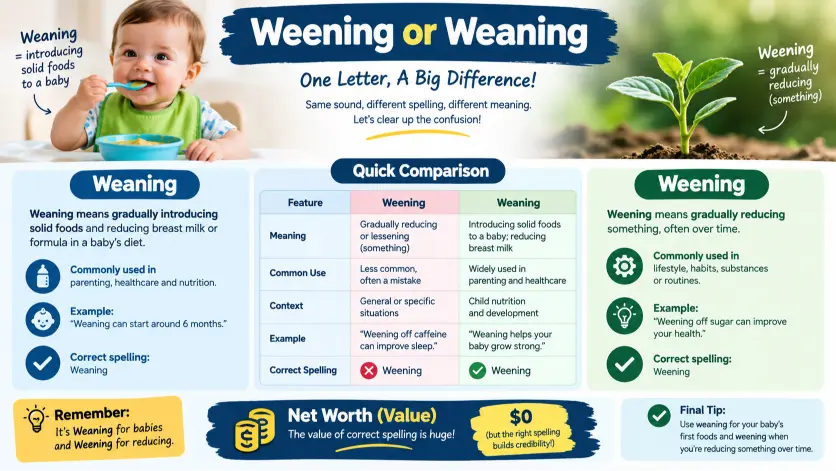
Have you ever wondered whether the correct spelling is weening or weaning? These two words look almost identical, so it is easy to mix them up when writing an email, preparing an assignment, or publishing online content. However, choosing the right spelling matters because even a small spelling mistake can make your writing less clear and professional. If you have searched for “weening or weaning,” you are not alone. Many English learners and everyday writers face the same confusion and want a simple, reliable explanation.
The correct word in standard English is weaning, which means gradually stopping a baby from breastfeeding or helping a person or animal become less dependent on something. For example, “The mother is weaning her baby onto solid foods.” The word can also describe gradually reducing dependence on a habit, treatment, or substance, depending on the context. In contrast, weening is generally considered a misspelling when someone intends to use the word weaning. It is not the standard spelling for the process of gradually ending dependence.
In this guide, you will discover the difference between weening and weaning, their meanings, correct spelling, and practical examples that make the distinction easy to remember. You will also learn how to use weaning in everyday conversations, professional writing, and common real-life situations. By examining the definitions and sentence examples, you can avoid this frequent spelling confusion and communicate more confidently. Whether you are an English learner, student, blogger, or professional writer, this straightforward guide will help you choose the correct word whenever the question “weening or weaning” comes up.
Weening or Weaning: What’s the Difference?
The main difference is that weaning is the correct standard spelling, while weening is generally considered a spelling error when someone means the gradual process of stopping breastfeeding or reducing dependence. Weaning can also describe helping animals transition away from their mother’s milk or reducing reliance on a substance, habit, or behavior.
| Feature | Weaning | Weening |
|---|---|---|
| Part of speech | Noun or verb form | Nonstandard spelling in the intended context |
| Meaning | Gradually stopping milk feeding or dependence | Usually an accidental misspelling |
| Correct usage | We are weaning the baby. | We are weening the baby. |
| Formal writing | Recommended | Avoid |
| Academic writing | Standard spelling | Generally incorrect |
| Everyday communication | Correct | Likely to be misunderstood |
In simple terms, weaning is the word you should normally use when describing a gradual transition away from breastfeeding, milk feeding, or dependence.
Although both spellings may appear in online searches, that doesn’t make them interchangeable. Therefore, choose weaning for professional, educational, and everyday writing.
Is Weening or Weaning a Grammar, Vocabulary, or Usage Issue?
Primarily, this is a spelling and vocabulary issue, rather than a complicated grammar rule. Both spellings may look plausible to an unfamiliar reader; however, only weaning is the standard spelling for the meaning discussed here.
Are Weening and Weaning Interchangeable?
No, not in standard English.
For example, consider this sentence:
The parents are weaning their baby from breastfeeding.
Here, weaning describes a gradual transition. Replacing it with weening would introduce a spelling error.
Similarly, a farmer might say, “We are weaning the calves from their mothers.” Again, the standard spelling remains unchanged.
Formal Versus Informal Usage
In formal communication, including reports, healthcare documents, educational materials, and workplace correspondence, use weaning.
Likewise, informal conversations and text messages should generally use the same spelling. Although casual writing sometimes contains misspellings, informality doesn’t turn weening into the standard form.
Academic Versus Casual Writing
In academic writing, spelling accuracy matters because readers expect clear, consistent terminology. For example, a student discussing infant nutrition should write about the weaning process.
In casual writing, a reader might understand weening from context. Nevertheless, using the correct spelling helps prevent confusion and makes the message more credible.
How to Use Weaning Correctly
Weaning is the correct term when describing the process of gradually stopping one kind of feeding or reducing dependence on something. It can function as a noun or as the present participle of the verb wean.
Definition and Examples
As a verb, wean means to gradually accustom someone or an animal to going without something on which they have depended.
As a noun or gerund, weaning refers to that process itself.
For example:
- The family is weaning their toddler from breastfeeding.
- The veterinarian explained the importance of weaning young animals.
- Gradual weaning can help a person adjust to a new routine.
- The report examines weaning practices in livestock farming.
In each sentence, weaning expresses a transition away from an existing source of nourishment or dependence.
Workplace Example
Suppose a veterinary assistant is preparing a report about young animals.
Correct sentence: “The team is monitoring the weaning process to ensure the calves adjust properly.”
This sentence uses the standard spelling and clearly identifies the process being monitored.
Academic Example
A student writing a paper about infant feeding might state:
“Researchers examined the relationship between complementary feeding and the timing of weaning.”
Here, the term fits an academic discussion because it identifies a recognized feeding transition.
Technology Example
A technology writer might describe a company gradually reducing its reliance on a legacy computer system.
For instance: “The organization is weaning itself off outdated software by introducing a replacement system.”
This is a figurative use of weaning. It communicates gradual independence from an established tool or process.
Usage recap: Use weaning when describing gradual separation from milk feeding, a substance, a habit, or another form of dependence. In addition, remember that the word can be used literally or figuratively.
How to Understand Weening Correctly
Unlike weaning, weening is not the standard spelling for the feeding or dependency process. Consequently, you should normally correct it when editing a document or preparing published material.
Why Do People Write Weening?
There are several understandable reasons for the confusion.
First, English spelling doesn’t always follow predictable sound patterns. As a result, writers sometimes select a spelling that appears reasonable but isn’t conventional.
Second, people may encounter unfamiliar words through conversation before seeing them in writing. Therefore, they may reproduce the sound incorrectly when typing.
Finally, fast typing and spellcheck limitations can allow mistakes to remain in a finished document.
Workplace Example
Incorrect sentence: “The manager is weening the department off paper records.”
Correct sentence: “The manager is weaning the department off paper records.”
Although the intended meaning is understandable, the corrected sentence follows standard English spelling.
Academic Example
Incorrect sentence: “The study evaluates weening practices among farm animals.”
Correct sentence: “The study evaluates weaning practices among farm animals.”
In academic work, this correction is especially important because spelling errors can distract readers from the research itself.
Technology Example
Imagine entering weening into a content management system while preparing an article about infant feeding.
Although the software might accept the word, acceptance alone doesn’t establish correctness. Instead, review the sentence and replace weening with weaning if the intended meaning is gradual feeding cessation or reduced dependence.
Usage recap: In ordinary English writing, avoid weening when you mean weaning. If you encounter the unusual spelling, consider the context before deciding whether it is a typographical error or a specialized proper name.
When You Should NOT Use Weening or Weaning
Choosing the correct spelling is only the first step. Equally important, you must ensure that the word accurately communicates your intended meaning.
Here are eight common situations to watch for.
1. When you mean winning
Use winning to describe success in a competition.
Incorrect: “Our team is weaning the championship.”
Correct: “Our team is winning the championship.”
2. When you mean whining
Use whining when someone complains in an irritating or persistent manner.
Incorrect: “The child kept weaning about the toy.”
Correct: “The child kept whining about the toy.”
3. When you mean learning
Weaning doesn’t mean gaining knowledge or developing a new skill.
Incorrect: “She is weaning to drive.”
Correct: “She is learning to drive.”
4. When you mean stopping something immediately
Weaning generally emphasizes a gradual transition. Therefore, it may not accurately describe an abrupt decision to stop a behavior.
For example, “He stopped the activity immediately” is clearer when the action was sudden.
5. When you mean ordinary separation
Weaning usually implies reduced dependence or a feeding transition. Thus, use separating when you simply mean moving people or objects apart.
6. When describing a process that hasn’t started
If someone only plans to begin the process, use language such as “plans to start weaning” rather than suggesting the process is already underway.
7. When writing medical instructions without sufficient context
Although weaning is a standard term, it doesn’t automatically specify a safe method. Medical or medication related instructions should accurately describe the relevant process and follow appropriate professional guidance.
8. When describing a different specialized term
In a quotation, brand name, username, or other proper name, unusual spelling may be intentional. Consequently, don’t automatically change every instance of weening without checking its context.
Common Mistakes and Decision Rules
The following examples show how to correct common spelling and word choice problems.
| Correct sentence | Incorrect sentence | Explanation |
|---|---|---|
| We are weaning the baby. | We are weening the baby. | Weaning is the standard spelling. |
| The farmer is weaning the calves. | The farmer is weening the calves. | The animal feeding term uses weaning. |
| She is weaning herself off caffeine. | She is weening herself off caffeine. | Weaning describes gradually reducing dependence. |
| The team is winning the game. | The team is weaning the game. | Winning means achieving success. |
| The child is whining again. | The child is weaning again. | Whining means complaining. |
| The parents discussed weaning. | The parents discussed weening. | The noun form is spelled weaning. |
| The company is weaning itself off old software. | The company is weening itself off old software. | The figurative expression uses weaning. |
The Simple Decision Rule
Use weaning
When describing the process of gradually stopping breastfeeding, transitioning animals away from milk, or reducing dependence on something.
Avoid weening
When you intend the standard English word for feeding transition or reduced dependence. Use a different word if you mean winning, whining, or another unrelated action.
A useful distinction is that weaning is the process, while a person or animal undergoing that process can be described as being weaned. Neither form requires the spelling weening.
Weening or Weaning in Modern Technology
Digital writing tools, predictive keyboards, and spelling checkers can help identify common errors. However, their suggestions aren’t always sufficient to establish whether a word is appropriate in context.
For example, a spellchecker may overlook weening if it appears in a specialized name or an unusual sentence. Similarly, an automated writing assistant might recommend a correction without understanding the precise subject being discussed.
Therefore, use digital tools as a first check rather than a substitute for careful proofreading.
When preparing an article about infant feeding, search the document for both spellings. Then, review each occurrence and confirm that weaning is used wherever the intended meaning involves gradual feeding cessation or reduced dependence.
This extra step is especially useful when editing long reports, healthcare materials, educational content, or animal care documentation.
The Etymology of Weaning and Ween
The word wean has a long history in English. It developed from older Germanic language forms associated with the transition away from breastfeeding or dependence on a mother’s milk.
Over time, its meaning expanded beyond infant feeding. Today, writers can use weaning to describe a gradual reduction in dependence on a habit, substance, or established system.
By contrast, weening is not the conventional modern spelling for this process. Its resemblance to weaning explains why people sometimes confuse the two, but spelling similarity doesn’t make the words interchangeable.
Understanding the word’s history also clarifies its modern use: the central idea is a transition away from something previously relied upon.
An Expert Style Explanation
“Weaning describes a gradual transition away from a source of nourishment or dependence, while accurate spelling ensures that the intended meaning remains clear.”
This is an explanatory quotation, not a quotation attributed to a named researcher.
The principle is straightforward. First, identify the process you want to describe. Next, select the word that expresses it accurately. Finally, review the spelling before publishing or submitting your work.
Two Practical Case Studies
The following examples are hypothetical editing scenarios. They illustrate how correcting the spelling can improve clarity, rather than claiming measured research results.
Case Study 1: An Infant Feeding Guide
A parenting writer prepares a guide explaining how families can approach the transition from breastfeeding to other forms of feeding.
The first draft uses weening six times. Although readers may infer the intended meaning, the repeated spelling error weakens the document’s editorial quality.
The editor replaces all six instances with weaning and checks the surrounding sentences for appropriate context.
Result: The revised guide uses consistent terminology throughout and presents a more professional explanation of the feeding transition.
Case Study 2: A Livestock Management Report
A student prepares a report about moving young calves away from their mothers’ milk.
During proofreading, the student finds weening in three paragraphs. The student corrects each occurrence to weaning and confirms that the word accurately describes the process discussed.
Result: The final report uses the accepted spelling consistently, making the terminology clearer for readers studying livestock management.
These scenarios demonstrate why proofreading matters. Even when the intended meaning is obvious, correcting spelling helps readers focus on the information rather than the error.
Error Prevention Checklist
Use the following checklist whenever you’re unsure about weening or weaning.
Always Use Weaning When
- Describing the gradual transition away from breastfeeding.
- Discussing young animals moving away from their mother’s milk.
- Explaining reduced dependence on a habit or substance.
- Writing a report about feeding practices.
- Describing a gradual shift away from an established system.
- Preparing formal, academic, or professional documents.
Never Use Weening When
- You intend the standard word for the feeding transition.
- You’re discussing the process of reducing dependence.
- You’re proofreading a formal report and the spelling is accidental.
- You’re confusing the word with winning or whining.
- You’re assuming a spellchecker has verified the intended meaning.
One final precaution is worthwhile: if the word appears inside a proper name or direct quotation, verify the original wording before editing it.
Related Grammar Confusions You Should Master
Once you understand this spelling distinction, the following commonly confused words are also worth learning.
1. Winning vs. whining: Winning means succeeding, whereas whining means complaining.
2. Lose vs. loose: Lose means to misplace or fail to retain something, while loose means not firmly attached.
3. Affect vs. effect: Affect is usually a verb meaning to influence, while effect is usually a noun meaning a result.
4. Then vs. than: Then relates to time or sequence, while than introduces a comparison.
5. Advice vs. advise: Advice is a noun, while advise is a verb.
6. Breath vs. breathe: Breath is a noun, while breathe is a verb.
7. Accept vs. except: Accept means to receive or agree to something, while except means excluding.
8. Principal vs. principle: Principal can mean a school leader or something primary, while principle means a rule or fundamental belief.
9. Complement vs. compliment: Complement means something that completes or enhances another thing, while compliment expresses praise.
10. Everyday vs. every day: Everyday is an adjective meaning ordinary, while every day refers to each day.
Learning these distinctions strengthens spelling accuracy and makes everyday communication more precise.
Frequently Asked Questions
1. Is weening or weaning the correct spelling?
Weaning is the correct standard spelling when describing the gradual transition away from breastfeeding, milk feeding, or dependence on something. Weening is generally a misspelling in this context.
2. What does weaning mean in simple words?
Weaning means gradually helping a person or animal stop relying on a particular source of nourishment, especially milk. More broadly, it can describe gradually reducing dependence on a substance, habit, or established system.
3. Why do people spell weaning as weening?
People may confuse the spellings because they sound similar and English spelling patterns can be unpredictable. However, the conventional spelling for the feeding or dependency process is weaning.
4. Is weening ever a real word?
Weening is not the standard spelling of the verb associated with weaning. Nevertheless, it may appear in proper names, specialized contexts, or unusual historical material. Context matters when deciding whether a particular occurrence is an error.
5. What is the difference between weaning and being weaned?
Weaning describes the process of gradually reducing dependence or ending milk feeding. Being weaned describes the person or animal undergoing that transition. For example, “The parents are weaning the baby” describes the action, while “The baby is being weaned” describes the baby’s situation.
6. Is weaning only used for babies?
No. Although weaning is commonly associated with infants and breastfeeding, it is also used for young animals transitioning away from their mother’s milk. Furthermore, it can describe gradually reducing dependence on substances, habits, or systems.
7. Is weaning a noun or a verb?
Weaning can function as a noun or as a verb form. For example, “Weaning takes time” uses it as a noun or gerund, while “They are weaning the calf” uses it as part of a verb phrase.
8. How do you use weaning in a sentence?
You can write, “The parents discussed weaning their child from breastfeeding.” Another example is, “The farmer carefully monitored the calves during weaning.” In both sentences, the spelling and meaning are correct.
9. Is weaning formal or informal English?
Weaning is appropriate in both formal and informal English. It is used in ordinary conversation as well as professional, educational, veterinary, and healthcare writing. The meaning depends on the surrounding context.
Conclusion:
When choosing between weening or weaning, remember that weaning is the correct standard spelling for the gradual transition away from breastfeeding, animal milk feeding, or another form of dependence. In contrast, weening is generally a spelling mistake when used with this meaning.
Although the two forms look and sound similar, they shouldn’t be treated as interchangeable. Therefore, use weaning in everyday conversations, workplace documents, academic assignments, and published articles.
Ultimately, the easiest way to remember the distinction is to connect weaning with the gradual process of becoming less dependent on something. Once you understand that meaning, choosing the correct spelling becomes much simpler.









