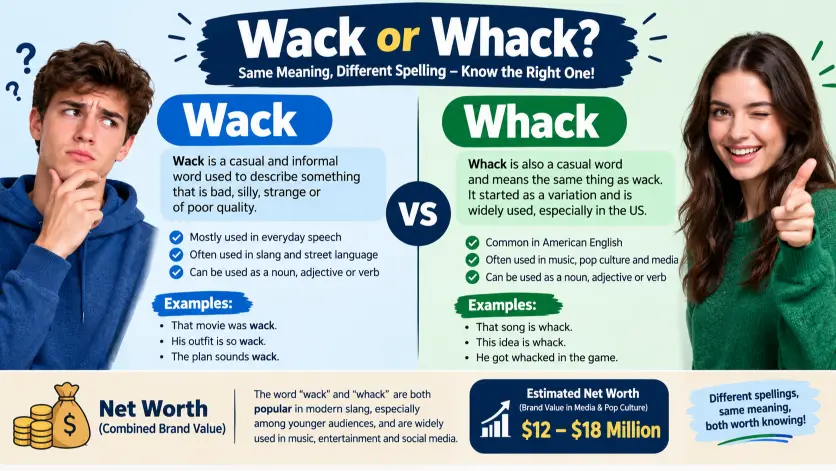
Have you ever wondered whether to write wack or whack? These two words look and sound similar, but their meanings and uses can be quite different. If you have seen someone describe a movie as “wack” or read about someone getting a “whack” on the arm, you might have questioned which spelling is correct. Understanding this difference can help you avoid common spelling mistakes and communicate more clearly.
The word wack is commonly used as informal slang to describe something bad, disappointing, uncool, or poor in quality. In contrast, whack is a standard English word that can mean a forceful hit, the act of striking something, or an attempt to do so. It also appears in informal expressions such as “out of whack,” meaning something is not working or positioned correctly.
In this guide, we will explain the meanings of wack vs. whack, explore their origins, and provide simple examples of how to use each word in everyday conversations, texting, and writing. By examining their spelling, context, and accepted usage, you will learn how to choose the right word confidently and understand why both forms appear in modern English.
Wack vs Whack: What’s the Difference?
The main difference between wack and whack is their meaning and grammatical function. Although they sound identical in many English accents, their spelling indicates different uses. Consequently, the best choice depends on whether you’re describing something as bad or referring to an action such as hitting.
What Does Wack Mean?
Wack is an informal adjective or slang expression used to describe something that is bad, strange, disappointing, ridiculous, or uncool. It appears most often in casual conversations, online discussions, music, and youth culture.
For example, someone might say, “That movie was wack,” to express disappointment with the film. Similarly, a person might describe an unfair decision as “wack” because they consider it unreasonable.
However, wack isn’t usually appropriate in formal academic writing or professional reports. In those situations, words such as poor, unreasonable, inadequate, or disappointing communicate the intended meaning more precisely.
What Does Whack Mean?
Whack is a standard English word that commonly functions as a verb or noun. As a verb, it means to strike or hit something forcefully. As a noun, it can describe a hit or blow.
For instance, “He gave the ball a whack” uses the word as a noun. Meanwhile, “She whacked the piñata” uses it as a verb.
Additionally, whack has several informal expressions. The phrase “out of whack” means that something is not working properly or is out of balance. In some contexts, “a whack at something” means an attempt to do it.
Comparison Table: Wack vs Whack
| Feature | Wack | Whack |
|---|---|---|
| Main meaning | Bad, ridiculous, or uncool | To hit or a forceful blow |
| Part of speech | Informal adjective, sometimes slang noun | Verb or noun |
| Register | Casual and informal | Standard and informal |
| Example | That excuse is wack. | He gave the door a whack. |
| Formal writing | Usually avoid | Appropriate when literally relevant |
| Common phrase | That’s so wack. | Out of whack |
| Common context | Slang, social media, conversation | Actions, sounds, expressions |
Quick recap: Use wack when criticizing something in slang. Use whack when describing a hit, striking action, or blow. Although the words sound alike, they aren’t interchangeable in their principal meanings. Therefore, check the meaning of your sentence before selecting either spelling.
Is Wack vs Whack a Grammar, Vocabulary, or Usage Issue?
The confusion between wack and whack is primarily a vocabulary and spelling issue rather than a complicated grammar rule. Both words can be grammatically correct, but they communicate different ideas. Therefore, understanding the context matters more than memorizing their pronunciation.
Are Wack and Whack Interchangeable?
No, not in their usual meanings. Wack describes something negatively in slang, while whack generally refers to hitting or a blow. For example, “The service was wack” expresses dissatisfaction, whereas “The player delivered a whack” describes a strike.
Nevertheless, informal slang changes over time, and some speakers use these spellings creatively. Even so, standard usage keeps their main meanings distinct.
Formal vs Informal Usage
In casual conversation, wack can communicate an opinion quickly. For example, a teenager might say, “That rule is wack,” when discussing a frustrating school policy.
By comparison, whack works in both casual and formal contexts when its meaning fits. A sports report might describe a player whacking a ball, while a technical report could refer to a machine component being struck.
Academic vs Casual Writing
Academic writing generally benefits from precise, neutral vocabulary. Instead of writing, “The experiment produced wack results,” a student could write, “The experiment produced unreliable results.”
However, whack may be suitable when describing a physical action, a literary passage, or an expression such as “out of whack.” Thus, the important distinction is not simply formal versus informal language. Rather, it is whether the selected word accurately expresses the intended meaning.
Practical Usage: When to Use Wack
The word wack is useful when you want to describe something as bad, disappointing, absurd, or uncool in an informal setting. Although its exact meaning depends on context, it generally communicates a negative judgment.
Workplace Example
Imagine that colleagues are discussing a poorly organized office event. One employee says:
“Honestly, the planning was wack because nobody knew the schedule.”
The sentence communicates dissatisfaction in a casual conversation. However, it would be more appropriate to write, “The planning was ineffective because the schedule was not communicated clearly,” in a formal workplace report.
Academic Example
Suppose a student wants to criticize an argument in a classroom discussion.
“That explanation is wack because it ignores the evidence.”
Although classmates might understand the comment, the wording is informal. A more suitable academic alternative would be, “That explanation is unconvincing because it overlooks important evidence.”
Technology Example
A user might post a casual review saying:
“This app is wack because it crashes every time I open it.”
The statement conveys frustration, but a technical support ticket should provide specific details instead. For example, “The application repeatedly crashes during startup.”
Consequently, slang can express an immediate reaction, while descriptive language helps developers identify and resolve technical problems.
More Examples of Wack
- “That excuse sounds wack.”
- “The concert was wack compared with last year’s show.”
- “It is wack that the rules changed without warning.”
- “His argument was wack and lacked evidence.”
- “That online challenge is wack.”
These sentences use wack to criticize an idea, experience, decision, or activity. However, the word’s informal tone makes it less suitable for official documents.
Usage recap: Choose wack when you intend to express a negative opinion through slang. In professional communication, consider alternatives such as poor, unfair, unconvincing, or disappointing.
Practical Usage: When to Use Whack
The word whack is the correct choice when describing a hit, a striking action, or a blow. It can also appear in established expressions that describe something malfunctioning or being out of balance.
Workplace Example
A maintenance worker might explain:
“The technician heard a whack when the metal panel closed.”
Here, whack describes a sharp impact or the sound associated with one. In a formal incident report, the writer could provide further detail about the impact and its possible cause.
Academic Example
A student writing a story analysis might explain:
“The character delivered a sudden whack to the wooden door.”
In this sentence, the word functions as a noun. Alternatively, the student could write, “The character whacked the wooden door,” using it as a verb.
Both versions are correct, although the noun emphasizes the blow while the verb emphasizes the action.
Technology Example
Consider a computer user whose device isn’t operating correctly. They might say:
“My settings are out of whack after the update.”
This familiar expression means the settings are incorrect, disorganized, or not functioning as expected. It doesn’t mean someone physically hit the settings.
Similarly, a mechanic might say that a machine’s alignment is out of whack, meaning it is no longer properly adjusted.
More Examples of Whack
- “He whacked the ball across the field.”
- “She heard a whack against the window.”
- “The schedule is completely out of whack.”
- “I’ll take a whack at solving the puzzle.”
- “The comedian whacked the piñata during the party.”
Notice that whack can communicate a physical action or appear in an idiomatic expression. Therefore, its intended meaning should be clear from the surrounding words.
Usage recap: Use whack for striking, a blow, or familiar expressions such as out of whack. Unlike wack, this spelling is established in standard English and isn’t limited to slang.
When You Should NOT Use Wack or Whack
Although these words sometimes appear in similar conversations, certain situations make one spelling clearly inappropriate.
1. When Describing a Physical Strike
Don’t use wack when you mean that someone hit an object.
Incorrect: “He gave the drum a wack.”
Correct: “He gave the drum a whack.”
The second sentence uses the standard noun for a blow.
2. When Criticizing Something in Slang
Don’t use whack merely because you want to call something bad or uncool.
Incorrect: “That movie was whack,” if you intend the conventional slang adjective wack.
Correct: “That movie was wack.”
Although readers may encounter alternative spellings in informal online writing, wack is the conventional choice for this slang meaning.
3. When Writing Formal Academic Essays
Avoid using wack as a substitute for precise criticism in a research paper.
Instead of “The theory is wack,” write, “The theory lacks sufficient supporting evidence.”
This change makes the criticism clearer and more appropriate for academic readers.
4. When Preparing Official Workplace Reports
Slang can make an otherwise useful report seem vague. Therefore, replace “The scheduling process was wack” with “The scheduling process was inefficient.”
However, keep whack if you’re accurately describing an impact or relevant established expression.
5. When Using the Expression Out of Whack
Don’t replace the standard expression with out of wack when following conventional spelling.
Correct: “The printer’s alignment is out of whack.”
The phrase describes something that is improperly adjusted or out of balance.
6. When Writing Technical Instructions
Avoid vague expressions when the reader needs exact instructions. For instance, “Whack the device until it works” is poor troubleshooting guidance because striking electronics can damage them.
Instead, describe a safe diagnostic step, such as restarting the device or checking its connections.
7. When Editing Professional Reviews
Don’t rely on slang alone to explain a negative evaluation. Rather than writing, “The product is wack,” identify the actual issue, such as poor durability, slow performance, or an unclear interface.
8. When the Context Changes the Meaning
Finally, don’t choose a spelling simply because it sounds right. Read the entire sentence and identify the intended meaning first. If you mean a blow, choose whack. If you mean bad or uncool in slang, choose wack.
Common Mistakes: Wack vs Whack
Many spelling mistakes occur because English speakers rely on pronunciation instead of meaning. Since these words sound alike, the sentence itself provides the best clue.
| Correct sentence | Incorrect sentence | Explanation |
|---|---|---|
| That decision was wack. | That decision was whack. | Use wack for the conventional slang meaning of bad or unreasonable. |
| He gave the table a whack. | He gave the table a wack. | A blow is spelled whack. |
| The schedule is out of whack. | The schedule is out of wack. | The established expression uses whack. |
| She whacked the ball. | She wacked the ball. | The standard verb meaning to hit is whack. |
| The service was wack. | The service was whack. | Wack expresses an informal negative opinion. |
| I’ll take a whack at it. | I’ll take a wack at it. | The idiom meaning to attempt something uses whack. |
The Decision Rule
Use WACK
If you’re describing something as bad, ridiculous, disappointing, or uncool in informal slang, choose wack.
Use WHACK
If you mean a physical hit, a blow, the action of striking, or an expression such as out of whack, choose whack.
This simple test works in most everyday situations. Nevertheless, if the intended meaning is unclear, replace slang with a more precise word rather than forcing either spelling into the sentence.
Wack and Whack in Modern Technology and Digital Communication
Digital communication has made slang more visible than ever. Consequently, wack frequently appears in comments, gaming conversations, short messages, music discussions, and product reviews.
For example, a gamer might write, “That update is wack,” to complain about an unpopular change. Similarly, someone might describe a poorly designed feature as wack in a casual discussion.
By contrast, whack appears when users describe an action or an unusual condition. A player might say, “I whacked the target,” while a computer user could report that their display settings are out of whack.
Importantly, spelling correction software may suggest changes based on the surrounding sentence. However, neither spelling should be selected automatically without checking its meaning. A useful writing assistant should distinguish slang from a standard verb or noun instead of treating every unusual expression as a spelling error.
Therefore, when writing online, consider your audience and purpose. Casual slang can make a message sound natural, while precise wording helps technical explanations remain understandable.
Etymology: Where Do Wack and Whack Come From?
The word whack has a long history in English as an informal term associated with striking or hitting. Its exact historical development is uncertain, although dictionaries commonly connect it with expressive words that imitate the sound of an impact.
Over time, whack developed additional meanings and expressions. For example, a whack at something can refer to an attempt, while out of whack describes something that is not properly balanced or functioning correctly.
The slang spelling wack, meanwhile, became associated with descriptions of something inferior, ridiculous, or uncool. It gained visibility through popular culture, especially hip hop and informal speech.
Although the two words sound alike, their conventional meanings evolved differently. As a result, modern English uses separate spellings to distinguish negative slang from striking and related expressions.
Expert Insight: How to Choose the Correct Word
A useful editorial principle is that spelling should communicate meaning, not merely reproduce sound.
“Choose the word that expresses your intended meaning, not simply the one that sounds right.”
This principle applies to many confusing English word pairs. For example, their and there sound alike but serve different grammatical purposes. Similarly, wack and whack require readers to interpret context rather than pronunciation alone.
When editing a sentence, identify the intended action or description first. Next, check whether the word functions as a noun, verb, or slang adjective. Finally, consider whether the tone suits the audience.
These three steps help writers avoid mistakes without relying on memorization alone.
Two Case Studies: Applying Wack and Whack Correctly
The following examples illustrate how the distinction works in realistic writing situations.
Case Study 1: A Negative Product Review
A customer purchases a mobile application that repeatedly freezes and displays errors. They initially write:
“This app is whack because it keeps crashing.”
The intended message is clear to many readers, but the conventional slang spelling for something bad is wack. Therefore, the corrected casual review is:
“This app is wack because it keeps crashing.”
However, if the review is intended to help the developer investigate the problem, a more useful version would be:
“The application frequently crashes during startup and becomes unresponsive.”
Result: The revised wording communicates dissatisfaction more accurately. The slang correction improves conventional spelling, while the technical alternative provides actionable information.
Case Study 2: Describing a Physical Action
A student writes a short story about a baseball player and includes this sentence:
“The player gave the ball a wack before running to first base.”
Here, the student means a forceful strike rather than a negative opinion. Therefore, the correct sentence is:
“The player gave the ball a whack before running to first base.”
An editor could also revise the sentence to read, “The player whacked the ball before running to first base.”
Result: The corrected spelling makes the intended physical action clear. The alternative verb construction also gives the sentence a more direct rhythm.
These case studies demonstrate the central rule: identify what the sentence means before choosing its spelling.
Error Prevention Checklist: Wack or Whack?
Before publishing a message, reviewing an essay, or sending a workplace email, use this quick checklist.
Always Use Wack When
- You want to describe something as bad or disappointing in slang.
- You’re expressing that an idea, decision, or experience is uncool.
- You’re writing informal dialogue that reflects casual speech.
- The sentence communicates a negative opinion rather than a physical action.
Never Use Wack When
- You mean a physical blow or strike.
- You’re using the conventional expression out of whack.
- You need the standard verb meaning to hit something.
- You’re writing formal criticism and a more precise adjective would communicate the point better.
Always Use Whack When
- You mean to strike or hit something.
- You are referring to a blow as a noun.
- You’re using expressions such as take a whack at something.
- You’re describing something that is out of balance or not working properly.
Final Editing Questions
Before deciding, ask yourself:
- Am I describing something negatively, or am I referring to a hit?
- Does the sentence use the word as an adjective, noun, or verb?
- Is the tone suitable for the intended reader?
- Would a clearer word communicate the meaning more effectively?
If you can answer these questions, you’ll usually identify the correct spelling.
Related Grammar Confusions You Should Master
Learning the difference between wack and whack can also help you understand other English words that sound similar but have different meanings.
- Their vs There: Learn the difference between possession and location.
- Your vs You’re: Distinguish a possessive determiner from a contraction.
- Its vs It’s: Understand possession versus the contraction of it is or it has.
- Affect vs Effect: Separate a commonly used verb from a commonly used noun.
- Then vs Than: Distinguish time or sequence from comparison.
- Lose vs Loose: Learn the difference between misplacing something and something that is not tight.
- Accept vs Except: Understand receiving something versus excluding something.
- Advice vs Advise: Separate the noun for guidance from the verb meaning to recommend.
- Compliment vs Complement: Distinguish praise from something that completes or enhances another thing.
- Weather vs Whether: Learn the difference between atmospheric conditions and a word introducing alternatives or uncertainty.
These pairs illustrate why context is important in English. Although similar sounds can make spelling confusing, identifying a word’s function and meaning usually resolves the problem.
Frequently Asked Questions
1. Is It Wack or Whack?
Both spellings are correct, but they have different meanings. Wack is informal slang for something bad, ridiculous, or uncool. Whack means to strike something, a blow, or a condition described by expressions such as out of whack.
2. What Does Wack Mean in Slang?
In slang, wack describes something considered bad, disappointing, ridiculous, or uncool. For example, “That game is wack” means the speaker thinks the game is poor or unenjoyable.
3. What Does Whack Mean in English?
Whack commonly means to hit or strike something forcefully. It can also be a noun referring to a blow. For instance, “He gave the ball a whack” describes a single striking action.
4. Are Wack and Whack Pronounced the Same?
Yes, they are generally pronounced the same in common English speech. This similarity explains why people confuse their spellings. However, their meanings differ, so the intended message determines which spelling is appropriate.
5. Is Wack a Real Word?
Yes. Wack is an established informal slang spelling used to describe something as bad, ridiculous, or uncool. Although it is widely recognizable in casual communication, it is less appropriate than precise alternatives in formal academic and professional writing.
6. Is Whack a Slang Word?
Whack is a standard English word that also appears in informal expressions. Its meaning as a hit or striking action is not limited to slang. Phrases such as out of whack are informal idioms, while the basic verb and noun are established English usage.
7. What Does Out of Whack Mean?
Out of whack means that something is not properly adjusted, balanced, organized, or functioning as expected. For example, “My sleep schedule is out of whack” means the person’s normal sleeping routine has become irregular.
8. How Do You Use Wack in a Sentence?
Use wack when expressing a negative opinion in informal speech. For example, “The service was wack because the staff ignored our requests.” In formal writing, poor, unprofessional, or disappointing may communicate the criticism more clearly.
9. How Do You Remember the Difference Between Wack and Whack?
Remember that whack contains the letter combination associated with the standard word for hitting. Meanwhile, wack is the informal spelling used for a negative judgment. Then check the sentence’s meaning to confirm your choice.
Conclusion: Wack or Whack, Which Is Correct?
Ultimately, both wack and whack are correct English words, but they serve different purposes. Use wack when describing something as bad, ridiculous, or uncool in informal slang. Conversely, choose whack when referring to a physical strike, a blow, or expressions such as out of whack.
Although their pronunciation is usually identical, their meanings aren’t interchangeable. Therefore, focus on the message you’re trying to communicate rather than relying on sound alone. When writing academic assignments, professional documents, or technical explanations, choose precise vocabulary that suits your audience.
Once you understand this simple distinction, you’ll be able to use both words confidently in everyday conversations, online messages, and formal writing.









