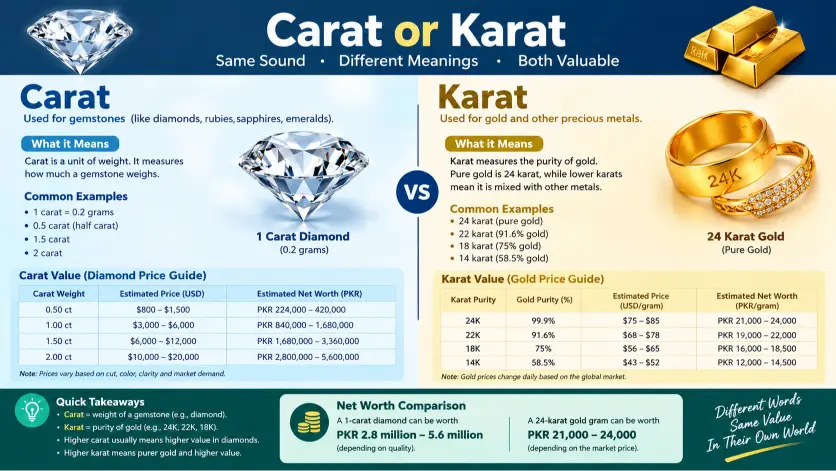
Have you ever wondered whether the correct word is carat or karat? These two terms sound exactly alike, which makes them easy to confuse, especially when shopping for diamonds, gold rings, or other valuable jewelry. Although their spellings differ by just one letter, they have distinct meanings. Choosing the right word can help you communicate more clearly and understand jewelry descriptions with greater confidence.
The main difference is simple: carat commonly measures the weight of diamonds and other gemstones, while karat indicates the purity of gold. For example, a two-carat diamond weighs twice as much as a one-carat diamond, whereas 24-karat gold is considered pure gold under the conventional karat system. Understanding this distinction helps prevent common spelling and terminology mistakes.
In this guide, we will explain the meanings of carat and karat, explore their correct usage, and provide practical examples to make the difference easy to remember. Drawing on standard English usage and established jewelry terminology, this article will help students, writers, jewelry shoppers, and anyone learning English choose the right term in everyday conversations and professional writing.
Carat or Karat: What’s the Difference?
The primary difference between carat and karat is the measurement each word represents. Although both relate to precious jewelry, they are not interchangeable in standard American English.
Carat
A carat is a noun that measures the weight of a gemstone. Jewelers commonly use it when discussing diamonds, rubies, emeralds, sapphires, and other precious stones.
One metric carat equals exactly 200 milligrams, or 0.2 grams. Therefore, a gemstone weighing five carats has a mass of one gram.
However, carat weight does not determine a gemstone’s entire appearance or market value. Cut, color, clarity, shape, and other characteristics also influence how a stone looks and how much it costs.
Karat
A karat is a noun used primarily in American English to describe the purity of gold. Pure gold is designated as 24 karat, although actual gold products may contain small amounts of other metals.
For example, 18 karat gold contains 18 parts gold out of 24 parts total, which equals 75 percent gold by weight. The remaining portion consists of other metals that can influence the material’s strength, color, and working properties.
Consequently, a karat rating tells you about gold purity rather than the weight of a diamond or another gemstone.
Comparison Table: Carat vs. Karat
| Feature | Carat | Karat |
|---|---|---|
| Part of speech | Noun | Noun |
| Main meaning | Gemstone weight | Gold purity |
| Common use | Diamonds and colored gemstones | Gold jewelry and alloys |
| One unit represents | 200 milligrams | One twenty fourth of the purity scale |
| Example | A 2 carat diamond | An 18 karat gold ring |
| American spelling | Carat | Karat |
| British spelling | Carat | Carat is also used for gold purity |
| What it tells you | How much a gemstone weighs | How much gold an alloy contains |
Quick Recap
A carat measures the weight of a gemstone, whereas a karat measures the purity of gold in American English.
For example, a three carat diamond weighs 600 milligrams.
Similarly, 14 karat gold contains 14 parts gold out of 24, or approximately 58.3 percent.
Therefore, remember that gemstones have carat weights while gold jewelry has karat ratings in American usage.
Is Carat or Karat a Grammar, Vocabulary, or Usage Issue?
The difference between carat and karat is primarily a vocabulary and usage issue rather than a grammar problem. Both words are nouns, and each can appear correctly in a sentence when its meaning matches the context.
Nevertheless, using one spelling in place of the other can create a factual error.
Are Carat and Karat Interchangeable?
No, not in standard American English when referring to gemstones and gold purity.
For instance, the sentence “This diamond weighs two carats” correctly describes a gemstone. However, saying “This diamond weighs two karats” uses the wrong term for its weight.
Likewise, “The necklace is made from 18 karat gold” correctly communicates the gold’s purity in American English. Using carat in this sentence would be understood by many readers, but karat is the customary American spelling for gold purity.
Formal vs. Informal Usage
In formal settings, including jewelry appraisals, product specifications, and educational materials, choosing the appropriate term improves precision. In casual conversations, people may understand the intended meaning from context, even when a spelling is incorrect.
However, informal familiarity does not make the terms identical. Therefore, use the conventional spelling whenever accuracy matters.
American vs. British English
Regional spelling creates an additional complication. In British English, carat can refer to both gemstone weight and gold purity. In American English, carat generally refers to gemstone weight, while karat refers to gold purity.
As a result, neither spelling should be judged without considering the variety of English being used.
Practical Uses of Carat
The word carat appears whenever the weight of a gemstone is discussed. Therefore, it is particularly important in jewelry shopping, gemstone certification, manufacturing, and educational writing.
Workplace Example
A jewelry store employee might explain, “The customer requested a one carat diamond for the engagement ring.”
Here, carat communicates the requested gemstone weight. Consequently, the employee can compare stones with similar weights before discussing their other qualities.
Academic Example
A student studying mineralogy might write, “The gemstone has a mass of 400 milligrams, equivalent to two carats.”
This sentence is accurate because one carat equals 200 milligrams. Moreover, including the metric conversion makes the measurement easier to verify.
Technology Example
An online jewelry catalog might display the specification “Diamond weight: 1.25 carats.”
This information helps shoppers compare gemstones across product listings. Nevertheless, carat weight alone cannot establish that two diamonds have identical dimensions, appearance, or quality.
Usage Recap
Use carat when measuring the weight of a diamond or another gemstone. Furthermore, remember that carat weight represents mass rather than a direct measurement of visible size.
Practical Uses of Karat
In American English, karat describes the purity of gold. Therefore, it appears frequently in descriptions of rings, bracelets, necklaces, earrings, coins, and other gold products.
Workplace Example
A jewelry specialist might say, “This wedding band is made from 14 karat gold.”
The phrase indicates that 14 parts out of 24 are gold by weight. Consequently, the remaining portion consists of other metals used in the alloy.
Academic Example
A materials science student might explain, “An 18 karat gold alloy contains 75 percent gold by weight.”
This statement accurately converts the purity rating into a percentage. Additionally, it illustrates how gold can be combined with other metals to create jewelry with different properties.
Technology Example
An online marketplace might label a necklace “18K yellow gold.”
In this case, the abbreviation K communicates the karat rating. However, buyers should still examine the seller’s documentation and product description rather than assuming that a label alone verifies authenticity.
Usage Recap
Use karat for gold purity in American English. Moreover, remember that 24 karat represents pure gold on the conventional scale, while lower ratings indicate a smaller proportion of gold.
When You Should NOT Use Carat or Karat
Although the terms are closely associated with jewelry, each has specific limits. Therefore, avoiding the following mistakes can improve both writing accuracy and purchasing decisions.
1. Do not use carat to describe gold purity in American English. Instead, write “14 karat gold” when explaining the proportion of gold in an alloy.
2. Do not use karat to describe gemstone weight. A diamond’s weight should be expressed in carats, such as “a 1.5 carat diamond.”
3. Do not assume carat measures the visible size of a gemstone. Two stones with identical carat weights can appear different because of their cut, proportions, and shape.
4. Do not assume a higher karat rating automatically means a better jewelry choice. Higher purity may be desirable, but durability, intended use, personal preference, and price also matter.
5. Do not confuse gemstone weight with gold content. A ring can contain a diamond measured in carats and a gold band described in karats.
6. Do not interpret 18 karat gold as 18 percent gold. The rating means 18 parts out of 24, which equals 75 percent.
7. Do not automatically mark carat as incorrect in British English when discussing gold purity. British usage commonly uses carat for both meanings.
8. Do not rely on spelling alone to establish jewelry authenticity. Instead, review reliable documentation, appropriate testing, and the seller’s stated specifications.
Common Mistakes: Carat or Karat
Even experienced writers can confuse these terms because they sound alike. However, examining the object being described usually reveals the correct choice.
| Correct sentence | Incorrect sentence | Explanation |
|---|---|---|
| The diamond weighs two carats. | The diamond weighs two karats. | Gemstone weight is measured in carats. |
| She purchased a 14 karat gold bracelet. | She purchased a 14 carat gold bracelet. | American English convention uses karat for gold purity. |
| The ruby weighs three carats. | The ruby weighs three karats. | A ruby is a gemstone, so its weight is expressed in carats. |
| This ring contains 18 karat gold. | This ring contains 18 carat gold. | Karat is the conventional American spelling for gold purity. |
| The diamond weighs 0.5 carats. | The diamond weighs 0.5 karats. | The decimal number describes gemstone weight. |
| The earrings are made from 24 karat gold. | The earrings are made from 24 carat gold. | In American English, gold purity uses karat. |
The incorrect examples above reflect American English conventions. In British English, carat can also be correct when describing gold purity.
Decision Rule Box
If you mean gemstone weight, use CARAT.
If you mean gold purity, use KARAT in American English.
For British English, carat is commonly used for both meanings.
For example, a two carat diamond set in an 18 karat gold ring contains two different measurements: the gemstone’s weight and the metal’s purity.
Carat or Karat in Modern Technology and Digital Tools
Today, jewelry information appears across online marketplaces, mobile shopping applications, digital appraisal records, and product databases. Therefore, consistent terminology helps customers interpret product details correctly.
For example, a jewelry database might store gemstone weight as 1.00 carat and gold purity as 18K. Although the abbreviated format saves space, the underlying meanings remain different.
Similarly, digital product filters may allow shoppers to select diamond weights or gold purity ratings. Consequently, clear labels reduce the risk of comparing unrelated specifications.
Automated writing and catalog systems can also confuse words that sound alike. Nevertheless, a simple context check can prevent many errors: if the description concerns a gemstone’s weight, choose carat; if it concerns gold purity in American English, choose karat.
Ultimately, technology can display the information, but the writer must ensure that each measurement accurately describes the product.
Etymology: Where Do Carat and Karat Come From?
The words carat and karat share a historical connection. Their development is associated with the Greek word keration, meaning the fruit or seed of the carob tree.
Historically, carob seeds were associated with weighing small quantities, including precious materials. Over time, related words passed through other languages and became established in European jewelry terminology.
Eventually, English developed the familiar spelling carat for gemstone weight. Meanwhile, karat became the customary American spelling for gold purity.
Although the spellings differ today, their shared history helps explain why they sound alike and why both belong to the vocabulary of precious jewelry.
An Expert Style Rule for Everyday Writing
A useful principle for jewelry descriptions is to identify the property being measured before selecting the term.
“Measure the gemstone in carats, describe the gold in karats, and always check the regional convention.”
This practical rule helps distinguish weight from purity without requiring you to memorize complicated definitions. Moreover, it works in product descriptions, customer conversations, classroom assignments, and jewelry comparisons.
Two Practical Case Studies: Choosing the Correct Term
The following illustrative case studies demonstrate how the distinction works in realistic situations. The outcomes are examples rather than reports of independently verified customer transactions.
Case Study 1: Comparing Two Diamond Rings
Imagine that a customer is comparing two engagement rings. The first has a diamond weighing 1.00 carat, while the second has a diamond weighing 1.50 carats.
At first, the customer might assume that the second stone must look exactly 50 percent larger. However, carat measures weight rather than visible dimensions. Differences in cut, depth, and shape can affect the apparent size.
Therefore, the customer compares the stone weights alongside their measurements and other quality characteristics. The result is a more informed comparison based on the actual specifications rather than the number alone.
Practical result: The customer understands what the carat rating establishes and avoids treating weight as a complete measure of appearance or quality.
Case Study 2: Understanding a Gold Necklace Label
Now imagine a shopper considering two necklaces. One is labeled 14K gold, while the other is labeled 18K gold.
The shopper initially assumes that 18K means the necklace contains 18 percent gold. However, the rating actually represents 18 parts gold out of 24, or 75 percent. By comparison, 14K gold contains approximately 58.3 percent gold.
After understanding the labels, the shopper can compare gold purity alongside price, durability, design, and intended use. Nevertheless, the rating alone does not verify the authenticity of either necklace.
Practical result: The shopper interprets the gold content correctly and makes a comparison based on the actual meaning of each rating.
Error Prevention Checklist: Carat or Karat
Before publishing a jewelry description, product listing, or educational paragraph, review the following checklist.
Always Use Carat When
- Describing the weight of a diamond.
- Recording the weight of a ruby, emerald, sapphire, or another gemstone.
- Explaining that one carat equals 200 milligrams.
- Comparing gemstone weights in a jewelry catalog.
- Writing an American English description of a gemstone’s weight.
Never Use Karat When
- You mean the weight of a gemstone in American English.
- You are converting gemstone carats into grams or milligrams.
- You need to describe a diamond’s weight rather than its setting’s metal purity.
- You are treating the karat rating as a percentage without converting it to a fraction of 24.
Final Review
Before submitting your work, identify whether the sentence concerns a stone or a metal. Then, check whether the context follows American or British spelling conventions. Finally, verify that any numerical statement accurately reflects the measurement being described.
Related Grammar Confusions You Should Master
Learning to distinguish similar sounding or similarly spelled words can improve your writing. Likewise, studying other commonly confused terms helps develop stronger vocabulary habits.
- Affect vs. Effect: Understand the difference between an action or influence and a resulting outcome.
- Fewer vs. Less: Learn when to use countable quantities and general amounts.
- Altar vs. Alter: Distinguish a religious structure from the act of changing something.
- Principal vs. Principle: Separate a person or primary item from a rule or belief.
- Complement vs. Compliment: Identify whether something completes another thing or expresses praise.
- Stationary vs. Stationery: Distinguish remaining in one place from writing materials.
- Advice vs. Advise: Recognize the noun for a recommendation and the verb meaning to recommend.
- Lose vs. Loose: Avoid confusing the act of misplacing something with the adjective meaning not tight.
- Their vs. There: Separate possession from a word referring to a place or introducing a statement.
- Carat vs. Karat: Remember the difference between gemstone weight and gold purity in American English.
Frequently Asked Questions
1. What is the difference between carat and karat?
A carat measures the weight of a gemstone, while a karat measures the purity of gold in American English. Therefore, a diamond is described by its carat weight, whereas a gold ring is described by its karat rating.
2. Is carat or karat correct for gold?
In American English, karat is the customary spelling for gold purity. However, British English commonly uses carat for both gemstone weight and gold purity. Therefore, the correct spelling depends on the regional convention.
3. Is a 24 carat diamond the same as 24 karat gold?
No. A diamond’s weight is measured in carats, while gold purity is measured in karats in American English. Consequently, a 24 carat diamond and 24 karat gold describe entirely different properties.
4. How many grams are in one carat?
One metric carat equals 0.2 grams, or 200 milligrams. Therefore, a gemstone weighing five carats has a mass of one gram.
5. Does a higher carat diamond mean better quality?
Not necessarily. A higher carat weight means a heavier gemstone, but it does not automatically mean better color, clarity, cut, or overall appearance. Therefore, buyers should compare several characteristics before choosing a diamond.
6. Is 18 karat gold pure gold?
No. Eighteen karat gold contains 18 parts gold out of 24, which equals 75 percent gold by weight. The remaining 25 percent consists of other metals in the alloy.
7. Is 14K gold better than 18K gold?
Neither rating is universally better. Fourteen karat gold contains approximately 58.3 percent gold, whereas 18 karat gold contains 75 percent. The right option depends on factors such as desired purity, durability, design, and budget.
8. Why do carat and karat sound the same?
Both words developed from historically related terminology associated with precious materials and measurement. Although their modern spellings and meanings differ, their pronunciation remains the same in many varieties of English.
9. Can I write carat for gold in British English?
Yes. British English commonly uses carat to describe both gemstone weight and gold purity. By contrast, American English generally distinguishes the terms by using carat for gemstone weight and karat for gold purity.
Conclusion:
The difference between carat or karat becomes straightforward once you understand what each term measures. A carat describes the weight of a gemstone, while a karat describes gold purity in American English. For example, a two carat diamond weighs 400 milligrams, whereas 18 karat gold contains 75 percent gold by weight.
Moreover, British English commonly uses carat for both meanings, so regional conventions matter. Ultimately, identify whether you are describing a gemstone or gold, consider your audience, and select the spelling that communicates the measurement accurately. With this simple distinction, you can write clearer jewelry descriptions and interpret product specifications with greater confidence.









