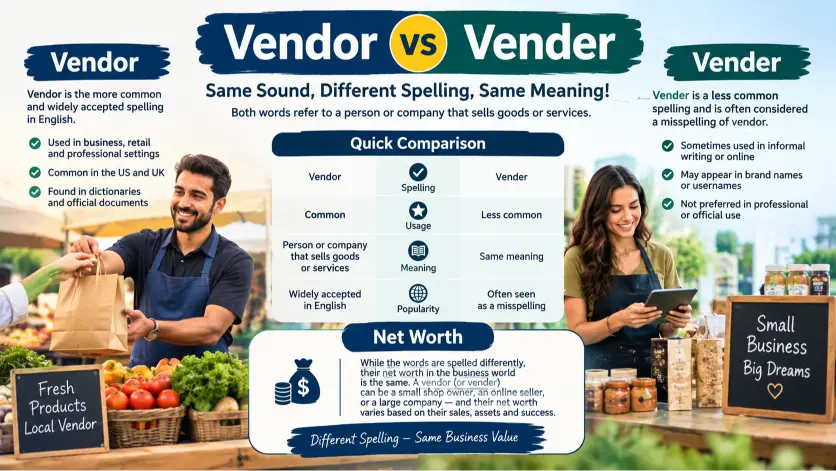
Have you ever typed “vendor or vender” and wondered which spelling is actually correct? You are not alone. These two words look almost identical, but only one is the standard spelling used in modern English. The confusion often appears in business writing, online shopping, workplace communication, and everyday conversations. Understanding the difference can help you avoid simple spelling mistakes and communicate more professionally.
In this guide, we will explain vendor vs vender in clear, simple English, including their meanings, correct spelling, pronunciation, usage, and practical examples. You will also learn why vendor is the accepted spelling when referring to a person or company that sells goods or services. Based on established English usage and dictionary conventions, this article focuses on the form you are most likely to encounter in professional, academic, and everyday writing. By the end, you will have a quick rule to remember which word to use with confidence.
Vendor or Vender: What’s the Difference?
At first glance, vendor and vender look almost identical. However, their frequency and practical usage are quite different. Understanding that distinction can prevent spelling errors in emails, reports, contracts, websites, invoices, and other professional documents.
The word vendor is a noun. It generally describes a person, company, shop, or organization that sells products or provides services. For example, a software company may purchase a subscription from a technology vendor.
The word vender is also a noun. Historically and lexically, it can refer to someone who sells something because it comes from the verb vend, meaning to sell. Nevertheless, vender is much less common in contemporary standard English.
Therefore, the important distinction is not that one word has a completely different meaning from the other. Instead, the major issue is modern usage and spelling preference.
In business communication, vendor is overwhelmingly more familiar. Likewise, readers generally expect vendor when discussing suppliers, contractors, software providers, retailers, or commercial partners.
Consequently, choosing vendor will usually make your writing sound natural and professional. Meanwhile, vender may look like a spelling mistake to readers who aren’t familiar with the less common form.
Is Vendor or Vender a Grammar, Vocabulary, or Usage Issue?
The confusion between vendor or vender is primarily a vocabulary and usage issue rather than a basic grammar problem.
Both forms can function as nouns referring to someone who sells something. However, English does not treat every technically possible spelling as equally common in contemporary communication.
For example, vendor is standard in expressions such as vendor management, vendor agreement, vendor relationship, and software vendor. These combinations are deeply established in professional English.
By contrast, vender has limited visibility in modern business writing. Although dictionaries may recognize it, its lower frequency means that many readers interpret it as an accidental spelling variation.
Furthermore, the distinction is not normally about formal grammar versus informal grammar. Instead, it is about which spelling is conventional and widely understood.
In academic writing, vendor is generally preferable because academic prose benefits from familiar terminology. Similarly, in workplace documents, vendor reduces unnecessary ambiguity.
Casual writing can sometimes tolerate less common variants. Nevertheless, if your goal is clarity, consistency, and broad reader acceptance, vendor remains the practical choice.
Vendor: Meaning, Examples, and Practical Usage
Vendor is the preferred modern spelling when referring to a seller, supplier, merchant, or company that provides goods or services.
For instance, a business may work with a vendor that supplies office furniture. Similarly, a technology department may evaluate several vendors before purchasing software.
Workplace example
A procurement manager might write:
“We are reviewing three vendors before renewing the contract.”
Here, vendor clearly identifies companies that provide products or services to the organization.
Likewise, an employee might say:
“Please contact the vendor about the delayed shipment.”
In this context, the word fits naturally because the external company is responsible for supplying the requested item.
Academic example
Consider a research paper discussing commercial relationships:
“The company selected a local vendor to provide laboratory equipment.”
Here, vendor identifies the business supplying the equipment. Therefore, the term works naturally in formal academic prose.
Technology example
Technology writing frequently uses vendor to describe a company that develops, sells, or supports a product.
For example:
“The organization contacted its software vendor after discovering an issue with the application.”
Similarly, phrases such as vendor support, vendor contract, vendor platform, and vendor management are common in professional technology environments.
Usage recap
Use vendor when referring to a modern seller or commercial provider. Furthermore, it works naturally for individuals, companies, suppliers, retailers, and service providers.
Therefore, if you’re writing an invoice, report, email, proposal, article, or business document, vendor is normally the appropriate choice.
Vender: Meaning, History, and Practical Usage
Although vender is much less common, it isn’t simply a meaningless spelling invented by mistake.
The term is connected to the verb vend, which means to sell. Consequently, vender can logically describe someone who sells something.
However, modern English strongly favors vendor for this meaning. As a result, using vender in ordinary business communication can distract readers or make them wonder whether the spelling was intentional.
Workplace example
A sentence such as:
“The company works with several food vendors.”
sounds completely natural.
Changing it to:
“The company works with several food venders.”
may still be understandable, but it is far less familiar to most contemporary readers.
Academic example
A historical discussion might use vender when describing an older text or a particular lexical tradition. Nevertheless, modern academic writers generally have little reason to choose it when vendor communicates the same idea more conventionally.
Technology example
Technology professionals almost always encounter phrases such as vendor software, vendor support, vendor documentation, and vendor agreement.
Using vender instead could make an otherwise polished technical document appear inconsistent.
Usage recap
Vender can be understood as a noun connected with selling. However, it is uncommon in modern standard usage.
Therefore, unless you have a specific reason to preserve an unusual or historical spelling, vendor is the better practical choice.
When You Should NOT Use Vendor or Vender
Knowing when not to use these terms is just as important as knowing their meanings. In particular, several situations call for a different word.
1. When you mean a customer
A customer buys something from a business. Therefore, calling the customer a vendor reverses the relationship.
Incorrect idea:
“The vendor purchased our product.”
If that company is buying rather than selling, customer or buyer may be more appropriate.
2. When you mean an employee
A vendor is not automatically an employee. Instead, a vendor normally operates as an external seller or provider.
Therefore, don’t use vendor when referring to someone employed directly by your organization.
3. When you mean a manufacturer
A manufacturer produces goods, while a vendor sells or supplies goods. Sometimes one company performs both roles. However, the terms aren’t automatically interchangeable.
4. When you mean a distributor
A distributor moves products through a supply network. A vendor may sell those products, but the two terms describe different business functions.
5. When you mean a buyer
A buyer purchases products or services. Conversely, a vendor supplies or sells them.
6. When discussing the verb action
If you want to describe the act of selling, use vend rather than vendor or vender.
For example:
“The company plans to vend its products at the festival.”
Here, vend is the verb.
7. When a specific professional term is clearer
Sometimes supplier, retailer, merchant, contractor, provider, or manufacturer communicates the relationship more precisely.
Consequently, choose the term that accurately describes the person’s or company’s role rather than automatically using vendor.
Common Mistakes: Vendor or Vender
Because the two spellings differ by only one letter, mistakes are easy to make. Nevertheless, a few simple examples can make the distinction much clearer.
Decision Rule
If you mean a person or company that sells goods or services, use vendor.
If you mean the act of selling, use vend.
If you encounter vender, understand that it is a rare variant rather than the normal modern spelling.
This rule is more reliable than simply memorizing the two spellings because it focuses on both meaning and contemporary usage.
Vendor and Vender in Modern Technology
Modern technology has made the word vendor particularly common.
For example, businesses routinely discuss software vendors, hardware vendors, cloud vendors, security vendors, and service vendors. Furthermore, procurement teams may maintain vendor databases to track contracts, payments, renewal dates, and supplier information.
The term also appears in technical documentation. A company may refer to a third party as a vendor when that organization supplies software, infrastructure, equipment, or technical support.
By comparison, vender appears much less frequently in this environment. Consequently, a technology professional who writes vender may unintentionally create the impression of a spelling error.
Modern digital communication also rewards familiar terminology. Therefore, vendor is generally the clearer choice for documentation, product descriptions, business correspondence, and professional reports.
Etymology of Vendor and Vender
The history of these words explains why the confusion exists.
Vendor ultimately comes through Latin and later European language forms associated with selling. English adopted the noun to describe someone who sells goods or services.
Meanwhile, vender is closely connected with the English verb vend. The verb itself means to sell or offer goods for sale.
Because the meanings overlap, both forms can appear logical. Nevertheless, language develops according to common usage rather than pure spelling logic.
Over time, vendor became the overwhelmingly familiar noun in modern English. Consequently, contemporary writers generally select vendor when describing a seller or commercial provider.
This is an important lesson in English vocabulary: a word can be technically recognizable while still being much less suitable for ordinary modern communication.
Expert View on Vendor or Vender
A useful linguistic principle is that frequency and convention matter alongside dictionary recognition. A form can exist in English without being the form most readers expect.
In practical writing, therefore, the best choice is usually the word that communicates the intended meaning immediately and naturally.
As a result, vendor is preferable in most contemporary contexts because readers encounter it frequently across commerce, technology, procurement, retail, and professional communication.
Two Practical Case Studies
Case Study 1: Procurement Communication
Suppose a purchasing department prepares an internal report comparing external suppliers.
The original draft repeatedly uses vender. Although readers can understand the meaning, several employees initially assume the spelling is accidental.
The team changes every occurrence to vendor. Consequently, the report becomes more consistent with established business terminology, and reviewers no longer need to question the unusual spelling.
The practical result is greater clarity without changing the underlying meaning.
Case Study 2: Technology Documentation
Imagine a software company preparing customer documentation about third party providers.
The first draft uses both vendor and vender inconsistently. Consequently, readers encounter two spellings for what appears to be the same concept.
The documentation team standardizes the terminology as vendor. As a result, terminology becomes consistent throughout the guide, headings become easier to scan, and readers encounter fewer distractions.
The lesson is straightforward: consistent terminology supports professional communication.
Vendor or Vender: Error Prevention Checklist
Before publishing or sending your writing, check the following points.
Always use vendor when:
You mean a person who sells goods.
You mean a company that provides commercial products.
You mean an external supplier.
You are writing about software providers.
You are discussing procurement or business relationships.
You are preparing professional documentation.
You want the spelling most readers expect.
Never use vender when:
You are simply trying to spell the common business term.
You are writing a formal report and have no historical reason for the uncommon variant.
You are describing a technology supplier.
You are creating standardized business documentation.
You are writing for a broad audience unfamiliar with uncommon vocabulary.
You want maximum clarity and conventional usage.
Related Grammar Confusions You Should Master
Learning vendor or vender can also help you notice a broader pattern in English spelling and usage. Similar pairs frequently cause confusion because they look or sound almost identical.
1. Adviser or Advisor
Both forms are established, although individual organizations may prefer one spelling.
2. Practice or Practise
These forms differ depending on whether the word functions as a noun or verb in varieties of English.
3. License or Licence
American and British English use different conventions for this pair.
4. Traveler or Traveller
The spelling varies between major English varieties.
5. Theater or Theatre
Both forms exist, although regional preferences differ.
6. Program or Programme
Usage depends strongly on context and regional English.
7. Catalog or Catalogue
Both spellings are recognized, with regional preferences influencing the choice.
8. Center or Centre
American English generally uses center, while British English commonly uses centre.
9. Stationary or Stationery
These words sound similar but have completely different meanings.
10. Principal or Principle
These terms are pronounced similarly in many varieties of English, yet their meanings are unrelated.
Therefore, the best approach to confusing word pairs is not simply to memorize spelling. Instead, learn the meaning, grammatical role, regional preference, and typical context.
Frequently Asked Questions
Is vendor or vender correct?
Vendor is the standard and widely preferred spelling in contemporary English. Vender is also recognized as a less common form connected with the verb vend. Therefore, vendor is normally the better choice for modern writing.
Is vender a misspelling of vendor?
Not necessarily. Vender is a recognized word in English, although it is uncommon. However, because vendor is far more familiar, many readers may assume vender is simply a spelling mistake.
What does vendor mean?
A vendor is a person, business, or organization that sells goods or provides services. For example, a company that supplies office equipment to another business can be described as a vendor.
What does vender mean?
Vender can refer to a person who sells something. However, this spelling is uncommon in contemporary English, so vendor is generally preferred.
Should I use vendor in business writing?
Yes. Vendor is the conventional choice for business communication involving suppliers, sellers, contractors, technology providers, and commercial service companies.
Is vendor a noun or a verb?
Vendor is normally a noun. It identifies the seller or provider. The related verb is vend, which means to sell or offer something for sale.
Can vendor mean supplier?
Yes, vendor can sometimes refer to a supplier. However, supplier may be more precise when the context specifically concerns supplying materials, components, or inventory rather than selling more broadly.
Is vendor used in technology?
Yes. Vendor is extremely common in technology. Terms such as software vendor, hardware vendor, security vendor, and technology vendor are widely understood.
Which spelling should students use in academic writing?
Students should normally use vendor when referring to a seller or commercial provider. Since it is the more familiar modern form, it creates less potential confusion for academic readers.
Why do people spell vendor as vender?
The confusion exists partly because vender has a logical connection to the verb vend. Since both forms relate to selling, writers may naturally assume either spelling is equally common. In practice, however, vendor is much more established in modern usage.
Final Answer: Vendor or Vender
When choosing between vendor or vender, use vendor in almost all modern professional, academic, technical, and everyday contexts.
Vendor is the conventional noun for a person, company, or organization that sells goods or provides services. Meanwhile, vender is a much less common variant associated with someone who sells something.
Therefore, if you’re writing an email, business report, academic paper, product description, contract, technical document, or website page, vendor is the clearest and safest spelling.
Finally, remember one simple distinction: vendor identifies the seller, while vend describes the act of selling. This rule makes the choice easy and helps prevent one of the most common spelling confusions involving this word.









