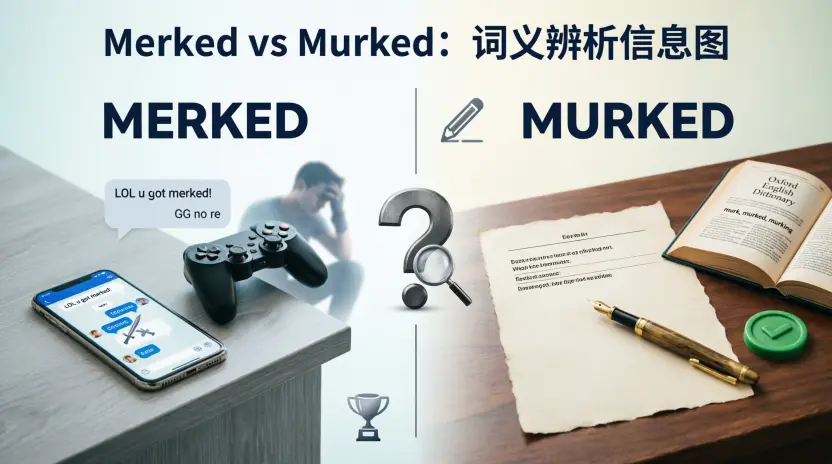
Have you ever seen “merked” or “murked” online and wondered which spelling is actually correct? These two forms can look and sound similar, especially in informal conversations, social media posts, gaming communities, and modern slang. However, the meaning and standard usage can depend heavily on context. If you are writing a message, caption, comment, or article, choosing the right form can make your meaning much clearer.
In this guide, we will explain merked or murked in simple language, including what each form means, where it is commonly used, and how context changes its interpretation. We will also look at example sentences and common mistakes so you can recognize the intended word more easily. Rather than relying on spelling alone, understanding the slang, vocabulary, and usage behind these terms gives you a more accurate answer. By the end, you will know when merked or murked fits the context and how to use the expression naturally.
Merked or Murked: What’s the Difference?
Murked and merked are informal terms that can look almost identical, yet their usage depends heavily on context. In modern slang, both spellings may be used to describe someone being badly defeated, dominated, or completely outplayed. However, murked is generally the more recognizable spelling for this meaning.
Merked can appear as an alternative spelling in casual online conversations, particularly in gaming, texting, and social media. Because slang often develops through different communities, spelling can vary even when people intend a similar meaning.
For formal writing, however, neither expression is usually the clearest choice. Words such as defeated, outperformed, overwhelmed, or dominated provide a more precise explanation.
| Feature | Murked | Merked |
|---|---|---|
| Common use | Informal slang | Informal slang |
| Typical meaning | Badly defeated or dominated | Often used as a variant of murked |
| Common settings | Gaming, texting, social media | Gaming, texting, online conversations |
| Formal English | Not normally recommended | Not normally recommended |
| Clear alternatives | Defeated, overwhelmed, outplayed | Defeated, overwhelmed, outplayed |
Quick Recap
Murked is the more widely recognized spelling for the slang meaning.
Merked may appear as a casual spelling variation.
Both forms are strongly dependent on context.
For formal communication, use a precise standard English alternative instead.
Is Merked or Murked a Grammar, Vocabulary, or Usage Issue?
At first glance, this looks like a spelling question. However, it is better understood as a vocabulary and usage issue involving slang variation.
Grammar explains how a word functions in a sentence. For example, “They murked the opposing team” uses the slang verb as an action. “They got murked” uses the same form after the verb “got.” Therefore, the sentence structure itself can be grammatically understandable even though the vocabulary remains highly informal.
The bigger concern is vocabulary choice. Since slang develops through communities, pronunciation, culture, media, gaming, and social communication, spelling variations can become established without following formal dictionary conventions.
Consequently, murked and merked are not interchangeable in every possible dictionary sense. They can overlap in informal slang, but “merked” has documented uses connected with “merk,” while “murked” is directly connected with “murk.”
In academic writing, formal reports, workplace correspondence, and official documents, neither expression is usually the clearest choice. Instead, words such as defeated, outperformed, overwhelmed, or dominated communicate the idea more precisely.
In casual conversations, however, the slang forms can sound natural when the audience already understands the expression.
How to Use Murked Correctly
The spelling murked is commonly understood when someone wants to describe an overwhelming defeat or strong domination. Gaming is one of the clearest environments because players regularly use expressive vocabulary to describe winning or losing.
For example, someone might say, “Our squad got murked in the final round.” Here, the statement normally means the team lost badly rather than providing a literal description of physical harm.
Workplace example
Imagine coworkers discussing a friendly office competition. Someone could jokingly say, “Our department got murked in the quiz.”
Although the meaning may be understandable, a professional report would be clearer with “Our department lost the quiz decisively.”
Academic example
A student should generally avoid writing, “The opposing theory got murked by the new evidence.”
Instead, an academic sentence could say, “The opposing theory was strongly challenged by the new evidence.”
Technology example
In a gaming forum, “I got murked by a beginner” can sound perfectly natural among people who understand gaming slang.
However, a software testing report would normally say, “The previous version performed significantly worse during testing.”
Usage recap
Therefore, murked works best when the audience expects casual slang.
It adds intensity and personality.
Nevertheless, formal contexts usually benefit from a precise standard expression.
How to Use Merked Correctly
Merked appears primarily in informal communication and is often understood as a variant spelling of “murked.” Contemporary explanations of the expression commonly describe this overlap, especially in gaming and social media.
Because spelling variation is common in online communities, a person might encounter “merked” even when another writer would choose “murked.”
Workplace example
In a casual team chat, someone might write, “We absolutely merked the other team.”
However, that wording would be unsuitable for a formal performance report. A better choice would be “We significantly outperformed the other team.”
Academic example
A university essay should not normally say, “The author merked the opposing argument.”
Instead, “The author decisively challenged the opposing argument” provides a clearer academic description.
Technology example
In a multiplayer gaming conversation, “You just merked me” may communicate humorous frustration after losing badly.
Meanwhile, a technical review could say, “The new processor substantially outperformed the previous model.”
Usage recap
Therefore, merked can be understood in informal digital environments.
However, it is less suitable when precision and formal vocabulary matter.
If an international audience may not recognize the expression, “defeated” or “outperformed” is safer.
When You Should NOT Use Merked or Murked
Although slang can make casual language lively, there are situations where these terms create unnecessary ambiguity.
First, avoid them in academic essays. Formal educational writing usually requires precise vocabulary rather than community specific slang.
Second, avoid them in legal documents. A legal statement should communicate exactly what happened without relying on expressions that may have multiple interpretations.
Third, avoid them in medical communication. Patients and professionals need wording that cannot easily be misunderstood.
Fourth, avoid them in official workplace reports. A phrase such as “the competitor got murked” sounds conversational rather than professional.
Fifth, avoid them in formal customer communication. Customers from different age groups and language backgrounds may interpret slang differently.
Sixth, avoid them when describing real world violence. Because the expression can carry a violent meaning in some contexts, it may create an unintended impression.
Seventh, avoid them when writing for beginners. Clear words such as “defeated” and “overwhelmed” usually communicate the intended meaning faster.
Finally, avoid switching spellings without reason. Consistency makes informal writing easier to understand.
Common Mistakes With Merked or Murked
| Correct sentence | Incorrect sentence | Explanation |
|---|---|---|
| He got murked in the game. | He got murked in the academic report. | The first is casual gaming language; the second needs formal wording. |
| Our team was defeated badly. | Our team was merked badly in the report. | Formal reports benefit from precise vocabulary. |
| She completely outperformed her opponent. | She murked her opponent in the presentation. | “Outperformed” is clearer for professional contexts. |
| They got murked during the match. | They got murked during the legal hearing. | The expression fits competition better than formal proceedings. |
| I got merked in that round. | I got merked in my research paper. | The first is casual slang; the second is inappropriate academic phrasing. |
Decision Rule Box
If you mean someone was heavily defeated, dominated, or overwhelmed in casual slang, “murked” is the more recognizable choice. If you encounter “merked,” understand it as an informal variant in contexts where the writer intends the same slang idea.
For formal writing, however, replace either form with defeated, outperformed, overwhelmed, or another exact expression.
Merked or Murked in Modern Technology
Modern digital communication has made slang variations easier to spread. Gaming platforms, comment sections, private messages, streaming communities, and social networks allow people from different regions to encounter the same expression quickly.
Consequently, spelling differences can travel across communities without becoming standardized in the traditional sense.
Gaming is especially important because competitive environments encourage short, expressive vocabulary. A player who loses badly may describe the experience with “murked,” “merked,” “destroyed,” “wrecked,” or another community specific expression.
However, automated writing systems, spell checkers, and conventional dictionaries may treat informal variants differently. Therefore, a writer should always consider the audience rather than assuming that a spelling accepted in one online community will feel natural everywhere.
For general clarity, murked is easier for many readers to recognize as the intended slang term.
Where Did Merked and Murked Come From?
The history is not completely uniform across sources, which is important when discussing slang. Contemporary explanations generally connect murk with informal language describing severe defeat, destruction, or killing, while “merked” appears as a related informal spelling or a past form of “merk.”
Over time, expressions like these moved through music, youth speech, gaming, online communities, and popular culture. Consequently, the meaning became broader in many casual settings.
A useful way to understand the development is to separate historical intensity from modern casual usage. In some contexts, the expression can carry a serious violent implication. In gaming or humorous conversation, however, it often simply means someone was beaten badly.
Language expert style observation: “Slang becomes easier to understand when you study the community using it, because context often carries more meaning than spelling alone.”
That principle explains why dictionary style rules cannot always settle informal vocabulary questions.
Two Illustrative Case Studies
Case Study One: Competitive Gaming
Consider a fictional gaming community where players frequently use “murked” to describe a decisive defeat. A new participant sees “You got murked” after losing a round and initially interprets it as literal violence.
After reviewing several surrounding conversations, the player notices that the expression consistently appears after ordinary competitive losses. In this illustrative example, the player begins using the phrase appropriately after learning the community convention.
Result: Context changes the perceived meaning from a potentially serious statement to ordinary gaming slang.
Case Study Two: Professional Communication
Now consider an illustrative employee who writes, “Our previous strategy got merked by the new campaign” in an internal business report.
The intended meaning is simply that the new campaign performed much better. However, colleagues unfamiliar with the slang may find the wording informal or unclear.
After replacing the phrase with “Our previous strategy was significantly outperformed,” the report becomes immediately understandable to a broader professional audience.
Result: The revised wording removes ambiguity while preserving the underlying meaning.
These examples demonstrate why word choice should follow audience, purpose, and communication setting.
Error Prevention Checklist
Always use murked when
You are participating in a casual gaming conversation.
You are writing informal dialogue where slang fits the character.
Your audience already understands contemporary internet expressions.
You want to describe an overwhelming defeat casually.
The surrounding language clearly establishes an informal tone.
Never use merked when
You are preparing an academic assignment.
You are writing a formal business report.
You are communicating medical information.
You are preparing legal or official documentation.
Your readers may interpret the expression literally.
You need internationally clear formal English.
Instead, choose a precise word such as defeated, outperformed, overpowered, or overwhelmed.
Related Grammar Confusions You Should Master
Understanding slang variation also makes it useful to study other commonly confused forms.
Affect or effect: One usually concerns influence as a verb, while the other frequently functions as a noun describing a result.
Less or fewer: The choice depends largely on whether the noun is treated as a mass quantity or as separate countable items.
Lay or lie: Their differences involve grammatical function and the forms required by each verb.
Then or than: One commonly concerns sequence or consequence, while the other is used for comparison.
Your or you’re: These forms differ completely in grammatical function despite their similar pronunciation.
Its or it’s: One is possessive, while the other is a contraction.
Their, there, or they’re: These forms sound similar but perform different grammatical roles.
Everyday or every day: One commonly functions as an adjective, while the other refers to frequency.
Further or farther: Usage can depend on whether the intended sense concerns figurative extension or physical distance.
Compliment or complement: One involves praise, while the other concerns something that completes or enhances another thing.
Learning these distinctions helps develop a broader understanding of context based vocabulary.
Frequently Asked Questions About Merked or Murked
Is it merked or murked?
Both spellings appear in informal language, but murked is generally the more recognizable spelling for the slang sense involving severe defeat or domination. Merked can appear as an informal variant, particularly in online communities.
What does murked mean in slang?
In modern casual slang, murked commonly means badly defeated, dominated, overwhelmed, or outplayed. Depending on context, it can also carry a stronger meaning involving killing, so surrounding language matters.
What does merked mean in texting?
In texting, merked is often used as an informal variant of “murked.” For many users, it communicates the idea of being completely defeated or outplayed.
Is murked a real English word?
Yes, “murked” exists as a form associated with the slang verb “murk.” However, its slang meaning is informal and context dependent, so it should not automatically replace precise standard vocabulary.
Is merked grammatically correct?
“Merked” can function as the past form of the slang verb “merk,” and dictionaries record that usage. Nevertheless, its informal nature means it is not an appropriate replacement for standard vocabulary in every situation.
Are merked and murked interchangeable?
They can overlap in casual slang when the intended meaning is severe defeat or domination. However, they do not have identical dictionary histories, so treating them as universally interchangeable would oversimplify the vocabulary.
Is murked appropriate for formal writing?
Generally, no. Formal communication is clearer when it uses words such as “defeated,” “outperformed,” “overwhelmed,” or “dominated.” These choices communicate the intended idea without depending on slang knowledge.
Does murked always mean killed?
No. Modern casual usage frequently describes competition, gaming, embarrassment, or overwhelming performance rather than literal killing. Nevertheless, the word can carry a more violent sense in some contexts, which is why surrounding information matters.
Why do people spell murked as merked?
Slang often develops spelling variations through pronunciation, community habits, online communication, and regional usage. Consequently, writers may choose “merked” even when another speaker prefers “murked.”
Which one should I use in casual conversation?
For broad recognition, murked is generally the clearer informal choice. However, if you are quoting someone, matching a particular online community, or preserving a character’s natural voice, “merked” may appear intentionally.
Final Verdict
The question of merked or murked is primarily a matter of informal vocabulary, spelling variation, and context rather than a straightforward grammar rule.
Murked is widely recognized as slang for being badly defeated, dominated, or overwhelmed. Merked can function as an informal variant in casual digital communication, although it also has its own recorded slang usage connected with “merk.”
Therefore, when casual slang is appropriate, murked offers broader recognition. Meanwhile, when the setting is academic, professional, legal, medical, or otherwise formal, choose a precise standard expression instead.
Ultimately, understanding the audience is more important than memorizing a single spelling rule. Slang changes through communities, and the same expression can carry different levels of intensity depending on where and how it appears.









