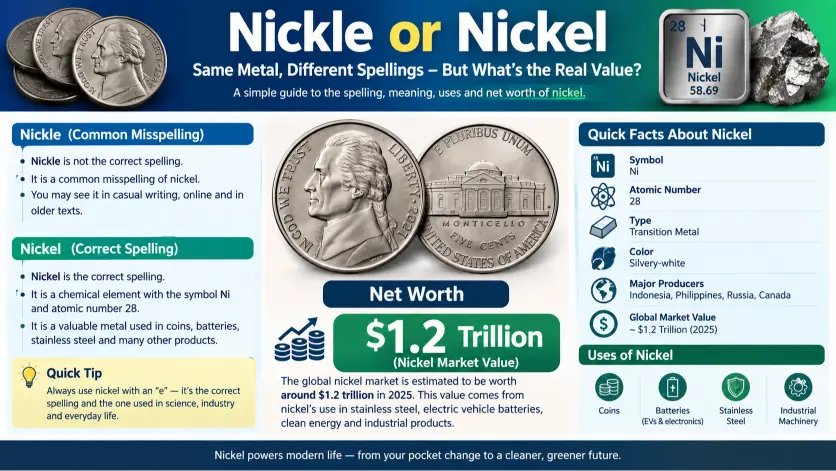
Have you ever written nickle or nickel and wondered which spelling is actually correct? You are not alone. This is a common spelling confusion, especially because the word is pronounced in a way that can make the missing “e” easy to overlook. If you are writing an email, school assignment, article, or everyday message, choosing the correct form matters.
The correct spelling is nickel. It can refer to the five cent coin in the United States and Canada, as well as the chemical element with the symbol Ni. Nickle is generally considered a misspelling when you mean the coin or the element.
In this guide, we will clearly explain nickle vs nickel, their meanings, pronunciation, common mistakes, and real sentence examples. You will also learn a simple way to remember the correct spelling so you can use nickel confidently in your writing.
Nickle or Nickel: What’s the Difference?
Nickel is a standard English noun. It commonly refers to a United States coin worth five cents. It also identifies a chemical element that has the atomic symbol Ni and atomic number 28.
Nickle, meanwhile, is not the standard spelling for either meaning. In ordinary English, it should generally be treated as an incorrect spelling of nickel.
| Feature | Nickel | Nickle |
|---|---|---|
| Standard English word | Yes | No |
| Part of speech | Noun | Usually a misspelling |
| Refers to five cent coin | Yes | No |
| Refers to chemical element | Yes | No |
| Used in scientific writing | Yes | No |
| Appropriate in academic writing | Yes | No |
| Common reason for confusion | Similar pronunciation | Incorrect remembered spelling |
Mini Recap
First, nickel is the correct standard spelling.
Next, it can describe a five cent coin or a chemical element.
Meanwhile, nickle is normally an accidental spelling error.
Therefore, whenever you’re discussing the coin or metal, choose nickel.
Is Nickle or Nickel a Grammar, Vocabulary, or Usage Issue?
This distinction is primarily a spelling and usage issue, rather than a grammar problem.
Grammar determines how words function within sentences. For example, it tells us whether a noun, verb, adjective, or pronoun is being used appropriately. In contrast, spelling determines whether the written form of a word is correct.
Here, nickel functions as a noun. You might write, “I found a nickel on the sidewalk.” Likewise, you could say, “Nickel is resistant to corrosion.”
Because nickle is generally not an accepted spelling for these meanings, substituting it for nickel isn’t a matter of choosing between formal and informal English. Instead, it is normally a spelling mistake.
Furthermore, the correct form remains the same in academic and casual writing. You don’t switch to nickle simply because a conversation is informal.
For instance, a student might write, “The machine contains nickel.” A friend might say, “I need a nickel.” Both situations require the same spelling.
Therefore, the safest rule is straightforward: use nickel whenever you mean the coin or the element.
How to Use Nickel Correctly
Because nickel has several related meanings, understanding its practical uses makes the spelling easier to remember.
Workplace Example
In a workplace setting, the word may appear in manufacturing, finance, mining, chemistry, or quality control.
For example:
The supplier confirmed that the component contains nickel.
Here, the word identifies a material used in an industrial context.
Similarly:
The cashier received a nickel from the customer.
In this sentence, the term identifies currency.
Consequently, workplace writing should always use the standard spelling because reports, invoices, specifications, and correspondence need precision.
Academic Example
In educational writing, nickel frequently appears in science, history, economics, and social studies.
For example:
Nickel is a metallic element with atomic number 28.
A history student might instead write:
The nickel became part of United States coinage during the nineteenth century.
Thus, the meaning changes according to context, but the spelling doesn’t.
Technology Example
Modern technology also provides many situations where nickel appears naturally.
For example:
The device uses a nickel based material in one of its components.
Likewise, technical documentation may discuss nickel alloys, nickel plating, or nickel containing materials.
Therefore, remembering the standard spelling is particularly useful when writing specifications or describing manufactured products.
Usage Recap
Use nickel for the five cent coin.
Use nickel for the chemical element.
Use nickel when discussing alloys, coatings, manufacturing, or materials.
Above all, don’t replace the standard spelling with nickle.
When You Should Not Use Nickle or Nickel
Although nickel is usually the correct choice, context still matters. There are several situations where writers can make mistakes.
1. Don’t Write Nickle for the Five Cent Coin
If you’re referring to United States currency, the standard form is nickel.
Correct:
She found a nickel beneath the chair.
Incorrect:
She found a nickle beneath the chair.
2. Don’t Write Nickle in Scientific Contexts
Scientific terminology requires standardized spelling. Therefore, the chemical element should always be written as nickel.
Correct:
Nickel has the chemical symbol Ni.
Incorrect:
Nickle has the chemical symbol Ni.
3. Don’t Assume Informal Writing Makes Nickle Acceptable
Casual communication doesn’t automatically turn a misspelling into an accepted variant.
For example, a text message might contain many shortened expressions. Nevertheless, if you write the element’s name, nickel remains the appropriate spelling.
4. Don’t Use Nickle in Academic Assignments
Teachers and instructors generally expect standard dictionary spelling. Consequently, using nickle can count as a spelling error.
5. Don’t Change the Spelling Based on Pronunciation
English contains many words whose pronunciation doesn’t reveal their spelling. Therefore, relying exclusively on sound can lead to mistakes.
6. Don’t Treat Nickle as an Alternative Variant
Unlike some British and American spelling differences, nickle isn’t simply an alternate regional form of nickel when referring to the coin or element.
7. Don’t Use Nickle in Technical Documentation
Specifications, manuals, laboratory notes, and manufacturing documents benefit from consistent terminology. Consequently, the standard form should be retained.
8. Don’t Assume Search Results Prove Correctness
A misspelled form may appear online because people make mistakes, not because the spelling is officially accepted. Therefore, frequency alone isn’t enough to establish correctness.
Common Mistakes: Nickle or Nickel
Understanding typical errors can make the correct choice much easier.
| Correct sentence | Incorrect sentence | Explanation |
|---|---|---|
| I found a nickel. | I found a nickle. | The coin is spelled nickel. |
| Nickel is a chemical element. | Nickle is a chemical element. | The element uses the standard spelling nickel. |
| He paid with a nickel. | He paid with a nickle. | The currency term requires nickel. |
| The alloy contains nickel. | The alloy contains nickle. | Material terminology uses nickel. |
| The nickel was shiny. | The nickle was shiny. | The noun is nickel. |
| Researchers studied nickel compounds. | Researchers studied nickle compounds. | Scientific terminology requires nickel. |
Decision Rule Box
If you mean the five cent coin or the chemical element, use “nickel.”
If you see “nickle” in ordinary writing, check whether it is simply a spelling error.
This rule is more reliable than trying to remember pronunciation because the two forms can sound almost identical.
Why People Spell Nickel as Nickle
There is a logical reason this mistake happens.
First, English spelling doesn’t always follow pronunciation perfectly. Consequently, speakers may remember how a word sounds without remembering every letter.
Second, the ending can cause uncertainty. Words such as “little,” “middle,” and “bottle” may influence how someone expects a similarly pronounced word to look.
Third, people sometimes omit the internal e because the pronunciation doesn’t clearly signal it.
Furthermore, repeated exposure to an incorrect spelling can make it appear familiar. When someone has seen nickle several times, the form may begin to look acceptable even though standard dictionaries use nickel.
Therefore, the best correction isn’t simply memorizing that one spelling is wrong. Instead, connect the correct form with its two major meanings: the five cent coin and the element Ni.
Nickle and Nickel in Modern Technology
Modern digital writing systems have made spelling correction easier, but they haven’t eliminated human errors.
Word processors, browsers, mobile keyboards, and writing applications may identify nickle as a possible spelling mistake. However, automated suggestions aren’t always sufficient because software depends on context and language data.
For example, if someone types a sentence about metal production, the intended word is almost certainly nickel. Similarly, a sentence about United States currency requires the same spelling.
Consequently, technology can help identify an error, but understanding the underlying distinction remains more valuable. A writer who knows why nickel is correct can make the right choice even without a correction tool.
The Etymology of Nickel
The history of nickel is surprisingly interesting.
The English name ultimately comes from German terminology associated with Kupfernickel, a name historically used for an ore that resembled copper ore but did not yield copper as expected.
The term became associated with the metallic element later identified as nickel. Eventually, the same word became strongly connected with the United States five cent coin because the coin was made using a copper and nickel alloy.
Thus, the spelling nickel has a long historical development rather than being an arbitrary modern construction.
Understanding that history can also help reinforce the standard written form.
An Expert Style Explanation
“When two spellings sound alike, meaning and standard usage should guide the writer. In this case, nickel is the established form for both the coin and the chemical element.”
This principle applies beyond this particular word. English contains numerous pairs and near pairs where pronunciation alone cannot reliably determine spelling.
Therefore, checking the accepted written form is especially important in educational and professional communication.
Two Practical Case Studies
Case Study One: Academic Writing
Imagine a student preparing a chemistry assignment about metals.
The student initially writes:
Nickle is a transition metal.
The intended meaning is understandable. However, the spelling is incorrect. After correction, the sentence becomes:
Nickel is a transition metal.
The factual statement remains essentially unchanged, yet the corrected version is suitable for academic work.
Result: The student avoids a spelling error and presents the scientific terminology correctly.
Case Study Two: Financial Communication
Now consider a workplace message involving cash handling.
An employee writes:
The register is short by one nickle.
Although the reader can probably understand the intended meaning, the written form is incorrect. The corrected sentence is:
The register is short by one nickel.
Result: The message becomes professionally acceptable while preserving exactly the same intended meaning.
These examples show why a tiny spelling difference can matter in otherwise straightforward communication.
Error Prevention Checklist
Use this checklist whenever you’re unsure about the spelling.
Always Use Nickel When
You mean the United States five cent coin.
You mean the chemical element.
You’re discussing nickel alloys.
You’re describing nickel plating.
You’re writing a scientific report.
You’re preparing an academic assignment.
You’re discussing manufacturing materials.
You’re writing professional correspondence.
Never Use Nickle When
You intend to name the coin.
You intend to identify the chemical element.
You are writing a laboratory report.
You are describing a metal composition.
You are preparing technical documentation.
You are writing formal educational content.
You are editing professional correspondence.
You are answering a spelling question about the standard English form.
Related Grammar Confusions You Should Master
Once you’ve understood this spelling distinction, several other commonly confused terms are worth studying.
1. Principal or Principle
Principal often refers to a person or something primary, while principle means a rule or belief.
2. Affect or Effect
These words frequently create problems because their functions can vary according to context.
3. Fewer or Less
Fewer generally accompanies countable items, whereas less commonly refers to uncountable quantities.
4. Its or It’s
Its shows possession, while it’s is a contraction of “it is” or “it has.”
5. Then or Than
Then usually relates to time or sequence, while than commonly appears in comparisons.
6. Your or You’re
Your expresses possession, whereas you’re means “you are.”
7. There, Their, or They’re
These forms sound alike in many accents but have completely different functions.
8. Altar or Alter
An altar is a raised structure used for religious purposes, while alter means to change something.
9. Complement or Compliment
A complement completes or enhances something, whereas a compliment expresses praise.
10. Stationary or Stationery
Stationary means remaining still, while stationery refers to writing materials.
Learning these distinctions gradually improves written accuracy and makes confusing spellings much easier to handle.
Frequently Asked Questions
What is the correct spelling, nickle or nickel?
The correct standard spelling is nickel. It refers to the United States five cent coin and the chemical element with the symbol Ni. Nickle is normally a spelling error when used with either of these meanings.
Is nickle a word?
Nickle can appear in names or unusual contexts, but it isn’t the standard spelling for the coin or chemical element. Therefore, writers should use nickel when discussing those subjects.
Why do people spell nickel as nickle?
The mistake usually happens because the two forms sound similar. Additionally, the internal e isn’t strongly represented in pronunciation, making it easy to omit during writing.
Is nickel a noun?
Yes. Nickel is a noun when it identifies the five cent coin or the chemical element. It can also appear in compound expressions describing materials and industrial processes.
How do you remember the spelling of nickel?
A useful memory technique is to associate the word with its two familiar meanings: the coin and the metal. Remembering the complete spelling, rather than relying on pronunciation, helps prevent the mistake.
Is nickel only the name of a coin?
No. The word has more than one meaning. It commonly identifies a five cent United States coin, but it also names a chemical element and can describe materials containing that element.
What is the chemical symbol for nickel?
The chemical symbol for nickel is Ni. It has atomic number 28 and belongs to the transition metals.
Should nickel be capitalized?
Usually, nickel is written with a lowercase letter because it is a common noun. However, the chemical symbol Ni uses an uppercase N and lowercase i.
Is nickle an American spelling?
No. Nickle isn’t simply an American alternative spelling of nickel. The standard American English form for the coin and element is nickel.
How can I avoid making this spelling mistake?
Whenever you’re referring to the coin or element, pause briefly and check for the internal e. Writing nickel consistently will eventually make the correct spelling automatic.
Final Conclusion:
The answer to nickle or nickel is simple: nickel is the correct standard spelling when you’re referring to the five cent coin or the chemical element.
Although nickle may look convincing and may appear in informal writing, it isn’t the accepted spelling for these meanings. Therefore, students, professionals, researchers, and everyday writers should consistently choose nickel.
Most importantly, don’t rely on pronunciation to decide. Instead, remember the two major meanings and connect both of them with the same spelling. Once that association becomes familiar, this common error becomes much easier to avoid.









