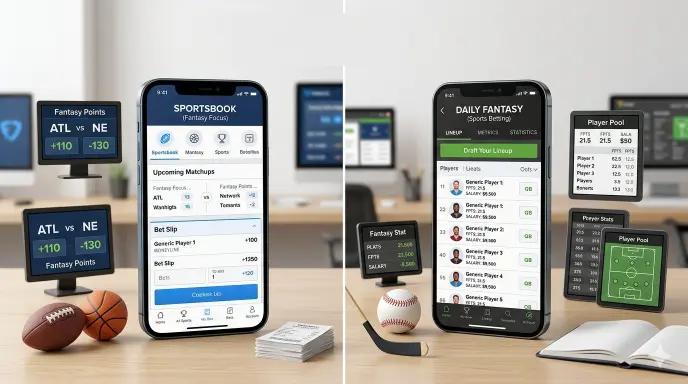
Choosing between FanDuel or DraftKings can feel difficult when both platforms offer daily fantasy sports, major sporting events, contests, and sportsbook features. At first glance, they may look similar, but important differences in scoring, contest formats, available markets, and overall user experience can influence which platform suits you best.
The right choice depends largely on what you want from the platform. FanDuel is often recognized for its simpler, beginner friendly experience, while DraftKings is known for deeper contest options, broader features, and more flexibility for experienced users. Neither platform is automatically the best for everyone, so understanding these differences matters.
In this guide, we will compare FanDuel and DraftKings across the features that matter most, including daily fantasy contests, scoring, sports coverage, apps, promotions, and overall usability. Whether you are completely new or already familiar with DFS, this comparison can help you make a more informed decision while keeping responsible play and local eligibility requirements in mind.
FanDuel vs DraftKings: What’s the Difference?
FanDuel and DraftKings are both proper nouns because each identifies a specific commercial brand. In everyday usage, however, they function as names for online sports betting and fantasy sports platforms.
FanDuel is associated with sportsbook wagering, daily fantasy sports, promotional offers, and a user interface that many customers find relatively simple to navigate. Meanwhile, DraftKings combines sportsbook services with daily fantasy contests and several other entertainment products.
Although their basic purpose overlaps, the experience isn’t identical. For instance, one platform may display a particular market more conveniently, while another may provide a different promotional structure or betting interface.
| Feature | FanDuel | DraftKings |
|---|---|---|
| Word type | Proper noun | Proper noun |
| Main identity | Sportsbook and fantasy platform | Sportsbook and fantasy platform |
| Mobile experience | Clean and straightforward | Feature rich and highly customizable |
| Sports coverage | Broad selection | Broad selection |
| Betting markets | Extensive | Extensive |
| Fantasy contests | Available | Available |
| Promotions | Frequently offered | Frequently offered |
| User experience | Often considered simple | Often considered detailed |
| Availability | Depends on jurisdiction | Depends on jurisdiction |
| Best fit | Users wanting simplicity | Users wanting variety and customization |
Quick Recap
FanDuel and DraftKings are competing platforms rather than alternative spellings or interchangeable words.
Both provide sports betting and fantasy related services, although their features and presentation differ.
Neither name is grammatically incorrect when used to identify its respective company.
Your final choice should depend on legal availability, preferred sports, interface, promotions, and betting features.
Is FanDuel vs DraftKings a Grammar, Vocabulary, or Usage Issue?
At first glance, this comparison may resemble a vocabulary question. Nevertheless, it isn’t actually a grammar problem. FanDuel and DraftKings are brand names, so the important distinction involves usage and meaning rather than grammatical correctness.
Because both names identify separate businesses, they shouldn’t be substituted for one another. Saying that someone placed a wager through FanDuel means something different from saying that the same person used DraftKings.
Furthermore, capitalization matters. FanDuel and DraftKings are official brand names, so writing them exactly that way provides clarity.
In formal writing, business reporting, academic discussions, and consumer guides, the names should remain distinct. In casual conversation, people may shorten references by saying “FanDuel” or “DraftKings,” but the underlying distinction remains.
For example, “Which one do you prefer?” can refer to either service when the context is already established. However, “I used DraftKings” shouldn’t be changed to “I used FanDuel” unless the person actually used FanDuel.
Therefore, the issue is primarily one of accurate reference. The names aren’t synonyms, and they aren’t two forms of the same word.
FanDuel: Meaning, Usage, and Practical Examples
FanDuel is a brand name commonly associated with online sports betting and fantasy sports. The company operates different products depending on the jurisdiction, meaning that available services can vary from one location to another.
For many users, FanDuel is recognized for an interface that emphasizes accessibility. Consequently, newcomers may find the navigation relatively easy to understand when browsing games, odds, and available markets.
Workplace Example
Suppose a sports media employee is preparing a comparison report. A suitable sentence would be:
“FanDuel reported strong interest in its sports betting products.”
Here, FanDuel identifies the company being discussed. Replacing it with DraftKings would change the factual meaning.
Academic Example
A researcher examining the development of online wagering could write:
“FanDuel became an important participant in the expansion of regulated sports betting.”
In this context, the brand functions as a proper noun identifying a specific organization.
Technology Example
A technology writer might say:
“The FanDuel mobile application provides users with access to available sportsbook features.”
Again, the name identifies a particular digital service rather than describing a general activity.
Usage Recap
Use FanDuel when you specifically mean that company or its relevant products.
However, don’t use the name as a generic replacement for “sportsbook,” because other operators provide similar services.
DraftKings: Meaning, Usage, and Practical Examples
DraftKings is another major brand associated with sports betting, fantasy sports, and digital entertainment products. As with FanDuel, exact offerings depend on the market and applicable regulations.
The name is particularly recognizable because the company developed a strong identity around fantasy sports before expanding further into sportsbook services.
Workplace Example
A business writer could state:
“DraftKings expanded its presence within regulated sports betting markets.”
That sentence specifically identifies the company.
Academic Example
A paper discussing digital sports entertainment might say:
“DraftKings contributed to the growth of commercial fantasy sports platforms.”
The brand name remains capitalized because it identifies a particular organization.
Technology Example
A product review could explain:
“The DraftKings application allows eligible users to explore available betting markets and account features.”
Therefore, the word refers to a specific digital platform rather than the broader concept of online wagering.
Usage Recap
Choose DraftKings when discussing that particular company or its products.
However, don’t treat the name as a general noun for sports betting platforms because doing so can create factual confusion.
When You Should NOT Use FanDuel or DraftKings
Knowing when to avoid these names can prevent misleading statements. Although the platforms compete in several areas, neither brand should automatically represent every sportsbook.
1. When Discussing Sportsbooks Generally
If you’re discussing the entire industry, saying “sportsbooks” is more accurate than naming either company.
2. When Referring to Another Operator
If a person actually used another service, substituting FanDuel or DraftKings would produce an incorrect statement.
3. When Describing Legal Availability
Neither platform should be presented as universally available. Regulations differ between states and territories.
4. When Comparing Unrelated Products
A general discussion about sports statistics doesn’t automatically involve either company.
5. When Discussing Fantasy Sports as a Whole
Fantasy sports include numerous operators and formats. Therefore, one brand shouldn’t stand for the entire category.
6. When Reporting a Specific Promotion
Promotional terms can change. Consequently, attributing an offer to the wrong company can mislead readers.
7. When Describing Another Company’s Technology
A sportsbook feature should be attributed to the correct operator rather than using a familiar brand name as shorthand.
8. When Making Universal Claims
Statements such as “everyone can use FanDuel” or “DraftKings is available everywhere” can be inaccurate because eligibility and jurisdictional rules vary.
Common Mistakes: FanDuel or DraftKings
| Correct sentence | Incorrect sentence | Explanation |
|---|---|---|
| I compared FanDuel with DraftKings. | I compared FanDuel with FanDuel. | The second version doesn’t identify two separate platforms. |
| She placed the wager through DraftKings. | She placed the wager through FanDuel. | The brand must match the platform actually used. |
| FanDuel offers sports betting in eligible markets. | FanDuel offers sports betting everywhere. | Availability depends on jurisdiction. |
| DraftKings has fantasy sports products. | DraftKings means fantasy sports. | A brand isn’t the same thing as an entire category. |
| Both platforms publish betting markets. | Both platforms are identical. | Similar services don’t make the companies identical. |
| I checked the FanDuel app. | I checked the DraftKings app. | The sentence must identify the actual application. |
Decision Rule Box
If you mean the FanDuel company or its platform, use FanDuel.
If you mean the DraftKings company or its platform, use DraftKings.
If you mean the broader category, use a general term such as sportsbook, betting platform, or fantasy sports service.
This rule is more appropriate than treating the comparison like a conventional spelling choice because these names identify separate brands.
FanDuel or DraftKings in Modern Technology and Digital Tools
Modern sportsbook applications have become increasingly sophisticated. Consequently, users may encounter live markets, statistical information, personalized displays, account management features, promotional sections, and multiple sports within one application.
Both FanDuel and DraftKings operate within this broader digital environment. However, their interfaces aren’t identical, and features can change over time.
For that reason, users shouldn’t assume that a feature visible on one platform automatically exists in exactly the same form on the other.
Technology also affects how people compare the services. Mobile usability, navigation speed, information density, notifications, and bet management can influence personal preference.
Furthermore, regulations can affect the functionality available to customers in different locations. Thus, a comparison written for one jurisdiction may not apply perfectly to another.
Etymology and Brand Naming
FanDuel is a coined brand name combining the concept of a fan with the word “duel,” creating a competitive sports oriented identity. The name is therefore designed primarily for branding rather than ordinary dictionary usage.
DraftKings similarly combines “draft,” a familiar concept in fantasy sports, with “kings,” which suggests competition, achievement, and winning.
Because both names were created as commercial identities, they don’t follow the normal distinction between common vocabulary alternatives. Instead, each points to a particular company.
That distinction explains why the names shouldn’t be treated as synonyms. Their meanings are tied to their respective brands and services.
An Expert Perspective on FanDuel and DraftKings
“When two brands offer similar services, accurate naming matters because a shared category doesn’t make the companies interchangeable.”
This principle applies beyond sports betting. Consumers regularly confuse competing technology companies, financial services, retailers, and entertainment platforms because their products overlap.
Therefore, the safest approach is to identify the exact company before making a claim about its service, promotion, technology, or availability.
Two Practical Case Studies
Case Study 1: Choosing a Platform for Simplicity
Consider a newcomer who wants to compare two sportsbook applications before deciding which interface feels easier to understand.
The user opens both platforms, examines navigation, checks available sports, reviews account tools, and compares the presentation of markets.
Afterward, the user prefers FanDuel because the layout feels more straightforward.
The result isn’t evidence that FanDuel is universally better. Instead, it demonstrates that personal usability can influence platform preference.
Case Study 2: Comparing Available Features
Now consider a bettor who values a wider range of features and prefers a more detailed interface.
That person may examine DraftKings alongside another platform, compare available markets, explore fantasy products, and evaluate account functionality.
After testing the applications, the user chooses DraftKings because its feature set better matches personal preferences.
Again, the result doesn’t establish a universal winner. Instead, it demonstrates why platform selection should be based on individual needs and current availability.
Error Prevention Checklist
Always use FanDuel when
- You mean the FanDuel company.
- You are describing its specific platform.
- You are discussing a FanDuel product.
- You are accurately attributing information to that company.
Always use DraftKings when
- You mean the DraftKings company.
- You are discussing its specific application.
- You are referring to its fantasy or sportsbook products.
- You are attributing a feature specifically to that company.
Never use either name when
- You mean the entire sportsbook industry.
- You are discussing another operator.
- You don’t know which platform a person actually used.
- You are making a universal statement about availability.
Related Grammar Confusions You Should Master
Understanding brand names becomes easier when you also recognize other common language distinctions. These comparisons are especially useful for clear online writing and everyday communication.
- Website vs webpage: A website can contain many individual webpages.
- Company vs brand: A company is an organization, while a brand represents an identity connected with products or services.
- Product vs service: A product is generally something offered for use or purchase, whereas a service involves an activity performed for customers.
- Their vs there: “Their” indicates possession, while “there” generally refers to a place or existence.
- Its vs it’s: “Its” indicates possession, while “it’s” means “it is” or “it has.”
- Affect vs effect: “Affect” commonly functions as a verb, while “effect” commonly functions as a noun.
- Company name vs common noun: A company name identifies a specific organization, whereas a common noun identifies a general category.
- Brand vs trademark: A brand is a broader commercial identity, while a trademark is a legally protected identifier.
- App vs platform: An app is software used on a device, while a platform can describe a broader technological environment.
- User vs customer: A user interacts with a service, while a customer generally has a commercial relationship with a provider.
Frequently Asked Questions
What is the difference between FanDuel and DraftKings?
FanDuel and DraftKings are separate companies that compete across sports betting and fantasy sports. Their offerings overlap, but interfaces, promotions, features, and availability can differ depending on the jurisdiction.
Is FanDuel better than DraftKings?
Neither platform is automatically better for everyone. Instead, the preferable option depends on the user’s location, preferred sports, interface preferences, available markets, promotions, and desired features.
Is DraftKings the same company as FanDuel?
No. FanDuel and DraftKings are separate companies. Although they operate in overlapping areas, they have different brands, products, technology, and corporate structures.
Which is easier to use, FanDuel or DraftKings?
Ease of use is subjective. Some people prefer FanDuel’s relatively straightforward presentation, while others appreciate the broader feature set and customization available through DraftKings.
Can I use FanDuel and DraftKings in every state?
No. Availability isn’t universal. Sports betting regulations vary by jurisdiction, and individual products can have separate eligibility requirements.
Are FanDuel and DraftKings both sportsbooks?
Both companies operate sportsbook products in eligible markets. However, their businesses extend beyond sportsbook wagering and can include fantasy sports and other digital entertainment services.
Which has better promotions, FanDuel or DraftKings?
Promotions can change frequently and may depend on location, eligibility, and account status. Therefore, there isn’t a permanent winner based solely on promotional offers.
Are FanDuel and DraftKings words or brand names?
They are brand names. More specifically, they function as proper nouns when referring to their respective companies and products.
Why do people compare FanDuel and DraftKings?
People compare them because both operate major sports betting and fantasy sports services. Since their offerings overlap, users often evaluate differences in usability, markets, promotions, and features.
Should I write FanDuel or DraftKings in formal writing?
Use the exact brand name that matches the company you are discussing. In formal writing, correct capitalization and accurate attribution are especially important.
Final Conclusion:
The choice between FanDuel or DraftKings isn’t a matter of choosing the correct spelling or grammar form. Instead, these are two distinct brand names representing separate companies with overlapping services. FanDuel may appeal to people who prefer a straightforward interface, while DraftKings can attract users who value a broader feature set and detailed digital experience. Nevertheless, neither option is universally superior.
Ultimately, the right comparison should consider location, legal availability, sports coverage, available markets, interface preferences, promotional terms, and individual needs. Most importantly, use FanDuel when you mean FanDuel and DraftKings when you mean DraftKings. When discussing the wider industry, choose a general term instead.
That simple distinction prevents inaccurate statements and makes your writing clearer, more precise, and easier for readers to trust.









