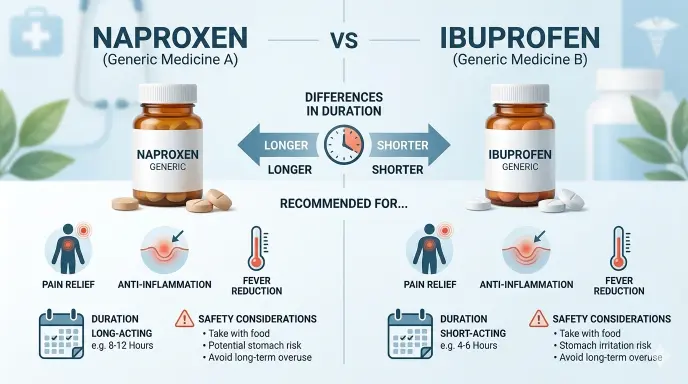
When pain, swelling, a headache, or muscle soreness strikes, naproxen and ibuprofen are two common medicines people consider. But are they really the same, and how do you know which one is appropriate? Both belong to a group of medicines called nonsteroidal anti inflammatory drugs, or NSAIDs, and both can reduce pain, inflammation, and fever. However, they differ in how long their effects may last, typical dosing schedules, and certain safety considerations. Understanding these differences can help you have a more informed conversation with a doctor or pharmacist.
In this guide, we’ll compare naproxen or ibuprofen in simple terms, covering their common uses, how they work, duration of action, potential side effects, interactions, and important precautions. Because individual factors such as age, medical history, pregnancy, kidney function, stomach health, and other medicines can affect NSAID safety, medication decisions should be based on reliable medical guidance rather than a one size fits all rule.
Naproxen vs Ibuprofen: What’s the Difference?
Naproxen is a noun and the name of an NSAID medication. It is available in prescription and nonprescription forms and is used for various types of pain, inflammation, arthritis symptoms, menstrual pain, and fever.
Ibuprofen is also a noun and belongs to the same NSAID family. It is available in prescription and nonprescription preparations and is commonly used for headaches, muscle aches, dental pain, menstrual discomfort, arthritis symptoms, fever, and other minor aches.
| Feature | Naproxen | Ibuprofen |
|---|---|---|
| Drug class | NSAID | NSAID |
| Main purpose | Pain and inflammation relief | Pain, inflammation, and fever relief |
| Common uses | Arthritis, menstrual pain, muscle pain, headaches | Headaches, fever, menstrual pain, muscle pain, arthritis |
| Typical nonprescription interval | Often every 8 to 12 hours, depending on product | Often every 4 to 6 hours, depending on product |
| Available forms | Tablets, capsules, liquid, prescription formulations | Tablets, capsules, chewables, liquid, drops, prescription formulations |
| Inflammation relief | Yes | Yes |
| Fever reduction | Yes | Yes |
| Major stomach risks | Possible ulcers and bleeding | Possible ulcers and bleeding |
| Cardiovascular warnings | Applies | Applies |
| Kidney concerns | Possible | Possible |
| Can normally be combined with the other NSAID? | Not without professional advice | Not without professional advice |
The central distinction is therefore not that one is a pain medicine while the other is something completely different. Both work within the same broad medication family.
Instead, the practical difference includes duration, product instructions, formulations, and how an individual’s medical circumstances affect safety.
Mini recap:
Naproxen and ibuprofen are both NSAIDs.
Both can reduce pain and inflammation.
Ibuprofen products are commonly taken more frequently than naproxen products.
Neither should automatically be combined with the other.
Is Naproxen vs Ibuprofen a Grammar, Vocabulary, or Usage Issue?
Although the wording resembles a typical vocabulary comparison, naproxen and ibuprofen are medication names rather than interchangeable language choices.
Consequently, the issue is primarily one of medical usage and medication selection, not grammar. Both names function as nouns, and neither is a formal or informal alternative to the other.
In casual conversation, someone might say, “I took something for my headache,” without naming the medicine. However, when communicating with a doctor, pharmacist, nurse, or other healthcare professional, the exact medication matters.
Likewise, academic writing should identify the medicine accurately because naproxen and ibuprofen have different product instructions and pharmacological characteristics.
Therefore, the correct question is not simply which word sounds better. Instead, the important question is which medication is appropriate for a particular situation.
Naproxen in Practical Use
Naproxen is used for several painful inflammatory conditions. Prescription forms may be used for osteoarthritis, rheumatoid arthritis, juvenile arthritis, ankylosing spondylitis, bursitis, tendinitis, gout related arthritis, and menstrual pain. Nonprescription forms can be used for temporary relief of several minor aches and pains.
Workplace example
Suppose an employee develops temporary back discomfort after physical work. The person should not automatically select a medication simply because a coworker used it successfully. Instead, the employee should consider the product label, existing conditions, current medicines, and advice from a pharmacist or healthcare professional when necessary.
Academic example
A health sciences student might write:
“Naproxen is an NSAID used to reduce pain and inflammation.”
That statement is more precise than describing naproxen merely as a general painkiller because its anti inflammatory activity is an important part of its therapeutic use.
Technology example
Medication reminder applications can help users record when they take a medicine. However, a digital reminder does not replace the directions printed on the medicine package or individualized professional advice.
Usage recap: Naproxen is an NSAID with several pain and inflammation related uses. Product formulations differ, so instructions should be checked rather than assumed.
Ibuprofen in Practical Use
Ibuprofen is another NSAID used for temporary relief of various aches and pains. Nonprescription forms are commonly used for headaches, muscle aches, arthritis, menstrual pain, toothache, backache, cold related discomfort, and fever.
Workplace example
Imagine someone develops a mild headache during a workday. If ibuprofen is being considered, the person should first check whether another medicine already taken contains an NSAID or whether a health condition makes NSAID use unsuitable.
Academic example
A student could accurately state:
“Ibuprofen belongs to the NSAID class and can reduce pain, inflammation, and fever.”
This explanation identifies both the medication category and its principal effects without implying that it is suitable for everyone.
Technology example
A smartphone health application may display a medication schedule or record symptoms. Nevertheless, software cannot independently determine whether ibuprofen is appropriate for a particular person.
Usage recap: Ibuprofen is an NSAID used for pain, inflammation, and fever. Its nonprescription products come in several formulations, including tablets, capsules, chewables, liquids, and drops.
How Long Do Naproxen and Ibuprofen Last?
One practical difference concerns how frequently products are commonly taken.
Nonprescription naproxen products are commonly labeled for use every 8 to 12 hours as needed, while nonprescription ibuprofen is commonly labeled for use every 4 to 6 hours as needed. However, the exact instructions depend on the specific product, strength, age, and medical circumstances.
Consequently, someone seeking longer intervals between doses may encounter naproxen products as an option, while ibuprofen products often have shorter labeled intervals.
That distinction does not mean naproxen is universally stronger or that ibuprofen is universally weaker. Medication strength cannot be determined simply by comparing the names of two drugs.
Research involving adults with knee osteoarthritis has found both naproxen sodium and ibuprofen to be effective compared with placebo, with some measures showing differences between treatments. Such findings also depend on the doses studied and the population involved.
When You Should NOT Use Naproxen or Ibuprofen
Certain situations require extra caution. Importantly, the following are not instructions to self diagnose. They are reasons to check with a healthcare professional before using an NSAID.
1. If you already took another NSAID
Naproxen and ibuprofen belong to the same medication class. Taking them together without professional direction can increase exposure to NSAIDs and may increase the chance of adverse effects.
2. If you have a history of stomach bleeding
NSAIDs can cause ulcers and gastrointestinal bleeding. The risk can increase with prolonged use and certain individual factors.
3. If you take blood thinning medicines
People taking anticoagulants or certain other medicines that affect bleeding should consult a healthcare professional before using NSAIDs.
4. If you have kidney disease
NSAIDs can create kidney related concerns, particularly in susceptible individuals. Therefore, existing kidney problems should be discussed with a healthcare professional before use.
5. During certain stages of pregnancy
Both naproxen and ibuprofen carry pregnancy related precautions. MedlinePlus advises avoiding these medicines around or after 20 weeks of pregnancy unless specifically directed by a healthcare professional.
6. Around certain heart surgeries
NSAIDs should not be used immediately before or after coronary artery bypass graft surgery unless specifically directed by the medical team.
7. If you have cardiovascular risk factors
NSAIDs can increase the risk of heart attack or stroke, with risk potentially increasing with higher doses or longer treatment.
8. If symptoms persist
Persistent pain should not simply lead to repeated self treatment. For example, MedlinePlus advises stopping nonprescription naproxen and contacting a clinician when pain lasts beyond the specified period on its guidance or when symptoms worsen or new symptoms appear.
Common Mistakes and Decision Rules
| Correct sentence | Incorrect sentence | Explanation |
|---|---|---|
| I checked the label before taking naproxen. | I took naproxen without checking because it worked before. | Product directions and individual circumstances matter. |
| Ibuprofen can reduce fever. | Ibuprofen is always safe for fever. | Safety depends on the individual and situation. |
| I asked my pharmacist about switching medicines. | I combined naproxen and ibuprofen for extra strength. | Both are NSAIDs and should not be combined casually. |
| I told my doctor that I use ibuprofen. | I only mentioned my prescription medicines. | Nonprescription medicines can also affect treatment decisions. |
| I followed the package directions. | I increased the amount because the pain was severe. | Taking more than directed can increase risks. |
Decision Rule Box
If you are choosing between naproxen and ibuprofen, first identify the purpose, then check the exact product directions and your personal risk factors. Do not assume that taking both provides better relief. If you already use another NSAID, ask a pharmacist or healthcare professional before switching or combining medicines.
Naproxen and Ibuprofen in Modern Technology and AI Tools
Modern health applications can make medication information easier to organize. For example, a person may use a smartphone reminder to record medication times, maintain a symptom diary, or store a list of current medicines.
However, technology should support medication organization rather than replace professional judgment.
Digital systems can also make mistakes when users enter an incorrect product, strength, timing, or medical history. Therefore, information from a digital tool should be checked against the medicine label and, when appropriate, confirmed with a pharmacist or clinician.
The same principle applies to automated health information systems. A generated answer can provide general educational information, but it should not be treated as a personal prescription.
Etymology and Medication Names
The names naproxen and ibuprofen are pharmaceutical generic names rather than ordinary English vocabulary pairs.
Ibuprofen was developed from compounds investigated for anti inflammatory activity, while naproxen belongs to another chemical family within the broader NSAID category.
Therefore, their similar purpose does not come from their names being linguistically related. Their connection is pharmacological: both are NSAIDs that reduce the production of substances involved in pain and inflammation.
An expert style explanation
“Both medicines belong to the same NSAID class, but the appropriate choice depends on the person, the condition, the product instructions, and the potential risks.”
This principle is consistent with established medication guidance emphasizing individual risk factors, interactions, and correct use rather than treating NSAIDs as universally interchangeable.
Two Practical Case Studies
Case Study 1: Occasional Muscle Pain
Consider an otherwise healthy adult who develops temporary muscle soreness after ordinary physical activity.
Both naproxen and ibuprofen are NSAIDs that may be used for pain and inflammation when appropriate. However, the person should read the specific product label, avoid exceeding directions, and consider whether another medicine has already been taken.
The important result is not choosing a universally superior medicine. Instead, safe use involves checking the product, following instructions, and considering individual risk factors.
Case Study 2: Chronic Joint Symptoms
Now consider someone with recurring arthritis symptoms.
Both medicines may provide symptom relief, and clinical research has demonstrated effectiveness for NSAIDs in osteoarthritis. Nevertheless, long term NSAID use can involve gastrointestinal, cardiovascular, and kidney related concerns. Consequently, ongoing symptoms warrant professional review rather than indefinite self treatment.
Naproxen or Ibuprofen: Safety Checklist
Always check these points before using an NSAID
□ Read the complete product label.
□ Check whether another medicine already contains an NSAID.
□ Consider existing stomach, kidney, liver, or cardiovascular conditions.
□ Tell a healthcare professional about prescription and nonprescription medicines.
□ Follow the stated dose and timing.
□ Avoid using a higher amount simply because pain feels severe.
□ Ask about use during pregnancy.
□ Seek professional guidance when pain repeatedly returns.
Never assume these things
□ Never assume two NSAIDs are safe to combine.
□ Never assume a medicine is appropriate because someone else tolerated it.
□ Never assume a longer lasting medicine is automatically stronger.
□ Never assume an over the counter product has no serious risks.
□ Never ignore persistent or worsening symptoms.
Naproxen or Ibuprofen for Common Types of Pain
For headaches, either medicine may be used in appropriate circumstances, although the correct choice depends on the individual and product directions.
For menstrual cramps, both are NSAIDs and can help reduce prostaglandin related effects associated with cramping.
For arthritis, both naproxen and ibuprofen can reduce pain and inflammation. Clinical evidence shows that both can be effective, although outcomes vary according to the medicine, dose, condition, and patient.
For fever, ibuprofen is commonly used in nonprescription products, while naproxen also has fever reducing activity. The product label and individual circumstances should guide use.
Related Medication Confusions You Should Master
Understanding this comparison also makes several related medication questions easier to understand:
- Ibuprofen or acetaminophen
- Naproxen or acetaminophen
- Aspirin or ibuprofen
- Naproxen sodium versus naproxen
- Prescription versus nonprescription pain medicine
- NSAIDs versus acetaminophen
- Pain relief versus inflammation reduction
- Short term versus long term NSAID use
- Brand name versus generic medicine
- Combination cold medicines versus single ingredient products
These comparisons matter because similar looking products can contain different active ingredients and carry different precautions.
Frequently Asked Questions
Is naproxen stronger than ibuprofen?
There is no simple universal answer. Both are NSAIDs, and effectiveness depends on the condition, dose, formulation, treatment duration, and individual response. Clinical research has found both medicines effective for osteoarthritis symptoms.
Can you take naproxen and ibuprofen together?
They should not normally be combined unless a healthcare professional specifically tells you to do so. Both belong to the NSAID class, and combining them can increase NSAID exposure and potential adverse effects.
Is naproxen or ibuprofen better for inflammation?
Both can reduce inflammation because both are NSAIDs. The appropriate choice depends on the condition, individual risk factors, other medicines, and product instructions rather than a universal rule.
Is naproxen or ibuprofen better for headaches?
Both medicines are used for certain headaches and other minor aches. However, suitability depends on the person’s medical history, other medicines, and the specific product instructions.
Which lasts longer, naproxen or ibuprofen?
Nonprescription naproxen products are commonly labeled for use every 8 to 12 hours, whereas nonprescription ibuprofen is commonly labeled every 4 to 6 hours. Exact directions vary by product.
Can I take ibuprofen if I already took naproxen?
Do not assume that switching or adding ibuprofen is safe after taking naproxen. Because both are NSAIDs, ask a pharmacist or healthcare professional for guidance.
Is naproxen safer than ibuprofen for the stomach?
Neither should be considered automatically safe for the stomach. Both can cause ulcers and gastrointestinal bleeding, particularly with certain risk factors, higher exposure, or prolonged use.
Can I use these medicines during pregnancy?
Both naproxen and ibuprofen have pregnancy related precautions. MedlinePlus specifically advises avoiding them around or after 20 weeks of pregnancy unless directed by a healthcare professional.
Can naproxen or ibuprofen damage the kidneys?
NSAIDs can cause kidney related problems, particularly in people with existing kidney disease or other risk factors. Anyone with kidney concerns should consult a healthcare professional before using them.
Final Takeaway:
Naproxen and ibuprofen are closely related medicines because both belong to the NSAID family, yet they should not be treated as identical products. Both can relieve pain and inflammation, while ibuprofen is also widely used for fever. Their product instructions, formulations, dosing intervals, and individual safety considerations differ.
Ultimately, the safest approach is to identify the reason for treatment, read the exact product label, consider existing health conditions, review other medicines, and seek professional advice when uncertainty exists. Most importantly, don’t combine naproxen and ibuprofen simply because both are available without a prescription.
Medical note: This article provides general educational information and does not replace individualized medical advice. For severe symptoms, persistent pain, suspected overdose, pregnancy related questions, significant medical conditions, or medication interactions, consult a qualified healthcare professional promptly.









