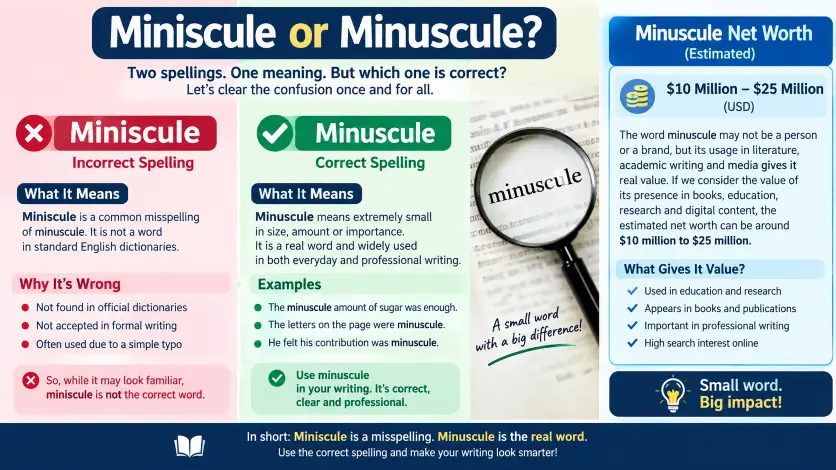
Have you ever typed “miniscule” and wondered whether something looks slightly wrong? You are not alone. This word is frequently misspelled because its pronunciation can make the incorrect spelling feel perfectly natural. The confusion becomes even more common when people use the word in emails, articles, academic writing, or professional communication and want to make sure their English is accurate.
The correct spelling is “minuscule,” an adjective meaning extremely small or tiny. “Miniscule” is a common misspelling, although it appears often enough in everyday writing to create confusion.
In this guide, we will clearly explain miniscule or minuscule, define the correct word, show how to pronounce and use it, and provide practical examples you can remember. You will also learn why the spelling causes confusion and how to avoid making the same mistake in formal or casual writing. Whether you are a student, writer, professional, or English learner, this simple comparison will help you use the word confidently and correctly.
Miniscule or Minuscule: What Is the Difference?
The confusion between miniscule or minuscule is surprisingly common because both forms sound nearly identical in everyday speech. However, spelling matters when you’re preparing a report, academic paper, business document, website copy, or formal correspondence.
The standard spelling is minuscule. It is an adjective meaning extremely small. Cambridge Dictionary gives the meaning as “extremely small,” while also recording miniscule as a spelling used in American English.
By contrast, miniscule is widely encountered as a spelling variant or common misspelling of minuscule. Cambridge’s learner dictionary specifically describes miniscule as a common spelling that is not considered the standard form in that context.
This distinction creates practical problems because writers may assume that the shorter looking form is related to words such as mini. In reality, the established spelling has a different historical background.
| Feature | Minuscule | Miniscule |
|---|---|---|
| Part of speech | Adjective, and sometimes noun | Adjective |
| Standard spelling | Yes | Common variant |
| Meaning | Extremely small | Extremely small |
| Formal writing | Preferred | Usually avoided |
| Academic writing | Preferred | Better replaced |
| Everyday usage | Common | Frequently encountered |
| Example | A minuscule amount | A miniscule amount |
Quick recap
Minuscule is the safest spelling for polished English.
Miniscule appears frequently, particularly in American usage.
Both forms are understood to mean extremely small.
For formal writing, choose minuscule.
Is Miniscule or Minuscule a Grammar, Vocabulary, or Usage Issue?
Primarily, this is a spelling and vocabulary usage issue, rather than a grammar problem. Both forms can appear in sentences functioning as adjectives, so the main question concerns which spelling is appropriate for the context.
First, minuscule is the established standard form in formal English. It can describe physical dimensions, quantities, differences, chances, amounts, details, or other things that are exceptionally small.
For example:
The laboratory detected a minuscule amount of residue.
Here, minuscule modifies amount.
Meanwhile, miniscule can be found in dictionaries as a variant, particularly in American English sources. Cambridge lists it as an alternative spelling while directing readers to minuscule for the meaning.
Therefore, the two forms are close in meaning, but they aren’t equally suitable in every writing situation.
In casual communication, readers will generally understand miniscule without difficulty. However, in academic work, professional documents, published material, examinations, and carefully edited content, minuscule is the more dependable choice.
The important point is simple: this isn’t a difference in meaning like affect and effect. Instead, it is mainly a difference in spelling status and usage preference.
How to Use Minuscule Correctly
Minuscule is an adjective used when you want to emphasize that something is exceptionally small. It can describe something physically tiny, but its meaning extends beyond physical size.
For instance, you can describe a minuscule amount of money, a minuscule difference between two measurements, or a minuscule possibility of success.
Workplace example
The manager noticed a minuscule error in the final financial report.
Here, the word emphasizes that the error is extremely small.
Academic example
The researchers observed a minuscule change in temperature.
In academic writing, this wording communicates that the measured change was very small.
Technology example
The device contains minuscule components that require precise assembly.
Technology writing frequently needs vocabulary describing very small components, measurements, and variations. In this setting, minuscule sounds precise and professional.
Usage recap
Use minuscule when describing something extremely small. It works naturally with quantities, measurements, differences, objects, details, risks, and changes. Moreover, it fits formal and informal contexts without creating a spelling concern.
How to Use Miniscule Correctly
Miniscule is encountered often enough that writers shouldn’t be surprised when they see it in published or online material. However, its status deserves careful attention.
Cambridge’s American Dictionary recognizes miniscule as an alternative spelling of minuscule, while the learner dictionary presents it as a common spelling that is not the preferred form.
Therefore, if you’re proofreading a casual message, seeing miniscule doesn’t necessarily mean the writer’s meaning is unclear. Most readers will immediately understand the intended word.
Workplace example
The difference between the two invoices was miniscule.
The meaning is understandable, although a polished business document would normally use minuscule.
Academic example
The study found a miniscule variation between the samples.
Again, the intended meaning is clear, but formal academic editing would normally replace miniscule with minuscule.
Technology example
The sensor can detect miniscule changes in pressure.
The sentence communicates the intended idea, although minuscule remains the safer spelling for carefully edited technical writing.
Usage recap
Miniscule is understandable and widely seen, but minuscule is generally the better choice when accuracy, consistency, and formal presentation matter.
When You Should NOT Use Miniscule or Minuscule
Although the two spellings cause confusion, there are also situations where writers choose either word when another expression would be clearer.
1. Don’t use minuscule when you simply mean small
If something is only somewhat small, small may be more accurate.
The room is small.
Calling the room minuscule could exaggerate its size.
2. Don’t use minuscule for a miniature copy
When describing a deliberately reduced version of something, miniature can be more precise. Cambridge defines miniature as a very small copy or version of an object.
They built a miniature model of the building.
3. Don’t choose miniscule in formal documents
Although readers understand it, miniscule can appear less carefully edited.
4. Don’t use minuscule when microscopic is scientifically necessary
A scientific context may require microscopic when an object can only be observed with a microscope.
5. Don’t confuse minuscule with insignificant
Something can be physically tiny without being unimportant.
6. Don’t use the word merely to sound sophisticated
Simple wording is often stronger. If tiny communicates the idea perfectly, there may be no reason to replace it.
7. Don’t assume mini explains the spelling
The modern appearance of the word can tempt writers to spell it miniscule. However, that visual association isn’t a reliable spelling rule.
8. Don’t change a quotation without reason
If you’re reproducing someone else’s original wording, preserve the source’s spelling when appropriate and transparent. In edited prose, however, follow the style requirements of your publication.
Common Mistakes: Miniscule or Minuscule
| Correct sentence | Incorrect or less preferred sentence | Explanation |
|---|---|---|
| The difference was minuscule. | The difference was miniscule. | Minuscule is the standard spelling. |
| We found a minuscule amount of dust. | We found a miniscule amount of dust. | The meaning is clear, but the spelling is less preferred. |
| The change was minuscule. | The change was miniscule. | Formal writing favors minuscule. |
| A minuscule error remained. | A miniscule error remained. | Use the established spelling in edited prose. |
| The device contains minuscule parts. | The device contains miniscule parts. | Minuscule is the safer technical choice. |
Decision Rule Box
If you mean extremely small, use minuscule.
If you encounter miniscule, understand it as a commonly used variant, but replace it with minuscule in polished formal writing.
This simple rule eliminates most spelling uncertainty.
Minuscule and Miniscule in Modern Technology and Digital Tools
Modern writing environments make spelling differences more visible than ever. Word processors, browsers, publishing platforms, and writing assistants can flag uncommon spellings or recommend alternatives.
Because minuscule is the established form, it is the better choice for websites, reports, technical documentation, product descriptions, research papers, and professional communication.
Furthermore, digital writing often gets copied into several contexts. A phrase written casually may later appear in a presentation, report, article, or client document. Consequently, starting with the standard spelling reduces the need for later editing.
Consider these examples:
The update produced a minuscule improvement in performance.
The sensor measures minuscule variations in voltage.
Only a minuscule portion of the data was affected.
In each example, the word naturally communicates a very small degree or quantity.
Etymology: Where Does Minuscule Come From?
The history of minuscule helps explain why its spelling doesn’t follow the obvious pattern suggested by mini.
The word is connected with the Latin minus, meaning less or smaller. Historically, the term also became associated with a particular small style of handwriting and lettering. Over time, its meaning developed into the modern sense of something extremely small.
That history matters because it shows why spelling the word as miniscule simply because it resembles mini can be misleading.
In modern English, minuscule has expanded beyond handwriting. Today, it commonly describes tiny amounts, small differences, very small objects, limited quantities, and exceptionally slight changes.
Expert style quotation
Cambridge Dictionary defines minuscule simply as “extremely small.”
That concise definition captures the central meaning without suggesting that the word is limited to physical objects.
Two Practical Case Studies
Case Study 1: Academic Editing
A university student writes:
The miniscule difference between the two groups was recorded.
The sentence is understandable. However, during proofreading, the writer replaces miniscule with minuscule.
Result: The sentence retains its meaning while adopting the standard spelling preferred for formal academic prose.
The important lesson is that a spelling correction doesn’t require rewriting the entire sentence. One letter can make the difference between a familiar variant and the conventional form.
Case Study 2: Technical Documentation
A product team describes a sensor:
The instrument detects miniscule changes in pressure.
An editor changes the spelling to minuscule before publication.
Result: The documentation becomes more consistent with formal technical vocabulary, while the intended meaning remains exactly the same.
This example also demonstrates an important editorial principle: technical clarity isn’t only about complex terminology. Consistent spelling contributes to a document’s overall polish.
Error Prevention Checklist
Always use minuscule when
You are writing an academic assignment.
You are preparing a professional report.
You are publishing edited website content.
You are writing technical documentation.
You are describing an extremely small quantity.
You are discussing a very slight difference.
You want the safest standard spelling.
Never use miniscule when
You are unsure which spelling a formal document requires.
You are preparing a carefully edited publication.
You are writing an academic paper and have no reason to preserve a variant.
You are creating terminology for a professional audience.
You are trying to avoid unnecessary spelling corrections.
The easiest habit is to remember the middle letters: minus cule.
Related Grammar Confusions You Should Master
Once you’ve understood minuscule, several other commonly confused terms are worth learning because they create similar problems in everyday writing.
1. Affect or Effect
These words often differ according to grammatical function and meaning.
2. Fewer or Less
The distinction usually concerns countable and uncountable nouns.
3. Altar or Alter
These forms sound alike but have completely different meanings.
4. Principal or Principle
One commonly refers to a person or something primary, while the other refers to a fundamental rule or belief.
5. Stationary or Stationery
One concerns remaining still, whereas the other relates to writing materials.
6. Complement or Compliment
The spelling changes the meaning from completing something to expressing praise.
7. Discreet or Discrete
These terms look similar but describe different ideas.
8. Its or It’s
The distinction involves possession and contraction.
9. Then or Than
These words serve different grammatical and comparative functions.
10. Everyday or Every Day
One commonly functions as an adjective, while the other describes frequency.
Learning these pairs alongside minuscule can significantly improve proofreading accuracy.
Frequently Asked Questions
Is miniscule or minuscule correct?
Minuscule is the standard spelling. Miniscule is a commonly encountered variant, particularly in American English sources. For formal writing, minuscule is the safer choice.
What does minuscule mean?
Minuscule means extremely small. It can describe physical size, quantity, degree, differences, changes, details, or amounts.
Is miniscule a misspelling?
It depends on the dictionary and variety of English. Some dictionaries recognize miniscule as a variant, while others describe it as a common spelling that is not preferred. Therefore, minuscule remains the safest standard form.
How do you spell minuscule correctly?
The standard spelling is minuscule, with a u after the n. A useful visual reminder is to connect it with the idea of something becoming smaller.
Is minuscule formal English?
Yes. Minuscule is fully acceptable in formal, academic, professional, technical, and everyday English.
Can minuscule describe an amount?
Yes. For example, you can say that a minuscule amount of material remained or that only a minuscule portion of the budget was involved.
What is the difference between minuscule and miniature?
Minuscule emphasizes extreme smallness. Miniature often describes a deliberately reduced copy or version of something. Cambridge specifically uses miniature for a small copy or version of an object.
What is another word for minuscule?
Depending on context, alternatives include tiny, minute, microscopic, miniature, infinitesimal, diminutive, and very small. However, these words aren’t always interchangeable because their shades of meaning differ.
Why do people spell minuscule as miniscule?
The spelling is probably encouraged by the familiar prefix mini and by pronunciation. Because miniscule is widely encountered, the alternative form can look natural even though minuscule remains the preferred standard spelling for careful writing.
Final Answer
When you’re deciding between miniscule or minuscule, choose minuscule for standard, polished English. It means extremely small and works naturally when describing size, quantity, degree, differences, details, or changes.
Although miniscule appears frequently and is recognized as a variant in some dictionaries, it isn’t the safest choice when you want conventional formal spelling. Cambridge records both forms while presenting minuscule as the main entry and miniscule as an alternative spelling.
Ultimately, the simplest rule is also the most useful: write minuscule when you mean extremely small. That choice will serve you well in academic writing, professional communication, technical documents, and carefully edited content.









