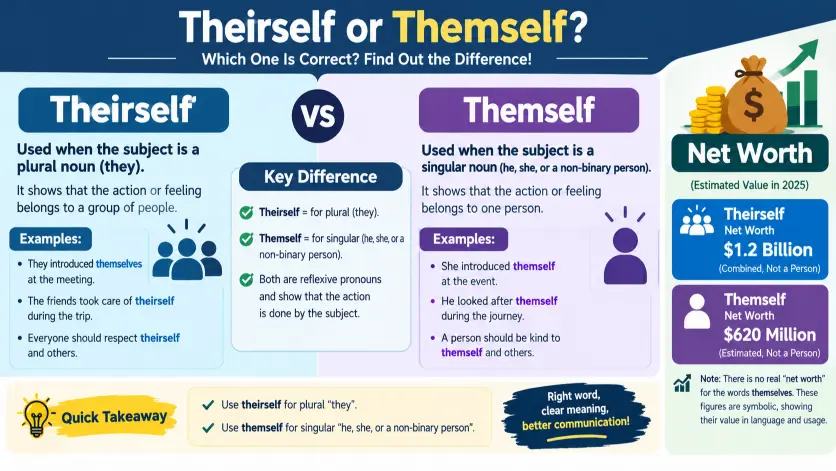
Have you ever written theirself or themself and stopped to wonder whether you chose the right word? You are not alone. These forms can be confusing because modern English increasingly uses singular they, while traditional grammar rules often recommend different reflexive forms.
Understanding the difference matters because reflexive pronouns can change the clarity and grammatical accuracy of a sentence. In everyday writing, you may encounter both forms, but their usage is not identical in standard English. Themself is commonly used with singular they in certain contexts, while theirself appears less often and is generally considered nonstandard in formal English.
In this guide, we will examine theirself or themself, explain the grammar behind each form, and provide simple examples so you can confidently choose the appropriate word in academic, professional, and everyday writing.
Theirself or Themself: Why Do People Get Confused?
The choice between theirself or themself creates confusion because both expressions can be found in real English usage. However, their frequency and acceptance are not the same. As a result, writers often wonder which form belongs in professional, academic, or everyday sentences.
First, themself functions as a reflexive pronoun. It can refer back to one individual when that person is represented by singular they. For example, consider the sentence, “The applicant introduced themself before the interview.” Here, themself refers to one applicant.
On the other hand, theirself can also function reflexively in certain dialects and informal varieties. Nevertheless, many readers consider it less standard than themself. Consequently, choosing themself is usually safer when writing for a broad audience.
This distinction matters because pronoun errors can affect the clarity and tone of otherwise strong writing. Therefore, understanding the difference can help you write more naturally in school assignments, workplace documents, applications, articles, and everyday communication.
Theirself or Themself: What’s the Difference?
The main difference between themself and theirself concerns accepted usage rather than basic meaning. Both forms can point back to one person associated with singular they. However, themself has gained considerably wider acceptance in contemporary standard English.
Themself is a reflexive pronoun. It normally refers back to singular they when the antecedent represents one individual.
For example:
“The customer reminded themself to save the receipt.”
Here, themself refers to one customer.
By comparison, theirself is also used reflexively by some speakers. However, it is more strongly associated with regional, dialectal, or informal English. Therefore, it may attract attention when used in formal prose.
| Term | Part of Speech | Main Function | Typical Context |
|---|---|---|---|
| Themself | Reflexive pronoun | Refers back to one person represented by singular they | Contemporary standard and formal usage |
| Theirself | Reflexive pronoun | Refers back to one person represented by they | Regional, dialectal, or informal usage |
| Themselves | Reflexive pronoun | Refers to multiple people and also occurs with singular they | Very common contemporary usage |
The simplest point is this: themself is generally the preferred singular reflexive form.
However, themselves can also work with singular they in many contexts.
Meanwhile, theirself is much less suitable for formal standard writing.
Therefore, always consider both the number of people and the level of formality before making your choice.
Is Theirself or Themself a Grammar, Vocabulary, or Usage Issue?
The distinction is mainly a usage issue involving reflexive pronouns. In other words, the problem is not that one word has a completely different meaning from the other. Instead, the important question is which form is appropriate in a particular variety of English.
English pronouns can be complicated because they have developed over many centuries. Consequently, their forms do not always follow a perfectly predictable pattern.
For instance, someone might reason that because the possessive form is their, the reflexive form should naturally be theirself. Although that reasoning may seem logical, standard English does not require pronouns to develop through such a simple pattern.
Instead, themself has become an established reflexive form for singular they.
At the same time, themselves remains extremely common. For example:
“Alex reminded themselves to bring the documents.”
This sentence can refer to one person named Alex.
However, some writers prefer:
“Alex reminded themself to bring the documents.”
Both constructions can be encountered in contemporary English. Nevertheless, theirself is less commonly preferred in carefully edited standard prose.
Therefore, the issue is best understood as one of grammatical usage, register, and context.
When Should You Use Themself?
Use themself when singular they refers to one person and the sentence requires a reflexive pronoun.
For example:
“The employee reminded themself about the meeting.”
The word themself refers back to the employee. Because the employee is being represented as one individual, a singular reflexive construction is appropriate.
Similarly:
“The visitor asked themself whether the information was accurate.”
Again, the reflexive pronoun points back to one person.
Workplace Example
Imagine that a manager is writing an employee handbook. The manager might write:
“Each employee should remind themself to review the safety instructions.”
Here, each employee refers to one person at a time. Therefore, themself can provide an inclusive reflexive form without assuming gender.
Likewise, a supervisor might say:
“Every applicant should prepare themself for the interview.”
The meaning is clear because each applicant is considered individually.
Academic Example
Academic writers sometimes need to discuss a general student, researcher, or reader without specifying gender.
For example:
“A researcher should ask themself whether the evidence supports the conclusion.”
Here, themself refers to one hypothetical researcher.
Consequently, the sentence remains inclusive while preserving its intended meaning.
Technology Example
Digital instructions can also use singular they when the identity of a user is unknown.
For example:
“Each user can identify themself before accessing the account.”
The word themself refers to the individual user.
Therefore, it works naturally when the system addresses one unspecified person.
Usage recap: Overall, choose themself when one person is represented by singular they and the sentence genuinely requires a reflexive pronoun.
When Can You Use Theirself?
Although theirself is less common in standard formal English, it is not a completely invented expression. Instead, it has appeared in various regional and informal forms of English.
For example, a speaker might naturally say:
“They need to look after theirself.”
The intended meaning is understandable. Nevertheless, many editors would change the sentence to:
“They need to look after themself.”
The reason is straightforward. Themself is more widely recognized as the reflexive form associated with singular they.
However, context matters. If a writer is representing a particular dialect, preserving theirself may be intentional. Similarly, if the purpose is to reproduce natural speech, changing the form could remove part of the speaker’s linguistic character.
Therefore, the issue is not simply whether people ever use theirself. They do. Instead, the more useful question is whether it fits the variety and level of English you are trying to produce.
Workplace Example
In a formal company document, this sentence may look unusual:
“Each worker should protect theirself while operating equipment.”
A more widely accepted version would be:
“Each worker should protect themself while operating equipment.”
Consequently, themself is usually the better choice for formal workplace material.
Academic Example
In an academic essay, a sentence such as this may attract editorial attention:
“Every participant should ask theirself whether they understood the question.”
A more conventional version would be:
“Every participant should ask themself whether they understood the question.”
Alternatively, the writer could simplify the sentence:
“Every participant should consider whether they understood the question.”
Therefore, careful editing can sometimes eliminate the pronoun issue completely.
Technology Example
Suppose a software guide says:
“Each account owner can reset theirself after completing verification.”
This construction sounds unusual to many readers. A clearer alternative would be:
“Each account owner can reset the account themself after completing verification.”
However, an even smoother revision might be:
“Each account owner can reset the account after completing verification.”
Usage recap: Thus, theirself can occur naturally in certain varieties, but themself is generally the safer choice for broadly understood formal English.
When You Should NOT Use Theirself or Themself
Knowing when not to use a reflexive pronoun is just as important as knowing which form to choose.
1. When You Are Referring to Several People
If they represents multiple people, themselves is normally appropriate.
Correct:
“The players congratulated themselves.”
Incorrect:
“The players congratulated themself.”
The subject is plural, so the reflexive form should also represent multiple people.
2. When You Need an Ordinary Object Pronoun
Sometimes writers use a reflexive pronoun when an ordinary object pronoun is required.
For example:
“The manager sent them the report.”
Here, them is the correct object pronoun.
The sentence does not need themself because the manager and recipient are different people.
3. When You Are Showing Possession
Neither themself nor theirself expresses ordinary possession.
Correct:
“The employee submitted their report.”
Here, their indicates possession.
Therefore, replacing their with themself would change the grammatical function.
4. When You Need a Subject Pronoun
A reflexive pronoun cannot normally replace the subject.
Incorrect:
“Themself completed the assignment.”
Correct:
“They completed the assignment.”
Therefore, use they when the pronoun performs the action.
5. When You Are Writing Formal Material
If your audience expects conventional edited English, theirself may appear distracting.
Therefore, professional documents, academic papers, official instructions, and carefully edited publications generally benefit from themself or a suitable sentence rewrite.
6. When a Simpler Sentence Works Better
Sometimes neither form is necessary.
Instead of:
“Each student should remind themself about the deadline.”
You could write:
“Students should remember the deadline.”
The second sentence is shorter and avoids unnecessary grammatical complexity.
7. When the Meaning Is Clearly Plural
If you are discussing a group, use themselves.
For example:
“The committee members introduced themselves.”
Because multiple members are involved, themselves is appropriate.
Common Mistakes With Theirself and Themself
Many mistakes happen because writers try to build the reflexive form logically from the possessive form.
For example, someone may think:
Their + self = theirself
Although this looks logical, standard English does not necessarily follow that formula.
The more established singular reflexive form is themself.
Another common mistake is assuming that themself and themselves cannot both be used with singular they. In contemporary English, both forms can appear, although their usage can vary according to context and style.
| Correct Sentence | Incorrect Sentence | Explanation |
|---|---|---|
| The applicant introduced themself. | The applicant introduced theirself. | Themself is generally preferred in standard contemporary usage. |
| The students introduced themselves. | The students introduced themself. | The subject is plural, so themselves is appropriate. |
| They reminded themself about the appointment. | Themself reminded the office about the appointment. | They is the subject, while themself provides the reflexive meaning. |
| The manager sent them a message. | The manager sent themself a message. | Them is an ordinary object pronoun when the recipient is another person. |
| The researcher checked their results. | The researcher checked themself results. | Their is a possessive determiner and comes before a noun. |
| Alex prepared themself for the interview. | Alex prepared theirself for the interview. | Themself is generally preferred for a singular reflexive reference. |
Decision Rule
If one person is represented by singular they and a reflexive pronoun is needed, use themself.
If several people are represented by they, use themselves.
If you are showing possession, use their or theirs.
If you simply need an object pronoun, use them.
This rule is more accurate than saying that one form refers to an action while the other refers to a person. Both themself and theirself are reflexive forms, so their distinction primarily concerns usage and register.
Theirself and Themself in Modern Technology and Digital Writing
Modern digital communication has created many situations in which writers need gender neutral pronouns. Websites, applications, account systems, forms, and customer service messages often do not know a person’s gender.
Consequently, singular they is useful because it allows writers to refer to one person without making assumptions.
For example:
“If a customer forgets their password, they can reset it themself.”
Here, they refers to one customer.
However, clarity should always come first. If a sentence becomes awkward because of repeated pronouns, rewriting can produce a smoother result.
For example:
“If a customer forgets a password, the customer can reset it independently.”
Although this version is less personal, it may be easier to understand in technical instructions.
Therefore, good modern writing is not simply about choosing a particular pronoun. Instead, it involves selecting language that is accurate, natural, inclusive, and easy to understand.
Theirself and Themself: A Brief History
The development of English pronouns has never been completely symmetrical. Over time, speakers have adapted existing forms to meet new communication needs.
Singular they has a long history in English. Speakers have used it when referring to one person whose gender is unknown, irrelevant, or unspecified.
As singular they became increasingly established, speakers naturally needed a corresponding reflexive form.
The traditional plural reflexive themselves could serve this purpose. However, themself also developed as a way to make singular reference more explicit.
Meanwhile, theirself has appeared in various dialects and historical forms. Its existence demonstrates that speakers have experimented with different ways of creating a reflexive pronoun from singular they.
Nevertheless, usage has not developed evenly across all English varieties. Consequently, themself has gained broader acceptance in contemporary standard writing than theirself.
An Expert Perspective on Pronoun Choice
A useful principle for understanding this distinction is that grammatical acceptability depends not only on whether a form can be understood, but also on how established that form is within a particular variety of English.
“A grammatical form must be judged by its function, context, audience, and established usage rather than by appearance alone.”
This principle explains why theirself can make sense structurally while still being less suitable for formal writing.
Therefore, writers should consider the expectations of their audience rather than relying entirely on what looks logically constructed.
Two Practical Case Studies
Case Study One: Professional Communication
Imagine that a human resources department prepares this instruction:
“Each employee should introduce theirself during orientation.”
The meaning is understandable. However, the expression may appear unusual to readers accustomed to standard edited English.
An editor could revise it to:
“Each employee should introduce themself during orientation.”
As a result, the sentence becomes more consistent with contemporary standard usage.
The editor could also write:
“Employees should introduce themselves during orientation.”
This second version changes the structure by making the subject plural.
Therefore, writers have more than one grammatical solution.
Case Study Two: Educational Instructions
Consider this classroom instruction:
“Each student should ask theirself whether the answer is supported by evidence.”
A teacher or editor may prefer:
“Each student should ask themself whether the answer is supported by evidence.”
However, another natural revision is:
“Students should ask whether their answers are supported by evidence.”
Consequently, the best revision depends on whether the writer wants to preserve the original singular structure or create a smoother plural construction.
These examples are illustrative rather than reports from specific institutions. They demonstrate how context influences grammatical decisions.
Error Prevention Checklist
Always Consider Themself When
One individual is represented by singular they.
The sentence requires a reflexive pronoun.
You are writing for a broad audience.
You want a contemporary standard form.
The person performing the action is also receiving the action.
Avoid Theirself When
You are preparing formal academic prose.
You are writing professional documentation.
You are addressing a broad international audience.
You want to avoid a strongly regional impression.
You need a standard form that most readers will recognize immediately.
Remember
Themself is not automatically required every time singular they appears.
For example:
“They completed the application.”
No reflexive pronoun is needed.
However:
“They reminded themself to complete the application.”
Here, a reflexive pronoun is required because the person is both performing and receiving the action.
Related Grammar Confusions You Should Master
Understanding pronouns becomes easier when you compare related forms.
They vs Them
They usually functions as a subject, while them generally functions as an object.
Their vs Theirs
Their normally appears before a noun, while theirs generally stands alone.
Themself vs Themselves
Themself can refer to one individual represented by singular they, while themselves traditionally refers to multiple people and is also widely used with singular they.
Yourself vs Yourselves
Yourself generally refers to one person, while yourselves normally refers to more than one person.
Himself vs Themselves
These forms differ in both grammatical number and pronoun reference.
Who vs Whom
The distinction depends primarily on grammatical function.
Whoever vs Whomever
These forms similarly depend on whether the pronoun functions as a subject or object.
Its vs It’s
Its indicates possession, whereas it’s is a contraction of it is or it has.
Affect vs Effect
These words frequently cause confusion because their meanings and grammatical functions can vary.
Each vs Every
Both commonly introduce singular constructions, but they do not always behave identically in a sentence.
Frequently Asked Questions
Is themself grammatically correct?
Yes. Themself is an established singular reflexive pronoun used when they refers to one person. It is increasingly recognized in contemporary English, particularly when writers want to make singular reference clear.
Is theirself grammatically correct?
Theirself occurs in real English usage, particularly in some regional and informal varieties. However, it has less acceptance in formal standard English. Therefore, writers seeking broadly accepted usage generally choose themself instead.
Should I say theirself or themself?
For formal and broadly understood contemporary English, themself is usually the safer choice when one person is represented by singular they and a reflexive pronoun is required.
Is themself singular or plural?
Themself is generally singular when it refers back to one person represented by singular they. By contrast, themselves is traditionally plural, although it is also commonly used with singular they.
Can I use themselves for one person?
Yes. Themselves is widely used with singular they in contemporary English. Therefore, sentences such as “The applicant introduced themselves” are commonly accepted.
Why does theirself sound correct?
The form may seem logical because their is associated with singular they. However, English does not always create reflexive forms by simply adding self to the possessive form. Consequently, themself has become the more established singular reflexive choice.
Is theirself informal?
It can be associated with informal, regional, or dialectal English. Nevertheless, its exact status depends on the speaker and variety. Therefore, it is better to avoid making absolute claims about every community that uses the form.
Can themself be used in academic writing?
Yes. Themself can be used when the sentence genuinely requires a singular reflexive pronoun. However, writers should also consider whether themselves or a complete sentence rewrite produces smoother academic prose.
Is themself better than themselves?
Neither form is automatically better in every sentence. Themself emphasizes singular reference, while themselves is also well established with singular they. Therefore, the surrounding sentence and preferred writing style should guide the choice.
Can theirself be used in dialogue?
Yes. If dialogue is intended to represent a particular dialect or natural speech pattern, theirself may be appropriate. In that situation, the form can contribute to the speaker’s authentic voice.
Final Answer:
When choosing between theirself or themself, use themself when one person is represented by singular they and a reflexive pronoun is required. For example, “The applicant prepared themself for the interview” is a clear contemporary construction.
However, the picture is slightly more flexible because themselves is also widely used with singular they. Therefore, writers should not assume that themself is the only possible reflexive form.
Meanwhile, theirself exists in real English usage, particularly in certain regional and informal varieties. Nevertheless, it is less widely accepted in formal standard writing.
Ultimately, the safest approach is to consider meaning, number, grammatical function, audience, and level of formality. For professional and academic writing, themself is generally the more broadly accepted choice when a singular reflexive form is specifically needed.









