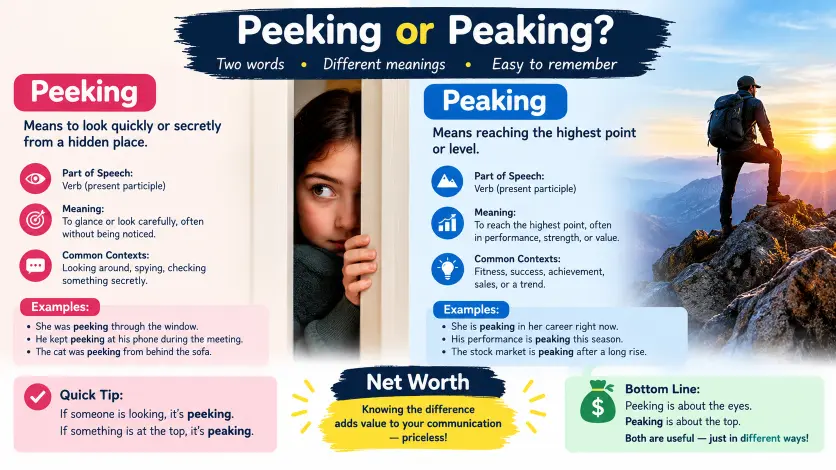
Have you ever wondered whether to write peeking or peaking in a sentence? These two words look and sound similar, which makes them easy to confuse, even for people who use English every day. However, their meanings are completely different. One describes looking at something secretly or through a small opening, while the other refers to reaching the highest point of something, such as popularity, performance, or intensity. Choosing the wrong word can change the meaning of your sentence, so understanding this simple spelling difference is important for clear communication.
The easiest way to understand peeking vs. peaking is to look at how each word is used in everyday English. For example, a child might be peeking through a doorway to see what is happening, while a singer’s popularity might be peaking after a successful performance. Both words are grammatically correct, but they cannot be used interchangeably. Learning their definitions, spelling patterns, and sentence structures will help you avoid common writing mistakes.
In this guide, you will discover the meanings of peeking and peaking, their differences, and practical examples that show when to use each word. We will also explore common errors, easy memory tricks, and frequently asked questions to make the distinction easier to remember. Whether you are writing an email, completing a school assignment, creating online content, or improving your vocabulary, this straightforward guide will help you choose the correct word with confidence and communicate your ideas more accurately.
X vs Y: What’s the Difference Between Peeking or Peaking?
Although these terms sound identical, their meanings depend on the situation. One describes an act of looking, while the other refers to a maximum level, height, or period of performance.
What Does Peeking Mean?
Peeking is a verb form of peek. It means looking quickly, briefly, or secretly at someone or something, often to avoid being noticed.
For example, imagine a child standing outside a room and looking through a slightly open door. The child is peeking inside because the action involves a brief or secret look.
Common examples include:
- Peeking through a window.
- Peeking at a birthday present before opening it.
- Peeking around a corner to see who is there.
- Peeking at your phone during a meeting.
What Does Peaking Mean?
Peaking is a verb form of peak. It means reaching the highest point, greatest intensity, or maximum level of something.
For instance, when a singer reaches the strongest point of a performance, their popularity reaches its highest level, or traffic becomes busiest during rush hour, the relevant activity or condition may be described as peaking.
Common examples include:
- Sales peaking during the holiday season.
- Temperatures peaking in the afternoon.
- An athlete peaking before a championship.
- Internet traffic peaking during a major event.
Peeking vs Peaking Comparison Table
| Feature | Peeking | Peaking |
|---|---|---|
| Base word | Peek | Peak |
| Part of speech | Verb form, present participle | Verb form, present participle |
| Main meaning | Looking briefly or secretly | Reaching the highest point |
| Typical context | Curiosity, observation, secrecy | Performance, numbers, intensity |
| Example | She is peeking through the door. | Demand is peaking this week. |
| Related noun | A peek | A peak |
| Common phrase | Peeking at a gift | Peaking in performance |
Quick recap: Use peeking when someone takes a quick look. Use peaking when something reaches its highest level. Although both words sound alike, their meanings are not interchangeable. Therefore, choose the spelling according to the action or situation you want to describe.
Is Peeking vs Peaking a Grammar, Vocabulary, or Usage Issue?
The difference between these words is primarily a vocabulary and word choice issue, rather than a grammatical rule. Both forms are grammatically correct, provided they appear in a sentence that matches their meanings.
Are Peeking and Peaking Interchangeable?
No. Although the words are homophones, meaning they sound alike but have different meanings, they cannot replace each other without changing the message.
For example:
Correct: The toddler was peeking through the curtains.
Incorrect: The toddler was peaking through the curtains.
The second sentence suggests that the toddler is reaching a maximum point, which does not make sense in this context.
Similarly, consider this example:
Correct: The athlete is peaking at the right time.
Incorrect: The athlete is peeking at the right time.
The second sentence describes looking briefly, not reaching the best level of athletic performance.
Formal vs Informal Usage
Both spellings work in formal and informal English. However, their suitability depends on the intended meaning.
In a casual conversation, someone might say, “I was peeking at my birthday gift.” Meanwhile, a business report might state, “Customer demand is peaking during the holiday period.”
Neither spelling is inherently more formal than the other. Instead, the surrounding words determine which one belongs in the sentence.
Academic vs Casual English
In academic writing, peaking frequently describes trends, measurements, temperatures, and performance levels. For example, a researcher might explain that a measured response peaked after a particular treatment.
On the other hand, peeking might appear in a story, a behavioral observation, or an experiment involving visual attention.
In everyday conversation, both words are equally useful. Nevertheless, writers should consider the subject of the sentence before choosing a spelling.
How to Choose Peeking or Peaking in Everyday Writing
Fortunately, you can distinguish these words with a simple question: Is someone looking, or is something reaching a high point?
If the sentence describes looking through a window, checking something secretly, or taking a quick glance, use peeking. By contrast, if it describes reaching maximum speed, popularity, demand, or performance, use peaking.
Consider these additional examples:
- The cat was peeking out from under the sofa.
- The company’s profits are peaking this quarter.
- She caught her brother peeking at her messages.
- Electricity demand is peaking during the evening.
- The performer was peeking behind the curtain.
- His athletic performance is peaking before the final.
Notice that the surrounding context makes the intended meaning clear. Furthermore, related forms such as peeked, peaks, and peaked follow the same distinction.
For example, “She peeked through the door” describes looking, whereas “The mountain peaked above the clouds” describes reaching a high point. In the second example, peaked is the past tense of peak.
When Should You Use Peeking?
Use peeking whenever a person or animal looks briefly, cautiously, or secretly at something. In particular, the word often suggests curiosity, privacy, or an attempt to see without being noticed.
Workplace Example
Suppose an employee checks a colleague’s computer screen from across the office.
Correct: “He was peeking at his colleague’s monitor.”
This sentence describes looking at something. However, if you mean that a company’s sales are reaching their maximum, peeking would be the wrong choice.
Academic Example
A psychology student might describe a child observing an unfamiliar object.
Correct: “The child was peeking through a small opening to observe the object.”
Here, the verb describes a visual action. Therefore, it fits the situation naturally.
Technology Example
Imagine someone briefly viewing a notification on a phone without opening the full conversation.
Correct: “She was peeking at the message preview.”
Although this is understandable everyday language, a technical document might use a more specific phrase such as previewing a notification, depending on the feature being discussed.
Usage Recap
Use peeking for brief or secret observation. Common contexts include windows, doors, messages, presents, corners, and private screens. Above all, remember that the underlying action involves looking rather than reaching a maximum level.
When Should You Use Peaking?
Use peaking when describing something that is approaching or reaching its highest level, intensity, or performance point. The term appears frequently in business, sports, science, entertainment, and discussions about trends.
Workplace Example
Consider a retailer preparing for a seasonal sales report.
Correct: “Online demand is peaking ahead of the holiday weekend.”
The sentence indicates that demand is reaching a high level. Consequently, peaking is the appropriate spelling.
Academic Example
A scientist might describe a temperature pattern recorded during an experiment.
Correct: “The temperature is peaking near the end of the observation period.”
In this context, the verb describes a maximum value. Depending on the data, a researcher might instead say that the temperature reaches its peak at a particular time.
Technology Example
Consider a website experiencing unusually high visitor activity.
Correct: “Server traffic is peaking during the live event.”
This sentence describes a rise toward maximum activity. Therefore, peaking is suitable for analytics reports, capacity planning, and discussions about system performance.
Usage Recap
Use peaking when discussing maximum levels, intensity, demand, popularity, or performance. In contrast to peeking, the word describes a condition or trend reaching a high point rather than someone taking a look.
When You Should NOT Use Peeking or Peaking
Even experienced writers occasionally confuse these homophones. However, several practical rules can prevent common errors.
1. Do not use peeking to describe maximum performance. For example, “The athlete is peeking before the final” is incorrect if you mean that the athlete is reaching peak form. Write peaking instead.
2. Do not use peaking to describe secret observation. If a child looks around a doorway, write “The child is peeking around the door.”
3. Do not assume that a high number always means peaking. The word is appropriate when the number or activity reaches a high point, not whenever a quantity increases. For instance, sales can increase without yet peaking.
4. Do not confuse peak with peek in past tense. The correct forms are peeked for looking and peaked for reaching a high point.
5. Do not replace peeking with peak when describing an ongoing action. “She is peaking through the window” does not communicate the intended meaning of looking.
6. Do not use peaking when you mean simply increasing. A value may continue rising without having reached its maximum. In such cases, increasing or rising may be more accurate.
7. Do not choose a spelling based only on pronunciation. Since both words are pronounced alike in standard English, listen carefully to the meaning of the sentence rather than relying on sound.
8. Do not overlook the surrounding context. A sentence about a mountain, a sales chart, or an athlete may use peak differently from a sentence about a person looking through a doorway.
Common Mistakes With Peeking and Peaking
The following table shows how to correct frequent spelling and usage errors.
| Correct sentence | Incorrect sentence | Explanation |
|---|---|---|
| She was peeking through the blinds. | She was peaking through the blinds. | Looking through blinds requires peeking. |
| Demand is peaking this month. | Demand is peeking this month. | Demand can reach a maximum, so use peaking. |
| He peeked at the answer sheet. | He peaked at the answer sheet. | Peeked is the past tense of peek. |
| Her performance peaked last season. | Her performance peeked last season. | The sentence describes reaching a maximum level. |
| The puppy is peeking around the corner. | The puppy is peaking around the corner. | The puppy is looking, not reaching a maximum. |
| Temperatures are peaking in the afternoon. | Temperatures are peeking in the afternoon. | The sentence describes a temperature high point. |
| I caught him peeking at the gift. | I caught him peaking at the gift. | The person is taking a quick look. |
| Website traffic peaked at noon. | Website traffic peeked at noon. | The traffic reached its highest recorded level. |
Decision Rule
If you mean the action of looking, use peeking.
Example: “He was peeking through the window.”
If you mean reaching the highest level, use peaking.
Example: “Demand is peaking this afternoon.”
One additional point is worth remembering: the distinction is based on meaning, not on whether the subject is a person, object, or measurement. A person can be peaking in performance, and a website can experience traffic that is peaking. Likewise, a cat, child, or adult can be peeking at something.
Peeking and Peaking in Modern Technology and Digital Tools
Digital communication makes correct word choice particularly important because short messages often lack context.
For example, someone might write, “I was peeking at your profile.” This means they briefly looked at the profile. However, “Engagement is peaking on our latest post” indicates that audience activity is reaching a high level.
Similarly, website owners might describe visitor numbers as peaking during a major campaign. By contrast, a user who briefly checks a message preview is peeking at the notification.
When writing reports, dashboards, social media captions, or product documentation, choose the word that describes the actual behavior. Furthermore, remember that spellcheckers may not flag either spelling because both are legitimate English words.
Etymology: Where Do Peeking and Peaking Come From?
Understanding the origins of these terms provides another way to remember their meanings.
The word peek has a history in English dating back several centuries. It refers to looking quickly or furtively, and it is associated with the act of taking a brief glance. Its precise historical development is not completely certain.
By comparison, peak is associated with a pointed summit or the top of a mountain. The noun later developed broader meanings involving the highest point of an activity, quantity, or period. Its verb form describes reaching that maximum.
The endings also provide a useful grammatical clue. Adding ing to peek creates peeking, while adding ing to peak creates peaking. In both cases, the base word retains its spelling.
An easy memory technique is to connect the double e in peek with eyes looking at something. Meanwhile, associate peak with the top of a mountain.
An Expert Style Rule for Remembering the Difference
A useful editorial rule is:
“Peek with your eyes; peak at the top.”
This short reminder captures the central difference without requiring you to memorize complicated grammar terminology.
When editing a sentence, first identify the intended action. If someone is observing something briefly, choose peek. If a measurement, trend, or performance is reaching its maximum, choose peak.
For example, consider the sentence, “The audience was peeking during the concert.” The wording is unclear because it does not explain what the audience was looking at. If the intended meaning is that audience excitement was reaching its highest level, rewrite it as “Audience excitement was peaking during the concert.”
Likewise, if you write, “The child was peaking through the curtains,” replace peaking with peeking. Consequently, a quick meaning check can prevent both spelling errors and awkward sentences.
Two Practical Case Studies: Peeking or Peaking?
The following case studies are illustrative examples designed to demonstrate how the distinction works in realistic situations. Their outcomes are examples, not independently measured research findings.
Case Study One: A Student Corrects a Writing Mistake
A student writes the following sentence in an English assignment:
“The little girl was peaking through the classroom door.”
Initially, the sentence appears reasonable because both spellings sound alike. However, the intended meaning is that the girl is secretly looking inside the classroom.
The student checks the meaning of the verb and replaces peaking with peeking.
Corrected sentence: “The little girl was peeking through the classroom door.”
The correction resolves the word choice error without changing the sentence’s structure. Moreover, the student learns a reusable distinction that applies to similar sentences about windows, curtains, and doorways.
Result: One incorrect word is corrected, and the sentence communicates the intended action clearly.
Case Study Two: A Business Analyst Describes Website Traffic
A business analyst prepares a report about website visitors during a product launch.
The original sentence reads:
“Visitor activity was peeking at 8 p.m.”
In this context, the analyst wants to communicate that visitor activity reached its highest level at that time. Therefore, peaking is the appropriate word.
Corrected sentence: “Visitor activity was peaking at 8 p.m.”
If the report confirms that 8 p.m. was the highest recorded point, the analyst could write, “Visitor activity peaked at 8 p.m.”
Result: The revised wording accurately describes a maximum in website activity rather than an act of looking.
Together, these examples demonstrate why context matters more than pronunciation. A quick review of the intended meaning is often enough to identify the correct spelling.
Error Prevention Checklist for Peeking and Peaking
Before publishing an article, submitting an assignment, or sending a professional message, review the following checklist.
Always Use Peeking When
- Someone looks quickly at an object or person.
- A child looks through a doorway.
- Someone secretly checks a present.
- A person briefly views a message or screen.
- An animal looks around a corner.
Never Use Peaking When
- The intended action is looking through a window.
- Someone is secretly checking another person’s activity.
- A person is taking a quick glance at a document.
- A child is looking through a gap in a fence.
- You are describing a brief look rather than a maximum level.
Always Use Peaking When
- Sales reach their highest level.
- An athlete reaches their best performance level.
- Temperatures approach their maximum.
- Website traffic reaches an unusually high point.
- Demand reaches its highest level during a particular period.
Final Proofreading Questions
Ask yourself these three questions:
- Does the sentence describe looking?
- Does it describe reaching a maximum?
- Would replacing the word with looking or reaching its highest point preserve the intended meaning?
If the first replacement works, peeking is probably correct. If the second replacement works, peaking is probably correct. Nevertheless, read the entire sentence to make sure the context supports your choice.
Related Grammar Confusions You Should Master
Once you understand these two words, consider learning the following commonly confused English pairs. Each involves a difference in spelling, meaning, or grammatical function.
| Word pair | Main distinction |
|---|---|
| Affect vs Effect | Influence versus result |
| Peek vs Peak | Brief look versus highest point |
| Principal vs Principle | Main person or thing versus a rule |
| Compliment vs Complement | Expression of praise versus something that completes another thing |
| Advice vs Advise | Recommendation versus the act of recommending |
| Lose vs Loose | Fail to keep versus not tight |
| Their vs There | Possessive determiner versus location or introductory expression |
| Then vs Than | Time or sequence versus comparison |
| Accept vs Except | Receive or agree versus exclude |
| Stationary vs Stationery | Not moving versus writing materials |
Although these pairs have different meanings, the same technique applies to all of them. First, determine the message you want to communicate. Then select the word that expresses that message accurately.
Frequently Asked Questions
1. What is the difference between peeking and peaking?
Peeking means looking briefly or secretly at someone or something. In contrast, peaking means reaching the highest point or maximum level of something, such as sales, temperature, popularity, or athletic performance.
2. Is peeking or peaking the correct spelling?
Both spellings are correct, but they have different meanings. Use peeking for looking and peaking for reaching a maximum. Therefore, the correct choice depends on the context of your sentence.
3. How do you use peeking in a sentence?
You can use peeking to describe a quick or secret look. For example, “The puppy was peeking through the fence to see the children playing outside.”
4. How do you use peaking in a sentence?
Use peaking when something reaches or approaches its highest level. For example, “Demand for winter clothing is peaking as temperatures fall.”
5. Are peeking and peaking pronounced the same way?
Yes. In standard English, these words are homophones, which means they share the same pronunciation but have different meanings and spellings. Consequently, context is essential when choosing between them in writing.
6. What is the past tense of peeking and peaking?
The past tense of peek is peeked, while the past tense of peak is peaked. For example, “She peeked through the door” describes looking, whereas “Sales peaked in December” describes reaching a maximum.
7. Is peaking the same as reaching your peak?
The expressions are closely related. Peaking describes the process of reaching the highest point, while reaching your peak means arriving at your maximum level of performance, ability, or achievement.
8. Can you use peeking when talking about social media?
Yes. You can say that someone is peeking at a profile when they briefly look at it. However, if you mean that engagement or views are reaching their highest level, use peaking instead.
9. Why does spellcheck not correct peeking to peaking?
Spellcheckers often accept both words because each is correctly spelled English. However, standard spelling tools may not recognize that the selected word is inappropriate for the intended meaning. Reading the full sentence is therefore important.
Conclusion:
Ultimately, the difference between peeking and peaking becomes simple once you focus on the meaning of the sentence. Although these words sound alike, they describe two completely different ideas. Use peeking when someone is looking briefly, secretly, or cautiously at something. Meanwhile, use peaking when a person, activity, measurement, or trend reaches its highest level.
For example, a child might be peeking through a window, while a company’s sales might be peaking during the holiday season. Both sentences are correct because each word matches its intended meaning.
The easiest rule to remember is this: peeking involves looking, while peaking involves reaching a high point. Apply this distinction whenever you write emails, academic assignments, business reports, or everyday messages, and you will be far less likely to confuse these commonly mixed up words.









