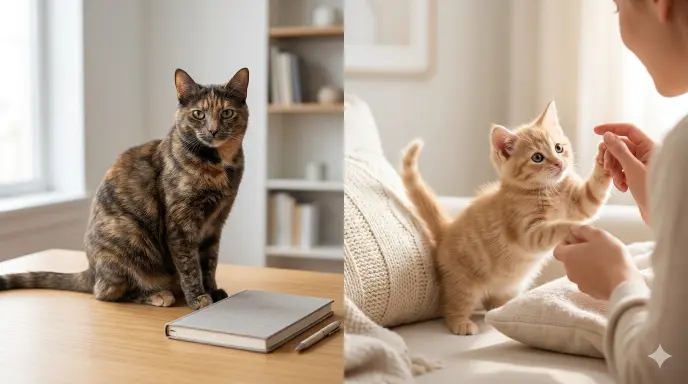
Have you ever wondered whether “kitty” and “cat” actually mean the same thing? While both words can describe the same animal, they carry different tones and are used in different situations. Knowing this small distinction can make your English sound more natural and appropriate.
The word cat is the standard and widely accepted term for the animal, while kitty is usually a more affectionate, informal, or playful word. You may hear it when someone talks lovingly about a pet or addresses a cat in a friendly way.
In this guide, we’ll explore kitty or cat, including their meanings, differences, everyday examples, tone, and common mistakes. Whether you are learning English, writing content, or simply curious about feline vocabulary, this explanation will help you choose the right word with confidence.
Kitty or Cat: What Is the Difference?
First, both words refer to a domesticated feline, but their tone is noticeably different. Cat is the ordinary and standard noun used in general English. Kitty, meanwhile, is an informal noun that often expresses affection, gentleness, familiarity, or fondness.
A cat can refer to an animal regardless of age, personality, or relationship with the speaker. For example, someone might say, “The cat is sleeping near the window.” This sentence sounds neutral and natural in almost every setting.
By contrast, kitty often sounds warmer. Someone may say, “Come here, kitty,” when calling a friendly feline. Similarly, a pet owner might describe an animal as “my little kitty” because the expression communicates emotional closeness.
| Feature | Kitty | Cat |
|---|---|---|
| Part of speech | Noun | Noun |
| Basic meaning | A cat, especially one addressed affectionately | A domesticated feline animal |
| Tone | Informal, affectionate, gentle | Neutral, standard |
| Formal writing | Usually unsuitable | Fully appropriate |
| Casual conversation | Common | Very common |
| Pet conversations | Very natural | Very natural |
| Academic writing | Rare | Standard |
| General reference | Possible | Preferred |
| Emotional feeling | Warm and personal | Neutral and factual |
Therefore, the distinction is not about the animal itself. Instead, it concerns register, emotional tone, and communicative purpose.
In short, cat is the safest general choice. Kitty adds warmth or affection. Consequently, a writer should consider the audience before selecting either expression.
Kitty or Cat: Grammar, Meaning, and Tone
From a grammatical perspective, both words normally function as nouns. However, their practical roles differ because their social meanings are not identical.
The noun cat works comfortably in formal reports, classroom assignments, veterinary discussions, news writing, scientific descriptions, and ordinary conversations. It does not automatically suggest affection.
The noun kitty is more personal. Although it can describe the same animal, it often carries a playful or tender feeling. As a result, parents, children, pet owners, and close friends may use it more frequently than professional writers.
For instance, “The cat requires regular veterinary care” sounds objective. Meanwhile, “The kitty is waiting by the door” sounds more personal and conversational.
Therefore, neither expression is grammatically wrong. Instead, the main issue involves vocabulary choice and usage.
Is Kitty or Cat a Grammar, Vocabulary, or Usage Issue?
Ultimately, this is primarily a vocabulary and usage issue, rather than a grammar problem.
Both terms can occupy the same grammatical position in many sentences. However, replacing one with the other can alter the emotional atmosphere.
For example, “The cat followed me home” gives a straightforward description. On the other hand, “The kitty followed me home” gives the sentence a softer and more affectionate character.
Nevertheless, the expressions aren’t always interchangeable in every situation. A veterinarian writing a professional record would normally choose cat. Similarly, an academic researcher would generally use cat because the word is precise and neutral.
Conversely, someone speaking affectionately to a pet may naturally choose kitty.
Thus, the practical rule is simple. Use cat when neutrality and clarity matter most. Choose kitty when affection, familiarity, or playfulness is intended.
When Should You Use Cat?
Generally, cat is the best choice whenever the animal needs to be identified clearly and neutrally.
Workplace Example
For example, a workplace message might say:
“The office cat has been taken to the veterinary clinic.”
This wording sounds professional and direct. Likewise, an animal shelter employee might write:
“The cat arrived this morning and is currently being examined.”
Because the setting involves professional communication, the neutral noun works especially well.
Academic Example
In academic writing, cat is also the natural choice.
For instance:
“The domestic cat is a widely studied companion animal.”
This wording communicates information without adding emotional coloring. Consequently, students, researchers, teachers, and scientific writers generally prefer cat.
Technology Example
Technology related descriptions also favor cat.
For example, a software application might display:
“Your cat profile has been updated.”
Likewise, a digital form could ask:
“Does your cat have an identification record?”
Here, clarity matters more than affection.
Usage Recap
Overall, cat works best for neutral descriptions, professional communication, educational material, research, records, forms, and general references. Therefore, when you’re uncertain, cat is usually the safer selection.
When Should You Use Kitty?
In contrast, kitty is particularly useful when the speaker wants to express affection, tenderness, familiarity, or playful emotion.
Workplace Example
Although less suitable for formal documentation, kitty can appear in casual workplace conversation.
For instance, a colleague might say:
“My kitty keeps sitting beside my laptop while I work.”
The expression sounds personal rather than professional. Therefore, it fits casual conversation better than official records.
Academic Example
In academic writing, kitty is uncommon. Nevertheless, it might appear inside a quoted statement, a study involving children’s language, or an informal discussion about pet related speech.
For example:
“The child repeatedly called the animal a kitty.”
Here, the term is appropriate because the writer is reporting someone’s actual language.
Technology Example
Digital products may also use kitty in friendly branding, games, stickers, usernames, virtual pets, or playful interface language.
For instance:
“Choose your favorite kitty.”
This sentence deliberately creates a cheerful and affectionate atmosphere.
Usage Recap
Overall, kitty works particularly well when emotional warmth is valuable. Therefore, use it in friendly conversation, pet names, children’s speech, playful content, and affectionate descriptions.
When You Should NOT Use Kitty or Cat
Although both expressions are useful, certain situations make one option considerably better than the other.
1. Avoid kitty in formal scientific writing
A research paper should normally identify the animal as a cat. Consequently, kitty can make a technical statement sound unnecessarily casual.
2. Avoid kitty in official veterinary records
A medical record requires precise and professional wording. Therefore, cat is usually more suitable.
3. Avoid cat when expressing deliberate affection
If you’re speaking directly to a beloved pet, cat may sound more neutral than intended. In that situation, kitty can create a warmer feeling.
4. Avoid kitty when discussing animal classification
Scientific classification requires precise terminology. Therefore, cat is the appropriate choice.
5. Avoid cat when addressing a friendly animal affectionately
If you’re calling an animal toward you with tenderness, kitty may sound more natural.
6. Avoid either term when the exact species matters
Sometimes neither everyday word provides enough scientific precision. In such circumstances, the writer may need a more specific biological term.
7. Avoid excessive use of kitty in serious communication
Repeated affectionate wording can weaken an otherwise professional message. Therefore, neutral vocabulary is generally preferable.
8. Avoid assuming kitty always means a young animal
Although some speakers associate kitty with a kitten, kitty can also refer affectionately to an adult cat. Context determines the intended meaning.
Common Mistakes: Kitty or Cat
The biggest mistake with kitty and cat is assuming that both words always create exactly the same impression. Although they can refer to the same animal, their tone and suitability can change depending on the situation. Therefore, beginners should focus on context, audience, and intended feeling rather than grammar alone.
| Correct Sentence | Incorrect or Less Suitable Sentence | Why It Is Wrong or Less Suitable |
|---|---|---|
| The cat needs medical treatment. | The kitty needs medical treatment. | The writer intends to describe the animal in a professional setting. Although kitty isn’t grammatically incorrect, it sounds too affectionate and informal for a medical record. |
| Come here, kitty. | Come here, cat. | The speaker intends to call the animal affectionately. Cat is understandable, but it sounds more neutral and less warm when directly addressing a pet. |
| The cat was examined by the veterinarian. | The kitty was examined by the veterinarian. | The writer is reporting a professional examination. Therefore, cat is more appropriate because it keeps the statement objective and formal. |
| My kitty sleeps beside me. | My cat sleeps beside me. | The second sentence isn’t wrong. However, if the writer wants to emphasize affection and closeness, kitty communicates that feeling more clearly. |
| The study examined domestic cats. | The study examined domestic kitties. | The intended meaning is scientific and objective. Consequently, cat is the correct vocabulary choice for academic writing, while kitty sounds overly casual. |
| The shelter has several cats available for adoption. | The shelter has several kitties available for adoption. | The writer is providing factual information about animals in a shelter. Cat sounds clearer and more professional in this context. |
| My daughter calls the animal a kitty. | My daughter calls the animal a cat. | If the writer is specifically reporting the child’s affectionate word choice, kitty should be preserved because it reflects the child’s actual language. |
| Please keep the cat indoors. | Please keep the kitty indoors. | The intended message is a clear instruction. Cat provides a neutral and direct reference, making it more suitable for notices or instructions. |
Why These Mistakes Happen
First, learners often think that kitty means only a baby cat. However, that’s not always true. A speaker can call an adult pet a kitty simply because the word sounds affectionate.
Second, some writers believe that kitty is grammatically incorrect. That’s also a misunderstanding. Kitty is a valid noun, but it is generally more informal than cat.
Finally, some people replace cat with kitty whenever they want to sound friendly. Nevertheless, excessive use of kitty can make professional, academic, or factual writing sound childish or overly personal.
A Simple Way to Avoid Mistakes
Before choosing between the two words, ask yourself what you are trying to communicate.
If you’re describing an animal objectively, choose cat.
If you’re showing affection toward a pet, kitty may sound more natural.
If you’re writing academically or professionally, choose cat.
If you’re speaking casually or playfully, either word may work, depending on the tone.
Therefore, the important distinction isn’t whether one word is correct and the other is incorrect. Instead, the real question is whether your vocabulary matches the situation.
Kitty or Cat in Modern Technology and Digital Tools
Modern digital communication has made tone increasingly important. Consequently, both expressions can appear in applications, games, social platforms, virtual pet systems, captions, and online communities.
A technology product that aims for a professional atmosphere may use cat. For example, an animal tracking application might label a profile “Cat Information.”
Conversely, a playful mobile game may choose kitty because the expression feels friendly and inviting. Similarly, a virtual pet character might introduce itself as a kitty to create a softer personality.
Therefore, digital wording often depends on branding and audience expectations. Neutral platforms tend to favor cat, while playful environments can comfortably use kitty.
Etymology and Language Background
The word cat has a long linguistic history and is related to terms found across several European and neighboring language traditions. Over centuries, it became the ordinary English name for the familiar domesticated feline.
Meanwhile, kitty developed as an affectionate form associated with cat. English frequently creates familiar expressions by modifying ordinary nouns, especially when speakers communicate tenderness or intimacy.
Interestingly, kitty doesn’t necessarily indicate age. A speaker can call a fully grown adult feline a kitty. Thus, the emotional relationship between speaker and animal can matter more than the animal’s physical age.
Language therefore shows an important principle here: a word can retain its basic reference while changing the emotional atmosphere surrounding that reference.
An Expert View on Kitty and Cat
“Good word choice doesn’t merely identify an object; it also signals the speaker’s relationship with that object.”
This principle explains why both terms remain useful. Although they identify the same familiar animal, their social effects differ. Consequently, strong writing considers not only dictionary meaning but also tone, audience, and purpose.
Case Study One: Veterinary Communication
Consider a veterinary clinic preparing a medical record.
A sentence such as “The kitty appears uncomfortable” may sound caring during a conversation with the owner. However, the written medical record would more naturally state, “The cat appears uncomfortable.”
As a result, the second wording creates greater professional consistency.
The lesson is straightforward. The underlying animal hasn’t changed. Instead, the communication setting has changed. Therefore, the appropriate vocabulary changes with it.
Case Study Two: Children’s Pet Story
Now consider a children’s story featuring a friendly feline character.
A sentence such as “The kitty curled up beside Mia” immediately creates a gentle emotional atmosphere. By comparison, “The cat curled up beside Mia” remains correct but sounds more neutral.
Consequently, kitty can contribute to characterization. The writer isn’t merely naming the animal. Instead, the writer is helping the reader experience the relationship between the character and the pet.
This example demonstrates why informal vocabulary can be powerful when used deliberately.
Error Prevention Checklist
Before publishing or sending a sentence, consider the following checklist.
Always use cat when:
- The context is academic.
- The statement is scientific.
- The wording belongs in a professional record.
- The audience requires neutral language.
- The animal is being discussed objectively.
- The sentence describes general feline behavior.
Consider kitty when:
- The speaker is showing affection.
- The conversation is informal.
- The audience expects playful language.
- A pet is being addressed directly.
- A children’s story needs warmth.
- A digital product intentionally uses friendly language.
Therefore, the safest approach is to match the word with the communication setting rather than treating one expression as universally correct.
Related Grammar Confusions You Should Master
Understanding this distinction can also help readers recognize other vocabulary choices where meaning and tone overlap.
- Child and kid
- Father and dad
- Mother and mom
- Residence and home
- Automobile and car
- Purchase and buy
- Assist and help
- Commence and start
- Infant and baby
- Photograph and picture
These pairs aren’t always perfect equivalents, yet they demonstrate an important language principle. Formality, familiarity, audience, and emotional tone can influence which expression sounds most natural.
Therefore, learning vocabulary isn’t only about memorizing definitions. It also involves understanding how real speakers use words in different circumstances.
Frequently Asked Questions
Is kitty another word for cat?
Yes, kitty can refer to a cat, especially when the speaker wants to sound affectionate or gentle. However, cat is the standard neutral term and works across a much wider range of situations.
Is kitty grammatically correct?
Yes. Kitty functions as a noun and is grammatically acceptable. Nevertheless, it is informal and often carries an affectionate tone, so it isn’t always the best choice for formal writing.
Is a kitty a baby cat?
Not necessarily. Kitty can refer to a young cat, but speakers also use it affectionately for adult cats. Therefore, the word doesn’t reliably indicate age.
Is cat more formal than kitty?
Yes. Cat is more neutral and broadly appropriate, whereas kitty is informal and emotionally warmer. Consequently, formal writing generally favors cat.
Can I use kitty in academic writing?
Usually, cat is preferable in academic writing. However, kitty can appear when discussing someone’s exact wording, children’s language, a cultural expression, or a quoted statement.
Should I say cat or kitty when talking to my pet?
Either expression can work. However, kitty often sounds more affectionate when directly addressing a pet, while cat sounds more neutral.
Is kitty a slang word?
Kitty is better described as an informal or affectionate term rather than ordinary slang. Its meaning remains closely connected to cat, although its emotional tone is different.
Why do people call adult cats kitties?
People often use kitty because it communicates fondness, tenderness, or familiarity. Therefore, the term can remain appropriate even when the animal is fully grown.
Which word is better for a professional article?
Cat is generally the stronger choice. It is clear, neutral, familiar, and suitable for professional and educational contexts.
Which word sounds cuter?
Kitty usually sounds cuter because it carries an affectionate and playful quality. Nevertheless, whether it sounds cute depends on the speaker, audience, and surrounding language.
Final Conclusion:
Ultimately, kitty or cat isn’t a question of which word is grammatically correct. Both expressions are valid, yet they serve different communicative purposes.
Cat is the standard, neutral noun. It works naturally in professional documents, academic discussions, scientific descriptions, general explanations, and everyday speech.
Kitty, meanwhile, adds affection, familiarity, softness, or playfulness. Therefore, it is especially suitable for casual conversations, pet names, children’s language, friendly storytelling, and warm personal descriptions.
The simplest rule is worth remembering: choose cat for neutrality and kitty for affection. Once you understand this difference, selecting the right expression becomes easy and natural.









