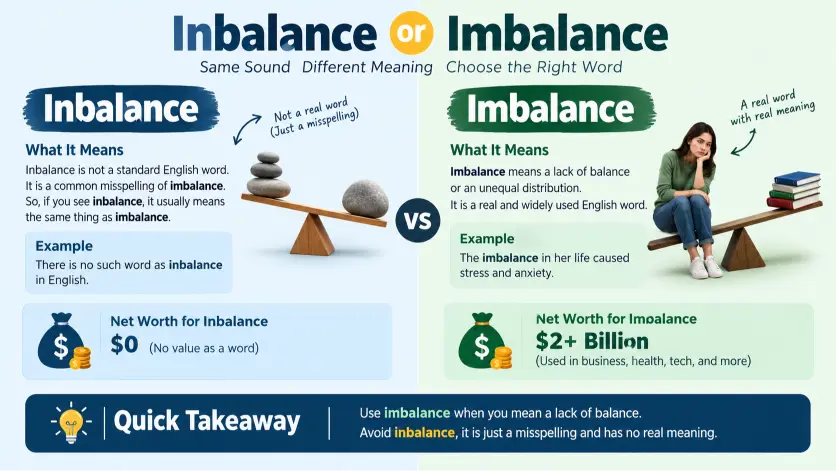
If you have ever written “inbalance” and wondered whether it looks right, you are not alone. Many English learners and even native speakers hesitate between inbalance or imbalance because the two forms look almost identical. The good news is that the correct standard spelling is imbalance, while “inbalance” is generally considered a misspelling in modern standard English.
Understanding this small spelling difference can help you write more accurately in emails, school assignments, professional documents, websites, and everyday communication. Imbalance refers to a lack of balance or an uneven state, and it can describe physical, emotional, financial, chemical, or other situations depending on context.
In this guide, we will explain inbalance or imbalance, including the correct spelling, meaning, pronunciation, example sentences, common mistakes, and practical usage. By understanding how the word is formed and seeing it used naturally in different contexts, you can avoid this common spelling confusion with confidence.
Why Do People Confuse Inbalance or Imbalance?
At first glance, inbalance seems reasonable because English frequently forms negative words by adding the prefix “in”. For example, words such as inactive, inaccurate, and incomplete follow that pattern. Consequently, writers sometimes assume that balance should work in exactly the same way.
However, standard English uses imbalance, not inbalance, when referring to an unequal, unstable, or disproportionate condition. Therefore, choosing the wrong spelling can make otherwise polished writing appear careless.
This confusion also occurs because the pronunciation does not clearly reveal the spelling. When people hear the word rather than see it, the initial sound can easily encourage the incorrect form.
Furthermore, the problem appears across several contexts. Someone may describe an imbalance in a budget, an imbalance in hormones, an imbalance between work and personal life, or an imbalance within a system. In each case, imbalance is the standard noun.
Therefore, learning the word as a complete vocabulary item is more reliable than trying to construct its spelling from the prefix alone.
Inbalance or Imbalance: What’s the Difference?
Imbalance is the correct standard English noun. It means a condition in which elements are unequal, disproportionate, unstable, or insufficiently balanced.
Inbalance is generally considered a nonstandard spelling when the intended meaning is a lack of balance. Consequently, it should normally be avoided in formal, academic, workplace, and published writing.
| Feature | Imbalance | Inbalance |
|---|---|---|
| Standard spelling | Yes | No |
| Part of speech | Noun | Nonstandard noun form |
| Meaning | Lack of balance or equality | Usually intended to mean lack of balance |
| Formal writing | Appropriate | Avoid |
| Academic writing | Appropriate | Avoid |
| Professional communication | Appropriate | Avoid |
| Everyday standard English | Appropriate | Not recommended |
Mini Recap
Imbalance is the established spelling used in standard English.
Inbalance is usually a spelling error rather than an accepted alternative.
Therefore, when you mean a lack of balance, choose imbalance.
This rule applies across professional, academic, technical, and everyday contexts.
Is Inbalance or Imbalance a Grammar, Vocabulary, or Usage Issue?
Primarily, this is a vocabulary and spelling issue, rather than a complicated grammar problem. The main difficulty comes from selecting the established word rather than creating an apparently logical alternative.
For example, a writer might think that “inbalance” means the opposite of “balance”. Nevertheless, English vocabulary does not always follow perfectly predictable word formation patterns. Established usage determines which form becomes standard.
Moreover, imbalance is a noun. It can appear as the subject or object of a sentence.
For example:
“The report identified an imbalance between supply and demand.”
Here, imbalance names a condition.
The word can also occur after certain verbs:
“The sudden change created an imbalance.”
In contrast, “inbalance” should not normally replace it.
Formal Versus Informal Usage
Because imbalance is the standard form, there is no practical reason to substitute inbalance in casual communication. Even in informal writing, imbalance remains the natural choice.
For instance:
“There’s an imbalance between the two teams.”
This sounds normal and requires no alternative spelling.
Academic Usage
Academic writing especially benefits from precise vocabulary. Therefore, researchers, students, teachers, and professionals should use imbalance when discussing unequal distributions, social conditions, physical systems, economic differences, or other forms of disproportion.
Practical Rule
Whenever you want the noun meaning a lack of balance, use imbalance. This remains true regardless of whether the writing is casual, professional, academic, or technical.
How to Use Imbalance Correctly
Because imbalance is the standard word, it appears naturally in many different subjects. In addition, its meaning can be physical, financial, social, emotional, biological, or abstract.
Workplace Example
In professional communication, imbalance often describes unequal workloads, resources, responsibilities, or priorities.
For example:
“The manager noticed an imbalance in the distribution of tasks.”
Likewise:
“The company experienced an imbalance between expenses and revenue.”
In both cases, the word identifies a condition where two sides are not appropriately proportioned.
Academic Example
Students and researchers may encounter imbalance in subjects such as economics, sociology, biology, psychology, physics, and environmental studies.
For example:
“The study examined the imbalance between urban and rural development.”
Similarly:
“The researchers investigated an imbalance in the population distribution.”
Thus, the word works comfortably in formal analytical writing.
Technology Example
Technical discussions also use imbalance when describing systems that contain unequal values, loads, signals, or resources.
For example:
“The system detected an imbalance in power distribution.”
Another example is:
“The sensor identified an imbalance between the two input signals.”
Consequently, imbalance is not limited to ordinary conversation. It functions naturally across specialized fields.
Usage Recap
Use imbalance whenever you are naming a condition involving unequal distribution, proportion, stability, or equilibrium.
The surrounding subject does not change the spelling. Whether you’re discussing finance, education, technology, health, or social conditions, the standard noun remains imbalance.
How to Use Inbalance Correctly
There is an important distinction here: in most modern standard English contexts, there isn’t a normal usage situation in which inbalance should replace imbalance.
Therefore, treating “inbalance” as an alternative spelling can create unnecessary errors.
For instance, consider this sentence:
“The company faced an inbalance between costs and income.”
The intended meaning is understandable. Nevertheless, the standard version is:
“The company faced an imbalance between costs and income.”
Workplace Example
Incorrect:
“The department has an inbalance of responsibilities.”
Standard:
“The department has an imbalance of responsibilities.”
Academic Example
Incorrect:
“The paper explores an inbalance in social resources.”
Standard:
“The paper explores an imbalance in social resources.”
Technology Example
Incorrect:
“The device reported an inbalance in voltage.”
Standard:
“The device reported an imbalance in voltage.”
Usage Recap
Inbalance should generally not be treated as a legitimate alternative to imbalance.
Instead, memorize imbalance as the standard noun. This simple approach eliminates uncertainty in almost every ordinary writing situation.
When You Should NOT Use Inbalance or Imbalance
Understanding when a word does not fit can be just as useful as learning its correct spelling. Therefore, consider these common situations.
1. When You Mean the Verb Balance
If you mean the action of making something stable or equal, use a verb such as balance or rebalance rather than imbalance.
Incorrect idea:
“Please imbalance the accounts.”
Better:
“Please balance the accounts.”
2. When You Mean Unequal Numbers
Imbalance works when you are naming the condition itself.
For example:
“There is an imbalance between demand and supply.”
However, don’t force the noun into a sentence that requires a verb.
3. When You Mean an Individual Person
Imbalance describes a condition, not a person.
For example, saying “She is an imbalance” does not normally communicate the intended meaning.
Instead, describe the person as experiencing or causing an imbalance when appropriate.
4. When You Mean a Difference Without Any Sense of Balance
Difference and imbalance are not always interchangeable.
Two quantities can be different without being improperly balanced. Therefore, use imbalance when unequal proportions or equilibrium are genuinely relevant.
5. When You Mean an Unfair Situation
Imbalance can describe unequal circumstances, but unfairness may sometimes be the more precise term.
For example, an imbalance of power describes unequal influence, whereas unfair treatment focuses on justice or conduct.
6. When You Need an Adjective
Imbalance is a noun. If your sentence needs an adjective, choose an appropriate related form.
For example:
“The system is imbalanced.”
Not:
“The system is imbalance.”
7. When You Need a Verb
Likewise, don’t use imbalance as though it were automatically a verb.
Depending on the meaning, balance, disturb, disrupt, or unbalance may be more appropriate.
8. When You Are Following the Prefix Alone
Finally, don’t assume that adding in to a familiar word always creates a standard English term. Established vocabulary does not always follow a simple formula.
Common Mistakes: Inbalance or Imbalance
Many errors become easier to understand when the intended meaning is compared directly with the incorrect construction.
| Correct sentence | Incorrect sentence | Explanation |
|---|---|---|
| The report found an imbalance in spending. | The report found an inbalance in spending. | Imbalance is the standard noun. |
| There is an imbalance between supply and demand. | There is an inbalance between supply and demand. | The second spelling is nonstandard. |
| The system detected an imbalance. | The system detected an inbalance. | Technical writing also uses imbalance. |
| An imbalance of power affected the negotiation. | An inbalance of power affected the negotiation. | The established form is imbalance. |
| The study discusses economic imbalance. | The study discusses economic inbalance. | Formal writing requires the standard spelling. |
| The workload created an imbalance. | The workload created an inbalance. | The noun remains imbalance. |
Decision Rule Box
If you mean a lack of balance, use IMBALANCE.
If you mean the act of creating or restoring balance, choose an appropriate verb such as BALANCE or REBALANCE.
Do not use INBALANCE as the normal spelling of the noun.
This rule is short enough to remember and broad enough to prevent most mistakes.
Inbalance or Imbalance in Modern Technology
Modern software frequently uses the concept of imbalance when describing unequal data, resource distribution, system loads, or classification patterns. For example, technical documentation may discuss an imbalance between different categories within a dataset.
Likewise, digital systems can identify uneven resource allocation. A monitoring platform might report an imbalance in network traffic, while a financial application could flag an imbalance between incoming and outgoing transactions.
Because technical writing depends heavily on consistency, the established spelling matters. Therefore, users should write imbalance, even when the surrounding terminology is highly specialized.
The same principle applies to automated writing tools, spell checkers, and language applications. However, the safest approach remains knowing the standard vocabulary rather than depending entirely on software suggestions.
Where Does the Word Imbalance Come From?
The word imbalance developed from the combination of the negative prefix im and the word balance.
The form of the prefix changes in some English words because pronunciation and historical word formation influence spelling. In this case, im appears before the consonant sound represented by b.
This pattern can be seen in words such as impossible and imperfect. Therefore, the spelling imbalance is not random.
Importantly, this does not mean that every word beginning with balance should receive the same prefix construction. Standard vocabulary is shaped by historical development and established usage.
That is why “inbalance” may seem logical while still failing to function as the normal modern spelling.
An Expert Style Explanation
“English spelling often reflects established word formation rather than a simple rule that can be applied mechanically to every word.”
This principle explains why memorizing commonly confused vocabulary can be more reliable than constructing unfamiliar forms from prefixes.
Two Practical Case Studies
Case Study One: Workplace Reporting
Imagine a company preparing a quarterly report about staffing. The writer wants to explain that several departments have unequal workloads.
An early draft says:
“There is an inbalance between departmental responsibilities.”
Although readers can understand the sentence, the spelling creates an unnecessary error in a formal document.
The revised version reads:
“There is an imbalance between departmental responsibilities.”
As a result, the sentence becomes standard, polished, and suitable for professional communication.
Case Study Two: Academic Research
Now consider a university student writing about economic development. The student writes:
“The research examines an inbalance between urban and rural investment.”
The intended idea is clear, but the noun is misspelled.
After correction:
“The research examines an imbalance between urban and rural investment.”
Consequently, the sentence follows standard vocabulary conventions and communicates the intended concept without distracting the reader.
These examples show that the issue is small but meaningful. A single spelling choice can affect the perceived accuracy of otherwise strong writing.
Error Prevention Checklist
Use this quick checklist whenever you’re uncertain about the spelling.
Always Use Imbalance When
You mean a lack of balance.
You are describing unequal proportions.
You are discussing unequal distribution.
You are writing about unstable relationships between elements.
You are describing unequal power or resources.
You are preparing academic or professional material.
You are naming the condition rather than the action.
Never Use Inbalance When
You intend the standard noun meaning lack of balance.
You are writing formal correspondence.
You are preparing an academic assignment.
You are producing a workplace report.
You are creating technical documentation.
You are describing unequal quantities.
You are discussing an uneven relationship between two sides.
The simplest memory trick is equally straightforward: balance becomes imbalance, not inbalance, when the intended noun means a lack of balance.
Related Grammar Confusions You Should Master
Once you understand this spelling issue, several other commonly confused forms are worth studying.
Affect or Effect
Affect commonly functions as a verb, while effect is frequently used as a noun.
Fewer or Less
Fewer generally refers to countable items, while less commonly refers to uncountable quantities.
Advice or Advise
Advice is a noun, whereas advise is a verb.
Then or Than
Then commonly relates to time or sequence, while than introduces comparisons.
Their, There, or They’re
These forms have different grammatical roles despite similar pronunciation.
Its or It’s
Its is possessive, while it’s is a contraction.
Your or You’re
Your shows possession, while you’re means you are.
Complement or Compliment
Complement refers to something that completes or enhances another thing, while compliment refers to praise.
Principal or Principle
Principal can refer to a person or something primary, whereas principle refers to a rule, belief, or standard.
Stationary or Stationery
Stationary means not moving, while stationery refers to writing materials.
Learning these distinctions alongside imbalance can strengthen spelling accuracy and vocabulary control.
Frequently Asked Questions
Is inbalance a correct English word?
Inbalance is generally not the standard spelling used in modern English when the intended meaning is a lack of balance. Therefore, writers should use imbalance in ordinary, professional, academic, and technical contexts.
Is imbalance one word or two words?
Imbalance is written as one word. It combines the negative prefix with balance and functions as a noun describing a condition of unequal proportion, stability, or distribution.
Why is imbalance spelled with im instead of in?
The spelling reflects established English word formation. The prefix takes the form im before certain consonant sounds, including the sound at the beginning of balance. Consequently, the established form is imbalance.
Can I use inbalance in informal writing?
Although readers may understand what you mean, inbalance is not recommended as the normal spelling. Even informal writing is clearer when you use the established form, imbalance.
Is imbalance a noun or adjective?
Imbalance is a noun. For example, “The report identified an imbalance.” The related adjective is imbalanced, as in “The system became imbalanced.”
What is the opposite of imbalance?
The opposite concept is generally balance, although the precise opposite can depend on context. Balance suggests appropriate equality, stability, or proportion between relevant elements.
Is imbalance the same as inequality?
Not always. Imbalance refers broadly to a lack of equilibrium or proportion, while inequality can specifically describe unequal status, treatment, quantity, opportunity, or distribution. Context determines which word is more accurate.
How do you remember the correct spelling of imbalance?
Remember the complete word rather than trying to build it from the prefix. The standard spelling is imbalance. A useful association is “im plus balance,” which produces imbalance.
Should I write inbalance or imbalance in academic writing?
Use imbalance. Academic writing requires standard vocabulary and consistent spelling, so inbalance should normally be corrected before publication or submission.
Final Answer:
When you’re deciding between inbalance or imbalance, choose imbalance for standard English. It is the established noun used to describe a lack of equality, stability, proportion, or equilibrium.
Although inbalance may appear logical because English sometimes uses in as a negative prefix, that reasoning does not make it the standard spelling. Therefore, writers should memorize imbalance as the correct form.
Whether you’re preparing an academic paper, workplace report, technical document, or everyday message, the same spelling applies. Furthermore, remembering the distinction can prevent a surprisingly common vocabulary error.
The easiest rule is simple: if you mean a lack of balance, write imbalance.
Conclusion
The difference between inbalance and imbalance is ultimately a matter of standard vocabulary and spelling. Imbalance is the established form, while inbalance should generally be avoided when expressing the idea of unequal balance or proportion.
Because English word formation isn’t always completely predictable, relying on a logical prefix pattern can sometimes lead to mistakes. Instead, learning the complete word provides a dependable solution. Therefore, whenever you need the noun describing a lack of balance, stability, equality, or proportion, choose imbalance. Once this spelling becomes familiar, the confusion becomes much easier to avoid.









