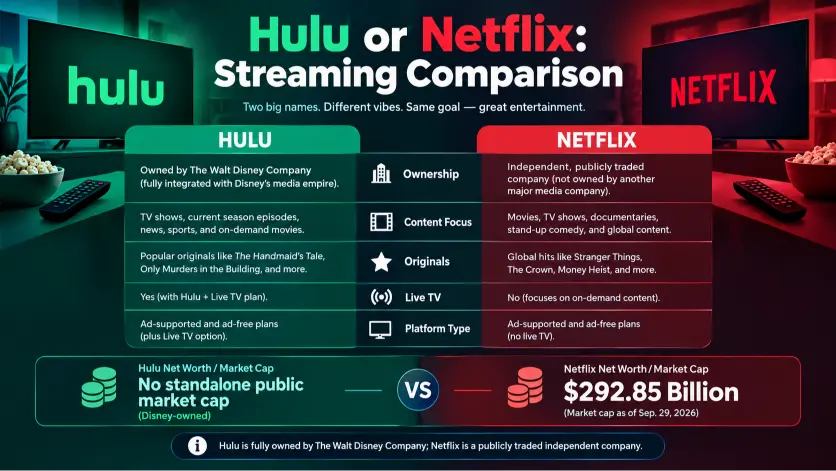
Choosing between Hulu or Netflix can be surprisingly difficult when both platforms offer thousands of movies, TV shows, original productions, and different subscription options. The better choice depends less on popularity and more on what you actually watch. Netflix emphasizes its broad on-demand catalog, original programming, international content, and flexible viewing features, while Hulu is particularly associated with current television programming, FX content, and additional bundle or live TV options in the U.S.
Before subscribing, it is worth comparing more than just the monthly price. Ads, video quality, simultaneous streams, offline downloads, content availability, and device compatibility can all affect your experience. Netflix’s current U.S. plans, for example, vary in advertising, resolution, downloads, and simultaneous viewing limits.
This Hulu or Netflix comparison for 2026 breaks down the major differences in simple terms so you can understand what each service offers. Rather than relying on hype, we will look at practical factors such as content, pricing, features, streaming quality, and viewing habits, helping you make an informed choice based on your own entertainment needs.
Hulu vs Netflix: What’s the Difference?
Hulu and Netflix are proper nouns used as brand names for streaming services. Although both platforms provide television shows, movies, documentaries, and original productions, their content libraries and viewing models have developed in different directions.
Hulu is particularly associated with television programming from major American networks and a mixture of current and older series. Depending on the program and subscription arrangement, viewers may find selected episodes available relatively soon after their original television broadcast.
Netflix, meanwhile, is widely recognized for its extensive collection of original series, films, documentaries, licensed programs, and productions from different countries. Its familiar release model often makes an entire season available at once.
| Feature | Hulu | Netflix |
|---|---|---|
| Word type | Proper noun | Proper noun |
| Main role | Streaming service | Streaming service |
| Strong association | Television series and current programming | Original productions and global entertainment |
| Release style | Often includes selected current television episodes | Commonly releases complete seasons |
| Original content | Hulu Originals | Netflix Originals |
| International programming | Available, with selection varying by market | Major part of the catalog |
| Viewing purpose | Current television plus streaming | On demand entertainment and original content |
| Usage context | Casual and formal discussions | Casual and formal discussions |
Therefore, neither name is a grammatical alternative to the other. Instead, each identifies a different entertainment platform.
Consequently, saying Hulu when discussing Netflix changes the meaning of the sentence because you’re referring to another service.
Likewise, choosing Netflix instead of Hulu can create confusion when discussing where a particular program is available.
Mini Recap
Hulu generally emphasizes television programming alongside streaming content.
Netflix places considerable emphasis on original productions and a broad international catalog.
Because they are separate brand names, they aren’t interchangeable.
The correct choice depends on the platform you actually mean.
Is Hulu vs Netflix a Grammar, Vocabulary, or Usage Issue?
The Hulu vs Netflix question is primarily a vocabulary and usage issue, rather than a grammar problem.
From a grammatical perspective, both names can function as proper nouns. For example, you can say, “I watched the show on Hulu,” or “I watched the documentary on Netflix.” Both sentences follow ordinary English grammar.
However, vocabulary matters because the two words identify different services. Consequently, replacing one with the other changes the factual meaning.
Furthermore, the distinction becomes important when discussing availability. If someone asks, “Is this series on Hulu?” answering “Yes, Netflix has it” doesn’t actually answer the question.
In formal writing, the brand names should be written correctly and capitalized. In casual conversation, however, people may simply say “Hulu” or “Netflix” without explaining what each service does.
In academic writing, business reports, technology discussions, and media studies, precise naming is especially useful. Meanwhile, casual conversations usually require less explanation because the audience may already understand the reference.
Thus, this isn’t a case where one spelling is correct and another is incorrect. Instead, it’s a matter of identifying the correct platform.
Practical Usage of Hulu
Hulu can appear naturally in conversations about television, streaming subscriptions, entertainment habits, and digital media.
For example, someone discussing a workplace conversation might say:
Workplace example:
“Our team used Hulu during the media presentation to demonstrate how streaming has changed television consumption.”
In an academic setting, the name can appear when discussing broadcasting or digital entertainment:
Academic example:
“The study examined how Hulu and other streaming platforms affected traditional television viewing habits.”
Similarly, technology discussions may mention Hulu when explaining streaming applications:
Technology example:
“The Hulu application allows subscribers to watch supported programming through compatible devices.”
Notice that the word itself doesn’t change according to the sentence. Since Hulu is a brand name, it remains capitalized.
Furthermore, you don’t normally pluralize the brand name when discussing the service. Instead, you might say “Hulu subscriptions,” “Hulu viewers,” or “Hulu programs.”
Hulu Usage Recap
Use Hulu when you specifically mean the Hulu platform.
Use the name when discussing its programming, application, subscription, or viewing experience.
Don’t substitute Netflix simply because both services provide streaming content.
Practical Usage of Netflix
Netflix functions in much the same grammatical way, although its content strategy differs from Hulu’s.
For workplace communication, the name can be used when discussing entertainment technology or media consumption:
Workplace example:
“The company analyzed Netflix viewing habits to understand changing customer preferences.”
In academic writing, it can appear in research concerning digital media:
Academic example:
“Researchers examined how Netflix contributed to changes in serialized television distribution.”
For technology discussions, you might write:
Technology example:
“The Netflix application supports streaming across a range of compatible devices.”
Because Netflix is a proper brand name, capitalization remains important. Therefore, “Netflix” is standard, while “netflix” is generally inappropriate in polished writing.
Also, the surrounding noun determines the exact meaning. For example, “Netflix subscription” refers to an account arrangement, whereas “Netflix series” refers to programming associated with the platform.
Netflix Usage Recap
Choose Netflix when you mean that specific streaming platform.
Use it when discussing its application, programming, subscription, or content ecosystem.
Although Hulu and Netflix occupy a similar category, their names shouldn’t be treated as interchangeable.
When You Should NOT Use Hulu or Netflix
Several common situations can lead writers to choose the wrong platform name.
1. When You Mean a Different Streaming Service
If the program is available through Netflix, calling it a Hulu series creates a factual error.
2. When Discussing Platform Specific Availability
Availability varies by market and licensing agreement. Therefore, don’t assume that a title appearing on one service must also appear on the other.
3. When Describing a Subscription
A Hulu subscription and a Netflix subscription are separate arrangements. Consequently, replacing one term with the other can confuse readers.
4. When Naming an Original Production
If a production is officially associated with one platform, use the correct brand name when describing it.
5. When Writing a Research Paper
Academic writing requires precise terminology. Therefore, using the wrong service can weaken the accuracy of an otherwise well researched paragraph.
6. When Discussing Technology
An application, interface, or device feature connected specifically to Hulu shouldn’t automatically be described as a Netflix feature.
7. When Comparing Streaming Business Models
The two companies have developed different approaches to programming, distribution, and audience engagement. Therefore, mixing their names can distort the comparison.
8. When Answering a Direct Question
If someone asks, “Is this on Hulu?” answering with information about Netflix doesn’t directly address the question.
Common Mistakes: Hulu or Netflix
Because the names belong to different platforms, most mistakes involve incorrect identification rather than grammar.
| Correct sentence | Incorrect sentence | Explanation |
|---|---|---|
| I watched the series on Hulu. | I watched the series on Netflix. | The incorrect version changes the platform being identified. |
| She has a Netflix subscription. | She has a Hulu subscription. | These describe different services. |
| The program is available through Hulu. | The program is available through Netflix. | Platform availability must be verified before making the statement. |
| We discussed Netflix in class. | We discussed Hulu in class. | The second sentence changes the subject. |
| He opened the Hulu application. | He opened the Netflix application. | The application names refer to different services. |
| They compared Hulu and Netflix. | They compared Hulu with Hulu. | A comparison requires two distinct subjects. |
Decision Rule Box
If you mean the Hulu streaming platform, use “Hulu.”
If you mean the Netflix streaming platform, use “Netflix.”
Unlike some word comparisons involving an action and a person or tool, this pair doesn’t follow that grammatical pattern. Both are proper brand names, so the key decision is identifying which service you actually mean.
Hulu and Netflix in Modern Technology
Modern streaming platforms operate within a larger digital entertainment environment involving smart televisions, mobile devices, gaming systems, tablets, browsers, recommendation systems, and connected home technology.
Consequently, Hulu and Netflix may appear in discussions about personalization, content discovery, digital distribution, and viewing behavior.
Recommendation technology is particularly important because streaming platforms can organize large catalogs around individual viewing patterns. As a result, two people using the same service may encounter very different suggestions.
Voice assistants and smart television interfaces can also make streaming applications easier to access. For instance, a viewer might search for a program through a television interface and then select the platform where it is available.
However, technology doesn’t make Hulu and Netflix interchangeable. Instead, it makes accurate platform identification even more useful because users frequently move between several services on the same device.
Etymology and Brand Naming
Hulu and Netflix aren’t ordinary English vocabulary items with traditional dictionary meanings comparable to words such as “effect” and “affect.”
Instead, they function primarily as brand names.
The name Netflix combines concepts associated with internet based distribution and movies, reflecting the company’s original relationship with DVD rental and later streaming entertainment.
Hulu has a different naming history and became associated with online television distribution and streaming entertainment.
Because both names developed as commercial identities, capitalization is significant in professional writing.
Therefore, writers shouldn’t treat either term as a common noun that can freely replace another streaming brand.
An Expert Style Explanation
“When two brand names identify different services, accuracy depends less on grammar and more on choosing the name that matches the real world entity being discussed.”
This principle applies well beyond streaming. Similar care is useful when distinguishing competing applications, technology companies, retailers, and entertainment platforms.
Two Practical Case Studies
Case Study 1: The Classroom Presentation
Imagine a student preparing a presentation about changes in television viewing.
The student writes, “Netflix provides the current television episodes discussed in this example,” while the source material actually concerns Hulu.
Although the sentence is grammatically correct, the platform identification is inaccurate.
Consequently, readers may misunderstand the evidence or believe the student researched a different service.
The correction is simple: replace the incorrect brand name with the platform actually examined.
The lesson is important because grammatical correctness doesn’t guarantee factual accuracy.
Case Study 2: Choosing a Streaming Service
Consider a household looking for a particular television series.
One family member says the program is available on Netflix, while another believes it’s on Hulu. Instead of treating either statement as automatically correct, they check the current catalog for their market.
This approach avoids an unnecessary subscription decision based on an assumption.
The result is better communication because the discussion separates general familiarity with a platform from verified availability.
Therefore, when writing about streaming services, precise terminology and current information work together.
Error Prevention Checklist
Always use Hulu when:
You mean the Hulu service.
You’re specifically discussing Hulu programming.
You’re referring to its application or subscription.
You’re comparing Hulu with another streaming platform.
You’re describing a source that specifically concerns Hulu.
Never use Netflix when:
The subject is specifically Hulu.
The cited program is being discussed as Hulu content.
The subscription being described belongs to Hulu.
The application being referenced is Hulu.
The research subject is explicitly Hulu.
Always use Netflix when:
You mean the Netflix service.
You’re discussing Netflix programming.
You’re referring to a Netflix subscription or application.
You’re examining Netflix’s content distribution.
You’re comparing Netflix with another platform.
Never use Hulu when:
The subject is specifically Netflix.
The production or research concerns Netflix.
You’re describing a Netflix account.
You’re identifying the Netflix application.
You’re reporting information specifically about Netflix.
Related Grammar Confusions You Should Master
Although Hulu vs Netflix isn’t a traditional grammar contrast, learning other commonly confused terms can strengthen writing accuracy.
- Affect vs effect
- Fewer vs less
- Lay vs lie
- Then vs than
- Who vs whom
- Its vs it’s
- Your vs you’re
- Further vs farther
- Compliment vs complement
- Advice vs advise
These pairs create different types of problems. Some involve spelling, some involve grammatical function, and others depend heavily on context.
For example, “advice” is a noun while “advise” is a verb. Likewise, “its” shows possession, whereas “it’s” is normally a contraction of “it is” or “it has.”
Therefore, the best way to master confusing terms is to identify their meaning and grammatical role before selecting a word.
Frequently Asked Questions
Is Hulu the same as Netflix?
No. Hulu and Netflix are separate streaming services. They belong to the same broad entertainment category, but they have different catalogs, original productions, availability arrangements, and platform experiences.
Which is correct, Hulu or Netflix?
Both names are correct when used for their respective services. The appropriate choice depends entirely on which platform you’re discussing.
Can I use Hulu and Netflix interchangeably?
No. Although both provide streaming entertainment, their names identify different companies and services. Substituting one for the other can create a factual error.
Is Hulu a proper noun?
Yes. Hulu is used as a proper brand name. Therefore, it should normally be capitalized when referring to the streaming service.
Is Netflix a proper noun?
Yes. Netflix is a proper brand name and should normally be capitalized in standard professional writing.
Why do people confuse Hulu and Netflix?
People often confuse them because both services provide movies, television programs, original productions, and applications for connected devices. However, their catalogs and distribution models aren’t identical.
Which sentence is correct: “I watched it on Hulu” or “I watched it on Netflix”?
Either sentence can be grammatically correct. The correct version depends on where the program was actually watched.
Should Hulu and Netflix be capitalized?
Yes. Since both names function as brand names, capitalization is appropriate in standard writing.
Are Hulu and Netflix grammar words?
No. They aren’t grammar terms. They are brand names that identify streaming services. Questions involving them are therefore primarily concerned with vocabulary, usage, and factual precision.
How can I remember the difference between Hulu and Netflix?
The easiest approach is to associate each name with the specific platform it identifies. When discussing Hulu, write Hulu. When discussing Netflix, write Netflix. Don’t choose between them based only on the fact that both offer streaming entertainment.
Conclusion:
The difference between Hulu and Netflix is straightforward once you recognize that they are separate brand names rather than interchangeable vocabulary terms.
Hulu is commonly associated with television focused streaming and selected current programming, while Netflix is widely recognized for original productions, international entertainment, films, documentaries, and on demand viewing.
Therefore, the correct choice depends on the service you’re actually discussing. If your subject is Hulu, use Hulu. If your subject is Netflix, use Netflix.
Ultimately, accuracy comes from matching the brand name to the real platform, program, subscription, application, or research subject. That simple habit prevents confusion in casual conversations, academic writing, workplace communication, and technology discussions.









