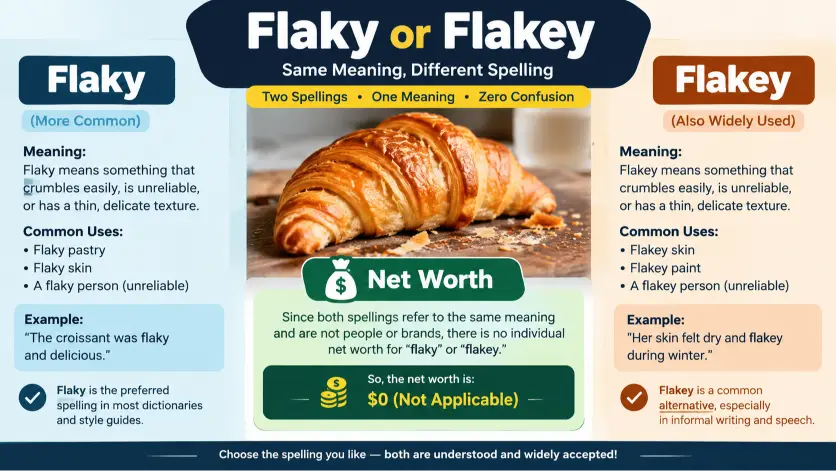
Have you ever typed flaky or flakey and suddenly wondered which spelling looks right? You are not alone. These two forms are often confused, especially when describing something that breaks into small pieces or a person who cannot be relied upon. One spelling is widely accepted in standard English, while the other is much less common.
Understanding the difference matters because choosing the correct form can make your writing clearer and more professional. Whether you are writing an email, school assignment, article, or social media post, knowing the standard spelling helps you communicate confidently.
In this guide, we will explain flaky or flakey, their meanings, correct usage, examples, and common mistakes. You will also learn why flaky is generally the preferred spelling and when the alternative form may appear.
Flaky or Flakey: What’s the Difference?
First, flaky is the established English adjective. It commonly describes food with a texture that breaks into thin pieces, particularly pastry. It can also describe a person who doesn’t reliably keep promises, attend appointments, or follow through with plans.
For example, you might say, “This croissant has a wonderfully flaky crust.” Similarly, you could say, “He’s been rather flaky about answering my messages.”
By contrast, flakey occasionally appears as an alternative spelling. However, it isn’t the standard choice for edited English. Because flaky is the conventional spelling found in dictionaries and formal writing, it should be your default selection.
The distinction becomes especially important when you’re writing an email, preparing an assignment, publishing an article, or communicating professionally. Although readers may understand flakey, the spelling can look unusual or incorrect to many English speakers.
| Word | Part of Speech | Standard Status | Main Meaning | Example |
|---|---|---|---|---|
| Flaky | Adjective | Standard | Easily breaking apart or unreliable | The pastry has a flaky crust. |
| Flakey | Adjective | Uncommon variant | Usually intended to mean flaky | His behavior seemed flakey. |
Quick recap
Flaky is the preferred spelling in standard English.
Flakey is occasionally seen, but it is much less common.
For formal writing, academic work, and professional communication, choose flaky.
The meaning usually stays the same, but the spelling does not have equal acceptance.
Is Flaky or Flakey a Grammar, Vocabulary, or Usage Issue?
At first glance, the question may seem like a grammar problem. However, it is primarily a spelling and usage issue. Both forms can function as adjectives, yet they don’t have the same level of acceptance in contemporary standard English.
Grammar determines how a word behaves within a sentence. Here, both forms can theoretically occupy the same grammatical position. For instance, “a flaky pastry” and “a flakey pastry” follow the same adjective plus noun structure.
Nevertheless, standard usage matters. Flaky is the spelling most readers expect. Consequently, choosing it removes unnecessary uncertainty.
In academic writing, the distinction becomes even more relevant. Students are generally expected to use conventional dictionary spellings. Therefore, flaky is the safer choice in essays, reports, examinations, and research related writing.
In casual communication, you might occasionally encounter flakey, especially in informal online conversations. Still, familiarity does not make it the preferred spelling.
The two forms aren’t completely interchangeable from a practical writing perspective. Their intended meaning may be understood, but their acceptability differs.
How to Use Flaky Correctly
To begin with, flaky has several useful meanings. Its literal sense refers to something that comes apart in thin, small pieces. Food provides some of the clearest examples.
You might describe a pie crust as flaky because it separates into delicate layers when cut. Likewise, a pastry can be flaky when its texture is light, crisp, and layered.
The word also has a figurative meaning. When applied to a person, flaky can suggest unreliability, forgetfulness, inconsistency, or a tendency to change plans.
Workplace example
A manager might say:
“John is talented, but he’s been flaky about meeting deadlines.”
Here, flaky doesn’t describe physical texture. Instead, it indicates inconsistent behavior.
Academic example
A student writing about food could say:
“The recipe produces a flaky pastry with several delicate layers.”
This usage is straightforward because the adjective describes physical texture.
Technology example
The word can also describe unreliable technology in informal communication:
“The internet connection has been flaky all afternoon.”
In this context, the connection isn’t literally breaking into pieces. Rather, it works inconsistently.
Usage recap
Use flaky when describing layered food, inconsistent performance, or unreliable behavior.
Because the spelling is standard, it works naturally in casual, professional, and academic contexts.
How to Understand Flakey
Now consider flakey. Although readers can usually understand what the writer intends, this spelling is far less conventional.
For that reason, it can create hesitation. A reader may wonder whether the writer made a spelling mistake rather than deliberately choosing an alternative form.
Workplace example
Writing:
“The supplier has been flakey about delivery dates.”
will probably be understood. However, a polished professional version would be:
“The supplier has been flaky about delivery dates.”
The second sentence follows the conventional spelling.
Academic example
In an essay, a student should write:
“The pastry developed a flaky texture after baking.”
Using flakey could distract from the actual point because academic readers generally expect standardized spelling.
Technology example
An informal message might contain:
“The server has been flakey today.”
Nevertheless, flaky is the stronger choice:
“The server has been flaky today.”
Usage recap
Flakey may appear in informal writing, but it isn’t the preferred standard form.
When accuracy, clarity, and professionalism matter, choose flaky.
When You Should Not Use Flaky or Flakey
Understanding when to avoid each spelling can prevent several common mistakes.
- Don’t choose flakey in formal writing.
Professional documents benefit from conventional spelling, so flaky is the safer option. - Don’t assume every unusual spelling is equally acceptable.
English contains many spelling variants, but some are considerably less established than others. - Don’t use flaky when you mean physically fragile in every situation.
Context matters. A fragile object may be better described as brittle, delicate, or weak. - Don’t use flaky as a formal insult.
When describing someone’s reliability, the word can sound critical or dismissive. A professional alternative could be “inconsistent” or “unreliable.” - Don’t use flakey simply because you have seen it online.
Online frequency doesn’t automatically establish a spelling as the preferred standard. - Don’t confuse flaky with flaked.
These forms can appear in different grammatical contexts and shouldn’t automatically replace one another. - Don’t assume the adjective always refers to food.
Modern English frequently uses flaky figuratively for people, services, systems, and plans. - Don’t overlook audience expectations.
A casual text and a university assignment have different standards. Therefore, spelling choices should match the situation.
Common Mistakes With Flaky and Flakey
The easiest way to understand the difference is to compare realistic sentences.
| Correct sentence | Incorrect or less preferred sentence | Explanation |
|---|---|---|
| The pie has a flaky crust. | The pie has a flakey crust. | Flaky is the conventional spelling. |
| He’s been flaky lately. | He’s been flakey lately. | The standard adjective is flaky. |
| The connection is flaky. | The connection is flakey. | Flaky is preferred in edited writing. |
| We need a flaky pastry. | We need a flakey pastry. | Standard spelling favors flaky. |
| Her attendance has been flaky. | Her attendance has been flakey. | The figurative adjective remains flaky. |
Decision Rule
If you mean the standard adjective for something layered, inconsistent, or unreliable, use “flaky.” If you encounter “flakey,” treat it as an uncommon spelling variant rather than the preferred standard form.
This simple rule works across food descriptions, personal behavior, workplace communication, and technology discussions.
Flaky or Flakey in Modern Technology
Modern digital communication has expanded the situations in which flaky can be used.
For example, people frequently describe an unstable connection as a “flaky network.” A service that works sometimes and fails at other times may also be called flaky.
Developers and technical teams sometimes use the adjective informally when discussing unreliable software behavior. For example, a test might be described as flaky when it passes on one occasion and fails on another without a clear change in the underlying code.
Even in highly technical environments, however, flaky remains the conventional spelling. The presence of specialized terminology doesn’t make flakey the preferred form.
Therefore, whether you’re discussing pastry, workplace behavior, an internet connection, or inconsistent software testing, flaky is the spelling to select.
Where Did the Word Flaky Come From?
The word flaky developed from flake, a noun referring to a small, thin piece or layer. The adjective naturally developed to describe something characterized by flakes or layers.
The literal sense became strongly associated with food, especially pastry. A flaky crust contains delicate layers that separate easily.
Over time, the adjective gained figurative meanings. English speakers began applying the idea of something unstable or inconsistent to people and situations. Consequently, calling someone flaky came to suggest that the person could not be relied upon.
This development reflects a common pattern in English. Physical descriptions often acquire figurative meanings because familiar objects provide convenient ways to explain abstract behavior.
An Expert Style Explanation
A useful linguistic principle is that standard spelling is determined by established usage rather than simple visual logic.
In other words, a spelling may look reasonable without becoming the preferred form. English contains numerous examples where one variant becomes dominant while another remains uncommon.
That principle explains why flaky should normally be selected. It has established usage across dictionaries, edited publications, education, professional communication, and ordinary conversation.
Case Study One: Professional Communication
Imagine an employee writing a report about a supplier whose deliveries frequently change.
The original sentence reads:
“The supplier has been flakey with delivery schedules.”
The meaning is understandable. However, the unusual spelling introduces an avoidable distraction.
A revised version says:
“The supplier has been flaky with delivery schedules.”
The correction doesn’t change the underlying message. Instead, it improves conformity with standard written English.
As a result, the revised sentence sounds more polished and appropriate for workplace communication.
Case Study Two: Food Writing
Consider a recipe writer describing a croissant.
The first version says:
“The dough creates a light and flakey texture.”
Although readers can understand the sentence, the spelling isn’t the conventional choice.
The edited version becomes:
“The dough creates a light and flaky texture.”
The result is clearer because the reader doesn’t have to pause over the spelling. Consequently, the description remains focused on the food rather than the wording.
Error Prevention Checklist
A short checklist can make this distinction almost automatic.
Always use flaky when
You are writing an academic assignment.
You are preparing a professional document.
You are describing pastry or another layered food.
You are describing unreliable behavior.
You are discussing inconsistent technology.
You are writing edited online content.
You want the conventional spelling.
Never prefer flakey when
You need formal standard English.
You are writing for an academic audience.
You are preparing a résumé or business document.
You are editing published material.
You want to eliminate spelling uncertainty.
You have no specific reason to use an uncommon variant.
Related Grammar Confusions You Should Master
Once you’ve understood flaky or flakey, several other spelling and usage questions become easier to approach.
- Affect or effect
- Fewer or less
- Altar or alter
- Former or latter
- Sheer or shear
- Shiny or shiney
- Focused or focussed
- Program or programme
- Favor or favour
- Practice or practise
These pairs and variants demonstrate an important lesson. English spelling can differ because of regional conventions, historical development, pronunciation, or established usage.
Therefore, don’t judge a spelling only by whether it looks logical. Instead, consider accepted usage, audience, region, and context.
Frequently Asked Questions
Is flaky or flakey correct?
Flaky is the standard and preferred spelling. Flakey appears occasionally as a variant, but it isn’t normally the best choice for formal or edited English.
Is flakey a real word?
Flakey can be found in English usage, so readers may recognize it. However, it is much less common than flaky. Consequently, standard writing generally favors flaky.
What does flaky mean?
Flaky can describe something that breaks into thin pieces or layers. It can also describe someone who is unreliable or inconsistent. In technology, it may describe a system or connection that behaves unpredictably.
Is flaky a formal word?
Yes, flaky is an established English adjective. However, its appropriateness depends on context. When describing an unreliable person, it can sound informal or critical, so a more neutral term may sometimes be preferable.
Why do people spell flaky as flakey?
The extra letter may seem intuitive because several English words contain the spelling pattern “ey.” Additionally, people may reproduce a spelling they’ve encountered elsewhere. Nevertheless, flaky remains the conventional spelling.
Is flaky an adjective?
Yes. Flaky is an adjective. It can modify nouns directly, as in “a flaky crust,” or describe a subject after a linking verb, as in “the connection is flaky.”
Can flaky describe a person?
Yes. When applied to a person, flaky usually means unreliable, inconsistent, forgetful, or prone to changing plans. Because the expression can sound judgmental, consider the audience before using it.
Is flaky used in technology?
Yes. Technology professionals and everyday users may describe unstable systems, connections, tests, or services as flaky. The term is particularly useful when something works inconsistently without an obvious reason.
Should I use flaky in academic writing?
Yes, when the meaning is appropriate. Flaky is the preferred spelling. However, when describing someone’s behavior in academic writing, a more precise term such as “inconsistent” or “unreliable” may provide greater formality.
Final Verdict:
When choosing between flaky or flakey, the safest answer is straightforward: use flaky. It is the established spelling for the adjective describing something that separates into thin pieces, as well as behavior, systems, or situations that are inconsistent or unreliable.
Although flakey can occasionally be encountered, it isn’t the preferred spelling in standard edited English. Therefore, using flaky will help your writing look natural, polished, and conventional.
Ultimately, the choice isn’t really about changing the meaning. Instead, it is about selecting the spelling that readers are most likely to recognize as standard. When in doubt, choose flaky.









