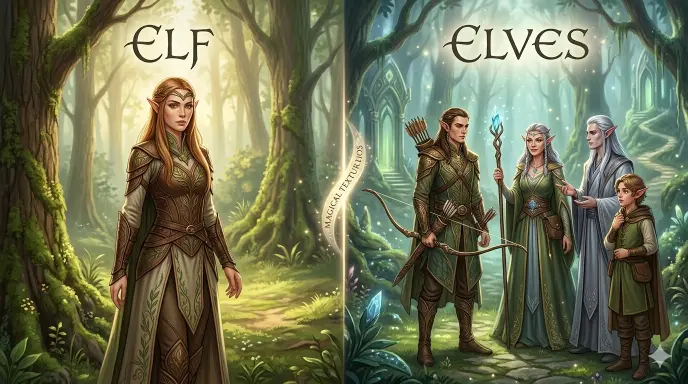
Have you ever typed “elfs” and wondered whether it should actually be “elves”? You are not alone. This is a common English spelling question because many plural nouns simply take an s, while elf follows a different pattern. Whether you are writing about Christmas elves, fantasy characters, folklore, or simply improving your English, knowing the correct plural form can help you avoid an easy grammar mistake.
The standard plural of elf is elves. The word elf refers to a mythical or folkloric creature, and its plural form has traditionally developed as elves. However, the spelling question becomes more interesting when you encounter “elfs” in older texts, specialized contexts, names, or informal usage. Understanding when each form appears gives you more than a simple spelling answer because it shows how English plural forms can develop and change over time.
In this guide, we will explain elfs or elves in clear, beginner-friendly language. You will learn the correct plural form, why elves is normally preferred, how to use it in sentences, and whether elfs can ever appear in English. We will also cover common mistakes, examples, and frequently asked questions so you can confidently choose the right word in everyday, academic, and creative writing.
Elfs or Elves: What’s the Difference?
The most important point is simple. Elf is the singular noun, while elves is the standard plural noun.
The word elf functions primarily as a noun. It identifies one mythical creature found in European folklore and later popularized through literature, fantasy fiction, films, games, and seasonal stories.
The word elves is also a noun, but it refers to two or more such beings.
The form elfs is not normally used in standard contemporary English. Readers will generally expect elves when they see the plural of elf. In some fictional or specialized environments, however, authors may intentionally choose unusual plural forms.
Mini Recap
Elf means one mythical being.
Elves means two or more mythical beings.
The spelling elfs is generally not the standard plural in modern English.
For ordinary writing, elves is the form readers expect.
Is Elfs or Elves a Grammar, Vocabulary, or Usage Issue?
The distinction is primarily a vocabulary and spelling usage issue, although grammar is involved because number changes from singular to plural.
English pluralization usually follows predictable patterns. For example, cat becomes cats, and river becomes rivers. However, some nouns have historical plural forms that don’t follow the simplest pattern.
The change from elf to elves belongs to this broader family of irregular plural formations. Similar patterns appear in words such as wolf and wolves, as well as leaf and leaves.
Therefore, replacing elves with elfs isn’t normally a difference between formal and informal English. Instead, it is usually a spelling mistake or a deliberate creative choice.
In academic writing, workplace communication, educational material, and ordinary conversation, elves is the expected plural.
Fantasy authors sometimes have more freedom. A fictional universe may establish its own terminology, and an author can intentionally create a distinctive plural. Even then, the unusual form should be treated as a stylistic decision rather than the ordinary English plural.
How to Use Elf Correctly
The singular elf should be used when the sentence refers to one individual.
For example, a workplace presentation about a holiday campaign might say, “The illustration features an elf holding a gift.” Only one fictional character is being described, so the singular form works naturally.
In an academic context, a student might write, “The medieval poem describes an elf living near the forest.” Again, the sentence identifies one supernatural figure.
Technology can also involve the term. A fantasy video game might display the message, “Choose your elf before entering the next level.” Since the player selects one character, elf is appropriate.
The same principle applies regardless of the setting. Count the creatures being discussed. If the reference is to exactly one, choose elf.
Usage Recap
Use elf for one being.
Use the singular form after words such as an, one, and each.
The surrounding context usually makes the number obvious.
How to Use Elves Correctly
The standard plural elves is required when the sentence discusses multiple mythical beings.
A workplace marketing document might say, “The holiday campaign features three elves decorating a tree.” Because the campaign includes several characters, elves is correct.
In academic writing, a literature student could write, “The novel presents elves as guardians of the natural world.” The plural form is necessary because the sentence discusses the group generally.
In technology, a fantasy game might display, “Players can create powerful elves with different abilities.” Since the game offers multiple characters, elves is the natural choice.
Notice that the meaning doesn’t change simply because the context changes. Whether you’re discussing literature, business material, entertainment, or software, the plural spelling remains elves.
Usage Recap
Choose elves when referring to multiple beings.
Use it after numbers greater than one.
Use it when discussing elves as a general group.
When You Should NOT Use Elfs or Elves
Knowing when a form should be avoided can prevent many common errors.
1. Don’t use Elfs as the Standard Plural
If you’re writing ordinary English, elfs should not normally replace elves. The conventional plural has a spelling change.
2. Don’t Write Elves for One Being
A sentence such as “An elves entered the room” is incorrect because an signals singular number. The correct form is an elf.
3. Don’t Add a Second Plural Ending
The word elves is already plural. A construction such as elveses is incorrect.
4. Don’t Assume Every Noun Takes S
English contains numerous irregular plural forms. Applying one plural rule to every noun can produce incorrect spellings.
5. Don’t Change Elves to Elfs in Formal Writing
Academic assignments, professional documents, product descriptions, and educational resources should normally use the established spelling elves.
6. Don’t Treat a Fictional Form as Standard English
A fantasy author might invent a special plural for a fictional culture. That creative decision doesn’t automatically make the form standard English.
7. Don’t Correct a Fictional Term Without Checking Context
If a novel, game, or invented language deliberately uses elfs, the writer may have established that spelling intentionally. Context matters.
Common Mistakes With Elfs or Elves
Decision Rule Box
If you mean one mythical being, use elf.
If you mean two or more mythical beings, use elves.
If you encounter elfs, check the context before assuming it is an ordinary plural. It may be a deliberate fictional spelling.
Elfs or Elves in Modern Technology
Modern technology has made fantasy vocabulary increasingly visible. Video games, character creators, digital stories, virtual worlds, and entertainment platforms frequently use terms associated with mythical creatures.
In these environments, elves remains the conventional English plural. A game interface might say, “Choose between humans, dwarves, and elves.” Here, each creature category represents a group.
Character creation systems may also use the singular form. A prompt such as “Create an elf warrior” refers to one character.
The important point is that digital environments don’t automatically change ordinary English grammar. A fictional universe can introduce its own terminology, but standard English remains the default unless the creator explicitly establishes another convention.
The Etymology Behind Elf and Elves
The unusual plural becomes easier to understand when you look at the history of English.
The word elf has very old Germanic roots. Related forms appeared in several Germanic languages, reflecting ancient beliefs about supernatural beings.
Over time, English spelling and pronunciation changed. The historical relationship between certain consonants and vowel sounds helped produce plural forms that look different from the singular.
This pattern isn’t unique to elf. English also has pairs such as wolf and wolves. Therefore, elves isn’t a random spelling. It reflects an older linguistic pattern that survived into modern English.
An Expert Style Perspective
“Good usage becomes easier when writers learn the pattern behind a word instead of memorizing the spelling in isolation.”
This principle is particularly useful with irregular plurals. Once you understand that some English nouns preserve older forms, unusual spellings become easier to remember.
Two Practical Case Studies
Case Study One: Fantasy Writing
Imagine a writer preparing a fantasy story about a magical woodland. During editing, the manuscript contains the sentence, “The elfs gathered beneath the ancient tree.”
The editor changes the sentence to, “The elves gathered beneath the ancient tree.”
The result is more consistent with standard English and immediately familiar to readers. The correction also removes an unnecessary distraction from the story.
The practical lesson is simple: when the author isn’t intentionally creating fictional terminology, elves should be used.
Case Study Two: Educational Content
Consider an educational worksheet containing the sentence, “Three elfs are standing beside the castle.”
A teacher revises it to, “Three elves are standing beside the castle.”
The correction makes the plural form consistent with standard usage. Students therefore encounter the conventional spelling rather than learning an unusual form accidentally.
The broader result is improved consistency. When educational material teaches standard language, familiar grammatical patterns reduce unnecessary confusion.
Error Prevention Checklist
Use this quick checklist before publishing or submitting your writing.
Always Use Elf When
You mean one mythical creature.
The noun follows an.
A number such as one appears before it.
You are describing a single character.
Always Use Elves When
You mean more than one mythical creature.
A number such as two, three, or ten appears before it.
You are discussing the group generally.
You are writing standard English without a special fictional convention.
Never Use Elfs When
You are simply trying to form the ordinary plural.
Your writing is academic or professional.
You are preparing educational material.
You have no fictional reason for creating a different spelling.
Related Grammar Confusions You Should Master
Learning one irregular plural can make other spelling questions easier. Several related topics deserve attention.
- Leaf or leaves: Understand why leaf changes to leaves in its common plural form.
- Wolf or wolves: Notice the similar spelling transformation.
- Knife or knives: Learn how certain nouns ending in f or fe form plurals.
- Life or lives: Distinguish the singular noun from its plural form.
- Loaf or loaves: Recognize another traditional plural pattern.
- Half or halves: Understand how the final consonant changes.
- Shelf or shelves: Apply the conventional plural spelling.
- Roof or roofs: Learn why not every word ending in f changes to ves.
- Chief or chiefs: Recognize exceptions to the common pattern.
- Safe or safes: Avoid assuming that every similar ending behaves identically.
These examples reveal an important truth about English. Patterns are helpful, but individual words sometimes preserve their own established forms.
Frequently Asked Questions
Is elves the correct plural of elf?
Yes. Elves is the standard plural form of elf in contemporary English. For normal writing, use elf when referring to one creature and elves when referring to more than one.
Is elfs ever correct?
Elfs can appear in specialized fictional contexts where an author intentionally creates a different plural. However, it isn’t the normal plural spelling used in standard modern English.
Why does elf become elves?
The spelling reflects historical changes in English. The word belongs to a group of nouns that developed plural forms involving a change from the final f sound or spelling to a v form.
What is the plural of elf in fantasy books?
Most fantasy books use elves because it is the established English plural. However, a fictional world can deliberately introduce a different form as part of its invented language or culture.
Should I write two elves or two elfs?
Write two elves in standard English. The number two requires a plural noun, and elves is the conventional plural of elf.
Is elf a noun?
Yes. Elf is primarily a noun referring to a mythical or folkloric being. In ordinary usage, it identifies a single creature.
What is the difference between elf and elves?
Elf is singular, while elves is plural. The first refers to one being, whereas the second refers to multiple beings.
Why is elfs considered unusual?
English speakers generally recognize elves as the established plural. Therefore, elfs can look like a spelling mistake unless a particular fictional setting deliberately uses it.
Are elves always magical creatures?
Not necessarily. Their characteristics vary between folklore, literature, films, games, and other fictional traditions. Different sources can portray elves in very different ways.
Final Conclusion:
When deciding between elfs or elves, standard English gives you a straightforward answer. Use elf for one mythical being and elves for more than one. The spelling elfs may appear in creative or specialized settings, but it isn’t the ordinary plural form.
The easiest way to remember the distinction is to focus on number. One is an elf. Two or more are elves. Once this pattern becomes familiar, the spelling becomes much easier to recognize.
For schoolwork, professional writing, educational content, storytelling, and everyday communication, elves is the conventional plural. Context can justify creative alternatives, but standard usage should remain your starting point.









